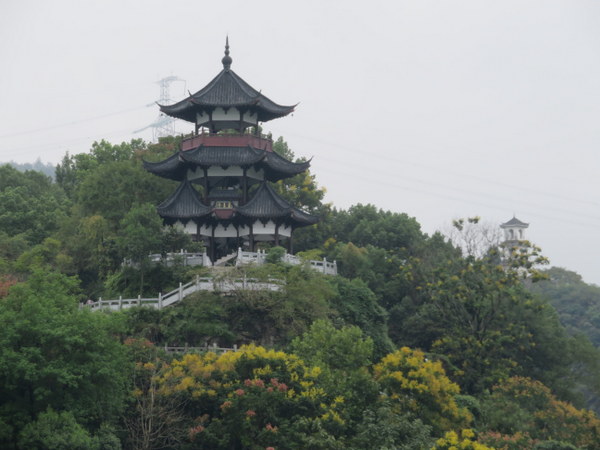
Tuesday, September 25, 2018

Chinese Opera


We slept well last night not waking until 6 am. I love the shower at the St. Regis Chengdu. There is a shower wand, a rainfall head and a series of body sprayers that can be selected. I normally take a quick shower but this is exceptional. We went to breakfast with Mark and Cindy at 6:30 then prepared to board the bus for our 8 am departure for the Sanxingdui Museum.
Jade Bi
This museum is a group of building displaying artifacts from a people in the area from the stone and early bronze ages. The first building had a lot of jade artifacts and stones used and food preparation, as weapons and for ornamentation. We saw a lot of the circular disks or bi that we saw at the museum in Wuhan. There were also a number of artifacts that they called tablets but looked more like giant jade swords to us. I found the partially finished items of most interest since they showed more about the process of making the item. There were also some raw stones that
Bronze age sculpture
showed where jade was being cut.
From this museum we walked the short distance to the bronze museum. The first thing we noticed was the size and number of bronze masks. Most of the masks had exaggerated features like huge mouths, bulging eyes and sharp noses. There were also bronze trees were believed to be ceremonial in nature. The museum was very large and we did not have time to see all of the exhibits.
We were appreciative of the handheld voice guides to the museum. We could enter a number for a labeled exhibit item and the device would give a succinct but informative description of the items. Since the archaeological site was used for several years the time span of the artifacts was quite large. It is believed that the stone and Bronze Age populations lived in the area from 7000 to 711 BC.
From the museum we went to a nearby Sichuan restaurant. As the capital of Sichuan, Chengdu is known for spicy Sichuan cuisine. We had a seemingly endless array of chicken, beef, pork and vegetables with sticky rice and noodles. Mark and I had a local beer which was surprisingly light and similar to light beers in the US. Like many other meals we have had in the area, it was served family style with a circular lazy Susan in the center of the table.
We were back at the St. Regis Chengdu by 2 pm and had time to take a walk around the city near the hotel. There were a number of street vendors pushing cell phones, phone plans, foods and other small electronics. It was apparent that the vendors were marketing to locals since we found no one who could speak English. We attempted to negotiate on a couple of things but were unable to communicate well enough to come to an agreement.   We found it interesting that everyone in China pays for things on their phones.  On several occasions we found that even street vendors have QR codes so buyers can easily pay for purchases on their telephones.  Chinese people seldom pay for anything with traditional credit cards or with cash in favor of scanning their phones.
Street vendor selling roasted potatoes and corn
The stands that I found most interesting were selling roasted potatoes and corn from a makeshift wood stove on the back of a three wheel bicycle. It just struck me as odd to have these merchants using technology and tools that could have come from the 1600s.
Walking around Chengdu was a lot more pleasant that our walk around Chongquing on Sunday night. It could be because Sunday was a national holiday weekend. Another related reason could be that there was a concert not far from our hotel. The most probable reason is that Chengdu has about 10 million few people than Chongquing. We also understand from our guides David (Chongqing), Annie (Chengdu) and Patrick that the attitudes of people in Chengdu are a lot more laid back than in other areas. Annie attributes this to the spicy Sichuan food. In any case, our walk was short but pleasant. We went up to our room on the 24th floor of the St. Regis Chengdu to change and get ready for the Chinese opera.
Chinese Opera
We had a short time to get our bags out in the hall outside our sleeping rooms by 4 pm. The checked bags were going to have a 12 hour drive by truck to our Wednesday evening destination in Xian. We laid out clothes for the Tuesday night dinner and opera outing as well as for our Wednesday morning trip to the panda preserve then train ride to Xian.
For dinner we went to the restaurant that is most popular with local Chengdu residents for Sichuan food. There was plenty of the spicy Sichuan food with less highly seasoned options available as well. Like all of our other meals in the area, it was family style with a lazy Susan in the table center. We all enjoyed our meals although we believe that some in our group are beginning to tire of Chinese food and meal procedures.
Chinese Opera
After dinner we had a short bus ride to the Shu Feng Ya Yun Sichuan Opera and Tea Room in Chengdu. The venue was a covered courtyard surrounded by local shops. We were seated around tables of five with tea cups and snack bowls at each place at the tables. The porcelain tea cups had loose green tea in the bottom with a lid that could be tilted to strain the leaves from the tea. As preparations for the show were being made, we were invited to watch the cast prepare their makeup and costumes. There were vendors selling snacks and food. We were especially interested in the practice of offering massage and ear cleaning off stage before the performance. We did not take advantage of any of the goods or services being offered. Throughout the performance there were servers circulating with pots of hot water to refill our tea cups. These pots had spouts up to three feet long so the servers could reach the cups of guests sitting back from the aisles. It was amazing that they were able to fill each patron’s cup multiple times throughout the play without spilling hot water on the guests.
The performance started with a skit involving actors in elaborate traditional Chinese costumes. Acrobats did flips across the stage and the characters sang and danced. A scrolling LED sign told the story as the actors sang but it was all in Chinese so it really didn’t help. The skit, like most of the ones to follow, lasted only about 10 minutes. Other skits were much easier to understand and were more enjoyable to us. A musician played a Chinese style violin which has only two strings. He was very talented and played beautifully. We kidded that he is China’s answer to Charlie Daniels.
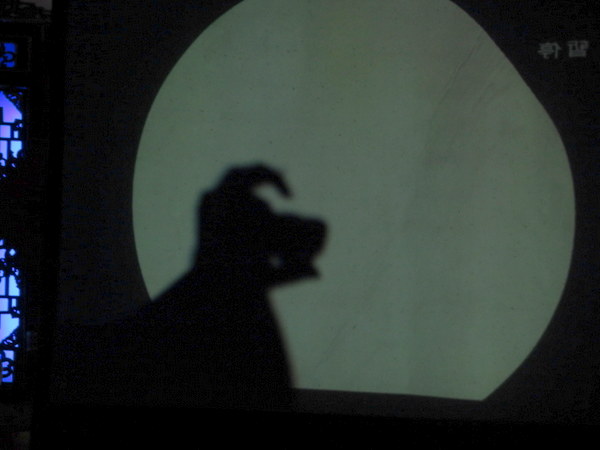
Shadow puppets at the Chinese Opera
The next act was a skit with a hand puppet that moved realistically. A musician played a small brass instrument that seemed to be a little like a bugle but was the size of a recorder. We all loved the lady doing shadow puppets. Using only her hands, she made birds, rabbits, wolves, dogs, owls, cats and other animals. There was a costume skit about two wise men who used their wisdom to trick an evil warlord and one about a henpecked man that included some balance and acrobatics stunts.
The final act was costume changing with is very popular in China. Singers came out in traditional robes of warriors with masks. They would change the color of their robes in the flash of an eye, too quick to discern how they removed their robes to reveal another color beneath. They then came into the audience and changed masks in similar fashion. We were amazed with the skill and precision of the actors and had a great evening. In addition, the skits changed frequently enough that it kept us engaged.
This performance was nothing of what we expected from a Chinese opera but we certainly enjoyed it.


Monday, September 24, 2018

Dazu Grotto

Entrance to Dazu Grotto

We woke at 5 am and put our bags out for the porter to load into the truck for our trip to Chengdu. We went to breakfast with Mark and Cindy around 6:15 and had a very good meal of mostly local breakfast items. Bacon, eggs, toast and cereal as well as other Western breakfast choices were available but we usually ate Chinese as much as possible.  Mary has really come to enjoy the bao which are dumplings filled with meats or bean paste.  I look forward to the steamed black rice and the Chinese yams and sweet potatoes.  Although the terms yam and sweet potato are used interchangeably in the US, they are very different foods from different types of plants from different parts of the world.  Fortunately, we had access to both at most breakfasts here in China.

The light rain had gotten heavier and we knew that our rain gear was in our checked bags, but Cindy and I were able to catch the porters before our bags were loaded onto the truck and retrieved our jackets. Patrick wanted to get an early start because holiday traffic was expected to be heavy, and we wanted to be at the Dazu Grotto in time to see the carvings.
After about a two hour drive in the rain we arrived at the Dazu Grotto. We walked a short distance then boarded golf carts to go to what would be called a hollow or canyon in the US. We were treated to hundreds of elaborate carvings in the limestone. The carvings were started over 1400 years ago but have continued by faithful Buddhists over the centuries. Detailed panels depict Buddhist gods, prophets and disciples. Interpretations of Heaven and Hell teach the consequences of good and bad behavior. Carvings illustrate how good Buddhists should live.  There are also depictions from Confucian and Taoist teaching. This illustrates the blending of these belief systems that is so common throughout much of China.
The beauty and craftsmanship of the panels were amazing enough but considering that the panels have been in place for over a millennium is even more impressive. During the Cultural Revolution Communist Chinese soldiers destroyed religious artifacts and locations on orders from Chairman Mao. However, farmers in the area who realized the importance of Dazu Grotto did not tell the soldiers about it. The remote location of the carvings in the hollow did not let the soldiers have a clue that they were there.
We were amazed with the detail and size of the carvings.  We thought there would be a few old statues, but we were treated to over 50,000 statues in the rock walls of Dazu Grotto.  Although the carvings started around 650 AD during the Tang Dynasty the work there continued until 1911 in the Qing Dynasty.
The Dazu Grotto was designated as a UNESCO World Heritage site in 1999. Until then the site was closed to all foreigners. Only Chinese Buddhists could come here to worship before 1999. Even when we were there most of the visitors were Chinese. Many visitors kneeled down to pray before the carvings. It was quite impressive and was one of the highlights of the trip. Even though we had to walk around the grotto in a steady rain, it was still a memorable visit.
We walked back to the bus in the rain then rode for three hours to get to Chengdu. This city of over 16 million is probably best known to westerners because of the Szechwan or Sichuan style of Chinese food from this area. Although there are several things that we want to learn about Chengdu, we certainly want to try the local Sichuan cooking.
We arrived at the St. Regis Chengdu at 5:30. Patrick needed our passports to check us in and he had our room keys ready for us when we arrived. When we got to the rooms our bags were already in the rooms which were spectacular. We have a huge bedroom with a king size bed, two desks, a multidirectional shower, a fully automated bidet, a television with Bose sound that sinks into the desk and automated lights and curtains. Our corner room looks out on a beautiful view of the city.
We dressed for dinner but decided to step over to the McDonald's across the street. They had a number of local Chinese and Sichuan choices available. Mark and Cindy tried some popcorn chicken and fries to see how they are different from McDonalds in the US.
We went to dinner at the St. Regis a little after 7 pm and had a large array of Chinese and specifically Sichuan choices. We had several meat and vegetable choices as well as fruits and cheeses. Mary and Cindy finished with a coconut crème brule. We all enjoyed our meals. We went up to get some sleep since we leave for a visit to the museum in Chengdu at 8 am.

Sunday, September 23, 2018

Chongqing

We awoke early in our room at the Intercontinental and prepared for our trip to the big city of Chongqing. We would have happily stayed in Lijiang longer but we needed to catch the bus to the airport at 10:30. After distributing our passports and boarding passes, Patrick led us through security at the Lijiang airport. Mark’s checked bag was pulled for inspection but otherwise there were no issues. Security at Chinese airports is a little different than in the US. You can wear your shoes and coats but the wanding and hand checking are more involved. We walked in the small Lijiang airport briefly but didn’t have a long wait. We had a bag lunch from the Intercontinental but the airline gave us a small lunch as well.
The flight from Lijiang to Chongqing was very rough but took only 80 minutes but when we landed the difference in climate was immediately noticeable. Being out of the mountains and in the Yangtze River valley, Chongqing is very’ hot and humid. Of course, we were still dressed in long pants for the cooler Himalayan climate so we were uncomfortably warm.
We learned that Chongqing is a very large city with a population of over 8 million but the municipality has a population of over 31 million people. 
View of Chongqing from Gen. Stilwell's residence
Our first stop of the day was to the home and headquarters of General Joseph Stillwell who was the US point of contact for China before and during World War II. Stillwell was known to be a tough character leading to his nickname, “Vinegar Joe”. It is said that Stillwell had more power and influence than the president of China. He is still revered in China because of the prosperity that he helped to bring to the nation.
General Joseph Stillwell
After leaving Stillwell house we walked cross the street to the “Flying Tigers” museum. This small group of pilots played a very important role during World War II in flying “over the hump” from Tibet to Chongqing, then known as Chungking. It is estimated that half of all airplanes shot down in the Pacific Theater were on the “hump road”. The air force painted the noses of their aircraft to look like sharks but the local Chinese thought they looked like tigers so they called them Flying Tigers. When airplanes were shot down by the Japanese all surviving airmen were taken in and protected by local Chinese people. The US Air Force still honors the Chinese people of the area for assisting the US forces.
A local artist was at the museum demonstrating traditional painting on rice paper. Her paintings as well as other local art was available to purchase with proceeds going to the Flying Tigers Museum.
We checked in at the Chongqing Westin Hotel around 5:30 then went for a walk around the downtown. We had no idea what we were in for. The municipality of Chongqing has over 31 million people. It seemed like all of them were downtown when we were walking. Since this is a long holiday weekend, many local people come to fairs, festivals and concerts in the cities. It turns out that there was a major concert near where we were walking. Because the area was so crowded and noisy we didn’t stay long but returned to the Westin to shower and dress for dinner.
The dinner buffet on the 51st floor of the Westin was huge. There were selections from several areas of China as well as India, Italy and the US. We all enjoyed our meals and returned to our rooms on the 40th floor.
Our sleeping rooms were spectacular. We had a great view of the city with the buildings doing a spectacular light show. The king sized bed was very comfortable and the bathroom was unbelievable. There were two sinks, a large soaker tub and a shower with regular and rainfall heads. The toilet automatically opened when the door to the water closet was opened. The toilet included a bidet with several spray and dry options. The toilet flushed and closed the lid when you left the room.
Since we needed to be on the bus at 7:30 am we packed before bed and hoped to get a good night’s sleep.

Saturday, September 22, 2018

Old Lijiang

Once again we awoke early and did some reading in our room at the Intercontinental Hotel. We used Google Hangouts to call Gran and the girls just to say hello. We went to breakfast in the hotel which was a good mix of Chinese and western breakfast choices, We tend to choose Chinese foods since we can have eggs or oatmeal any day when we are back home. It isn’t every day that we can have Himalayan breakfast foods.
Meat markets in Old Lijiang
We prepared for our morning trip into old town Lijiang after breakfast. Those from the group who wished to go out met with our local guide, Janice, at 9:30 am. As we waited in the lobby of the Intercontinental Hotel we chatted with a nice young man who is in training to be a Buddhist monk. He shared a number of parables with us that are especially meaningful to him. Much of the teaching in the Buddhist faith is taught through illustrative stories to teach lessons on how to live a good life.  After Janice arrived we walked into the old historic section of Lijiang starting in the local market.
Chicken feet for sale in Old Lijiang
The market is huge, noisy, smelly and chaotic. There are streets for each food category. There was a meat street, fish street, mushroom street, potato street, pickle street and noodle street. We entered at the meat street where we saw chickens, ducks, geese, rabbits and other animals being sold alive then slaughtered and dressed to order right there in the market.
Market in Old Lijiang
There were also parts from pigs, yaks, cattle, sheep and goats being cut up and prepared for sale. We saw a lot of potatoes especially purple potatoes which are a regional specialty. There were giant bags of peppers, mushrooms and other food being sold by the pound. All the while there were many people visiting each of the vendors to buy food and small trucks and motorbikes mixed in along the paths between vendors. It was nearly impossible to walk. Each area had a very characteristic smell. The animal area smelled like a slaughterhouse anywhere would smell. The earthy smells of the mushroom and potato streets gave way to fragrant smells of flower stands and noodle shops. We decided that we could locate our whereabouts blindfolded just on the characteristic smell. 
One of the many mushroom markets in Old Lijiang
In some ways the Lijiang market wasn’t much different than the Milton flea market. There were stands selling cheap junk as well as shops selling staples for existence. The market definitely caters to local Lijiang residents. I think we were the only non-Chinese in the market today.
From the market, Janice led us through other historic areas of Lijiang. We then headed for the home of Mu, the leader and Shaman of the Lijiang Naxi community. The Mu had a complex of living quarters and center of civic government. We walked through the area and looked at the statues and locations that were important
Residence of the Naxi Mu
to the Naxi culture. We noticed that the thresholds to rooms in the Mu’s complex were especially high. As we learned earlier in the week the high thresholds were intended to keep evil spirits from entering the dwelling according to Chinese superstition.
There were a number of children and families in the courtyard near the Mu’s residence making and decorating moon cakes.  These dense sweet cakes are a traditional celebratory food for the Mid-Autumn Festival sometimes called “Moon Cake Day”.  This holiday is celebrated on the day of the full moon in late September or early October. 
Children making Moon Cakes
After leaving the Mu’s residence we walked through some of the shops in town and stopped at a shop doing embroidery on silk similar to the gallery we visited in Shanghai. Several people bought things after a period of haggling over the price. There was a speaker and demonstration of the hieroglyphs that make up the Naxi written language. Although most people in Tibet and Eastern China now use the simplified Chinese written characters, many people of the Naxi minority use the traditional hieroglyphs as well.
Traditional Naxi hieroglyphs
After leaving the silk store we went to a restaurant that Janice recommended for lunch. We sat with Gary, Robin, Darla and Sherry who we learned met while working for the FFA in Anchorage. We ordered a family style meal with yak meat, corn, Naxi potatoes and steamed lotus. We had tea to drink. When we got the bill for the four of us we were shocked that it was less than 200 Yuan which is about $31.
After lunch we walked around the ancient city again including the market which was far less crowded now that the morning rush was over. Most of the vendors were there but fewer than a quarter of the shoppers were in the market by afternoon. We continued walking through the stands and small stores until a heavy rain hit. A huge crash of thunder shook us and then the rain soaked us. We took shelter for the heaviest rain then went back out to walk around the old city of Jijiang. We walked up the hill in search of a geocache then headed back to the hotel in a light mist of rain.
Naxi woman selling purple potatoes in Lijiang market
We met Janice again in the hotel lobby at 6 pm and walked to a wholesale tea vendor in old town Lijiang. We tasted several varieties of Pu-er tea and learned correct and incorrect ways of making tea. The shop owner poured water over the tea leaves and disposed of the water twice after a steep of only a couple of minutes. He then put hot water in again for a slightly longer soak and made cup after cup of delicious tea. Through Janice as an interpreter, he told us that he can make 30 runs on a set of tea leaves. He made a pot of tea from a dried tangerine that was hollowed out and filled with Pu-er tea. We bought a cake of good quality Pu-er tea and a bag of tea tangerines for 300 Yuan each. Mark and Cindy bought a stash of tea as well.
We walked back to the hotel where we had an excellent buffet dinner of Chinese and Naxi foods in the hotel dining room. We had to get our checked bags out in the hallway that evening for our flight to Chongqing that night so we headed out to our rooms.

Friday, September 21, 2018

Visit to Naxi Village near Lijiang

Our local guide in Lijiang, "Janice"

We were awakened by the sound of the ship’s crew docking at Chongqing around 4 am. We did some last minute preparations for the flight then went to the lobby to put the gratuities for the Viking Emerald staff on the credit card. By then Mary was down for breakfast.
When we were leaving the ship we saw the local men at the dock with bamboo poles hoping to carry luggage up the stairs from the dock to the bus. Since our backpack carry-on bags are fairly light we opted to just carry them ourselves. The bus ride from the dock to the airport took only about 30 minutes. I was called to security because my GPS showed up on the luggage scan. Once they saw it was a GPS they were fine. We all had a complete pat down at the security check point then went on to our gate. We were pleased to see that we were seated in business class which meant a little more legroom for us. The flight to Lijiang was only about 80 minutes but included a snack of traditional Chinese airline food. Mary had chicken with noodles and I had curry chicken with rice. Our bags came quickly at the Lijiang airport and our only slowdown was because a member of our group left his Kindle on the plane. We boarded a bus at the airport and met our local guide, “Janice”, who is a Tibetan woman from Lijiang.
Carved door in Lijiang
We took the bus into town to a local restaurant where we had a family style lunch with favorite meal items of the locals. Like many meals in China, dinner was served at a circular table for eight with a large glass lazy Susan at the center.  We started with a wooden bucket filled with sticky white rice. We had several dishes that included chicken, vegetables, pork and yak meat. Everything served in the town is locally produced and organically grown. I had never eaten yak but it is a very flavorful meat that is like a very lean beef. We ate with Daljip and Catherine, Scott and Marlene and Darla and Sharon. They were good lunch companions.
Traditionally dressed Naxi women in Lijiang
After lunch we took the buses out of town into the Himalayan Mountain rural community where we had tea at the home of a traditional local family. Many of the families in this community are subsistence farmers of the Naxi culture. They consider themselves a separate ethic group from most Chinese. The Chinese government recognizes 56 separate ethnic groups in the country. Most of the women in the area dress in the traditional attire. Most of the men now wear western style clothing. The home that we visited is very old but is well maintained and the wooden carvings are beautiful. At the 10,000 foot altitude here the sheep wool and yak fabric are certainly appropriate for most of the year.
This area is very beautiful. At 26 degrees north latitude, Lijiang is about the same latitude as Miami. However, the altitude makes the weather much cooler. There is a nice mix of tropical and temperate plants growing here. There is abundant water available making the plant life lush. It is no wonder that this area was the inspiration for ShangraLa. We could see this as a paradise.  Historically, Lijiang played important roles in the Tea and Horse Road by facilitating trade and transport of both commodities.  There are still many horses in use in the area that are descended from two bloodlines.  There are small Himalayan horses as well as large heavy bodied horses from the mounts of the Mongols who invaded and traded in the area many times.
The Naxi were nomadic people who raised yaks and sheep. They made many foods from the meat, skin and milk of these animals. They were important in assisting trade during the Silk Road era. Even now they are a very proud and self-sufficient people who adhere to their religious beliefs that are a blend of Taoist and Buddhist religious practices.
Naxi woman selling flowers on the street in Lijiang
After our tea with the family we walked the short distance to the home of Dr. Joseph A. Rock, an Austrian-American who wrote about China for National Geographic in the 1920s and 30s. Dr. Rock is still highly regarded in the town and his home has been converted into a museum of his life here. There were a lot of artifacts and items from his life on display. After walking around the area we got back to the bus and rode to the Intercontinental Hotel in Lijiang This hotel is really nice. We and the Whittingtons were in a villa that is very elegant as well as roomy. Everyone agreed that this is the nicest hotel we have ever stayed in. We were happy to be away from the smog and humidity of the previous week. We were also happy to have faster Internet.
Our evening meal was at a local Naxi restaurant and was served family style. There was plenty of food prepared in Tibetan style. We finished our meal and walked back through Lijiang to the Intercontinental Hotel. Since we were all tired we went to our rooms.

Thursday, September 20, 2018

Shibaozhai Temple


Sampan on the Yangtze
Once again we awoke early so we did a couple of Duolingo German lessons, read the hometown newspaper online and reflected on the prior day. We tried calling Emily at 6 am which would be 6 pm on Wednesday. The Internet connection onboard the ship was too slow to support a Google Hangout call. By going through the VPN we could get around the block on Google that exists in China, but we just don’t have the bandwidth here.
Mary and Cindy went to their last Tai Chi class this morning. Both enjoyed the exercise very much and plan to continue on their own back at home. The instructor offered to give them some of her videos if they bring a USB drive. They plan to do that this afternoon.
Shabaozhai Pagoda
Our usual breakfast was good with a variety of traditional stuffed Chinese dumplings, eggs, meats, cereal and fruit. We ate a little earlier than usual since we left the ship at 8:30 for a walking tour of the Shabaozhai Temple. The temple was originally from the ancient Ba culture who were a Neolithic people inhabiting the area from about 13,000 BC until about 300 BC. The temple and connecting pagoda were used for several functions including as a fort over the centuries. The wooden pagoda was constructed of local timber without the use of nails. The present pagoda was built in the early 1800s and has remained fairly unchanged since. The statuary, art and relics were destroyed in Mao’s Cultural Revolution but through recent relaxation of austere Communist policies banning religion, many of the artifacts have been reproduced.
Mary at Shabaozhai Pagoda
There was a heavy rain as we left the ship. Street vendors were lined up along the mile long route between the dock and the temple. We slogged through the rain and past the insistent merchants to a swinging suspension bridge leading to the temple and pagoda. Although Mary wasn’t anxious to cross the bridge, she did well as long as she didn’t look down or I didn’t shake the bridge.
Once at the pagoda we walked up 99 steps to the top of the pagoda leading to the temple’s entrance. The view down to the Yangtze River was spectacular even in the rain and fog. We took a number of snapshots then made our way back to the dock to board the ship after passing through security. The rain continued through the entire time that we were. In Shibaozhai.
We had a little time before lunch so we dried ourselves out and started packing things for the departure from the Viking Emerald and our flight on Friday morning. Since the requirements for baggage in China are different that in the US we had to shuffle some things around so that we not only made weight but had items in the carry on that are prohibited in our checked bags. For instance, China does not accept any batteries in checked bags but has no problem with them in carry on. Also, while the US permits 40 pounds in a checked bag, China allows 42 pounds.
Steve having chicken feet for lunch
Lunch today was an “interesting” choice that should be experienced visitors to China. While sandwiches, hamburgers and salads were available, the featured menu items were Phoenix claws (chicken feet), pig snouts, pig ears, pig tails, lotus roots and other traditional Chinese delicacies like duck, roast chicken and pork. I tried a title of each but was generally unimpressed with the chicken feet, pig ears and tail. There was just so little meat on the bones that I was hardly worth the effort. A chef was making lo mein noodles through traditional stretching and folding. We had some of the noodles, and they were fine. Everyone enjoyed the pork, sweet bean and vanilla custard dumplings. We all had a small square of Chinese style pumpkin pie for dessert.
After lunch the ship continued up the Yangtze River. The area where we are sailing now is considered the foothills of the Himalayan Mountains. The topography on either side of the ship continues to change as we move further and further up the river. We sat on the sub deck or in the observation room depending on the weather. It is still very humid, but the temperature seems to be cooling some.
Wheelhouse of the Viking Emerald
We came in at 2 pm for a tour of the bridge and to see how the captain and crew operate the ship. The high tech navigational aids and a well-trained crew keep the vessel safe and on course. We learned that three crew members are required at the bridge at all times. They serve a four hour shift then are off for eight hours before returning. Although our visit to the bridge was only 20 minutes we learned a lot about the operation of the ship.
After our tour the cribbage game continued while I sat on the sun deck to enjoy the cooler day after the rain had passed. Mary, Cindy and Mark attended a demonstration by the chef on his techniques for making Chinese dumplings. All agreed that although the demonstration was interesting, they will probably just buy their Chinese dumplings already made. There is a lot of work and skill involved in preparing the dough and making the many precise folds in the buns.
Pagoda along the Yangtze River
At dinner we sat with Larry and his wife from Bangor, Maine. Earlier in the week some of the Chinese people were taking selfies with Larry and pointing at him. We later learned it is because they thought he was Sean Connery. Larry is a Master Naturalist in Maine so we shared some great conversation. Mary had an excellent beef tenderloin and I had a very good baked cod filet. We all enjoyed our meals.
We returned to our rooms to pack for the flight from Chongqing to Lijiang. We needed to have our bags in the hall by 11 pm. We wanted to turn in early because breakfast was at 5:30 and we needed to board the bus for the airport by 8 am.

Wednesday, September 19, 2018

Goddess Stream

There was a good deal of noise throughout the night since the Viking Emerald was traveling through locks. I awoke a couple of times in the night but was able to go back to sleep. We slept nearly until 6 am then got our showers for the day. Mary and Cindy went to Tai Chi, Mark rode an exercise bike and I read on the sun deck. It was a beautiful morning with fog on the tops of the hills around the gorge. I took a few snapshots and appreciated the day. We went to breakfast around 7:30 siting with Peter and Jane from Fort Collins and Bob and Rod, a couple from Hawaii. Bob is quite a character and kept the table in stitches throughout our breakfast although his husband, Rod, was much more subdued. Of course, Peter and Jane argued the entire meal, as usual.
Tourist Sampan in the Goddess Stream area of the Yangtze
After packing our things for the day we left the Viking Emerald and walked along a series of docks to board Sampans which are traditional Chinese small boats. Of course the ones we were on are modern and produced specifically to transport tourists. Each of the Sampans held about 20 of us to travel up the Goddess Stream of the Three Gorges area. This part of the gorge is very narrow with deep water. The sheer cliffs were covered with vegetation some of which was still blooming with orange and purple flowers. It was a beautiful ride. The local guide told us a lot of the local legends about the goddess for whom the area is named and a little of the geology of the formation of the area. This area appears to be very popular with Chinese tourists since there were many tour boats in the area with Chinese people. Most of the visitors were anxious to greet us in the English phrases that they knew.
Goddess Stream area of the Yangtze River
On the short walk back to the Viking Emerald there were a number of vendors set up at tables although they appeared to be marketing to the Chinese visitors. We did notice a great deal more floating garbage in this section of the Yangtze River than we had seen in prior days. There were floating rafts of Styrofoam, bottles and other debris that are nearly an acre in size.
Pagoda along the Yangtze
We took lunch soon after returning to the ship. There were a number of Chinese and western choices, but I decided to go with the fish and chips with mushie peas on the side. It wasn’t spectacular but what English food is all that great? We ate with Keith and Virginia from Australia and they were very good lunch company.
Our afternoon was pretty lazy. There were a number of talks available on various decks and lounges of the ship, but we opted to take a brief power nap then sit on our stateroom veranda to sight-see as we continued up the Yangtze. We went by a place where the ancient Ba people placed their dead in burial chambers that are small caves in the rock face. Many homes or villages had small shrines facing the river. There were a number of temples visible to us as we sailed by. At one temple we saw what we thought were squirrels playing on the roofs and walls. On closer examination with the binoculars we learned they were rhesus monkeys romping and doing what monkeys do. We traveled along and saw a number of factories some of which were under construction and several places that appeared to be mines or quarries.
We attended a discussion by the program director on plans for Thursday then met with our tour escort, Patrick, to plan for Friday morning’s disembarkation and flight to Chongqing. Dinner was very good as usual. We were joined by Bob, Tammy and her 24 year old son, AJ. They are from the DC area and were good dinner companions. Mary had sesame chicken, and I had a very spicy beef with chili peppers. For dessert I had the blueberry ice cream, and Mary had fried rice balls with a cream sauce. We exchanged halves and enjoyed both choices.
We didn’t stay up too long after dinner. Mary and Cindy played cribbage, Mark read and I chatted with Hamish on the ship’s bow as we traveled. Hamish had some great stories of serving in the Scottish Navy stationed in the Middle East for much of his career. We skipped the crew variety show and the late musical entertainment in favor of turning in early. 

Tuesday, September 18, 2018

Three Gorges Dam


For the first time since we arrived in China we had a full night’s sleep. We were so pleased to sleep until 6 am and feel rested on awakening. Mary and Cindy went to Tai Chi at 7 and I sat out on the sun deck and talked with a couple from Fort Collins, Colorado. Peter is a retired veterinarian and Jane is a former educator. They are both characters and made great conversation. Mark, Cindy,
Three Gorges area of the Yangtze River
Mary and I met up at breakfast then went back to the sun deck. At 9 am one of the guides, “Elliot,” did a talk on the Three Gorges area.  We learned that the hydroelectric generation at the Three Gorges Dam is the largest hydroelectric generating dam in the world.  As we listened to Eliot we prepared to travel through the easternmost of the locks on the Yangtze. Our ship was a tight fit for the first lock, but we were shocked at how quickly water filled the lock chamber to raise the boat the 20+ meters to the upstream side of the dam. Once the lock gates closed it may have taken only 3 minutes to raise the ship to begin exiting the lock.
Pagoda along the Yangtze River
We sat with Peter and Jane as well as a couple from Alexandria, Virginia for lunch. Mary had a pumpkin/coconut soup with a ground beef and sautéed green bean dish. I had chicken cordon Bleu with a garden salad. We all had the crème Brule.
We had only a short amount of time after lunch to prepare for our afternoon visit to the Three Gorges Visitor Center. Of course we had to pick up our shore leave passes as we left the ship to walk to the buses. There was a swarm of street vendors waiting on us to pass through them to get to the buses. They were selling hats, shirts, maps, books and who knows what else. One more persistent lady was following me and pushing me to buy her book on the Three Gorges. I made the mistake of telling her “maybe later.”
Three Gorges Dam Visitor Center
The bus ride to the visitor center was short and uneventful. It was nothing like the wild ride to the school the day before. On arrival at the Three Gorges Visitor Center, we had to pass through security once again before getting back on a bus to the area where we would make our way to the dam viewing area. We noticed that there were a lot of grapefruit trees that were hanging full of fruit. I just didn’t think of China as a location for grapefruit although it is certainly at a very southern latitude.
Typical Chinese toilet
Some of the people on the trip received a surprise when they went to the toilet at the visitor center. In areas where there are few western tourists, the toilets are not porcelain stools but rather just porcelain lined holes in the floor over which one would squat for bodily functions. This was a bit disconcerting for some of our group, but we had seen these when we arrived at the Shanghai airport where there were the traditional hole toilets as well as western stools. In addition, most toilets in China do not come equipped with toilet paper.  It is expected that visitors bring their own paper to the toilet with them. We came to refer to these toilets as the “squatty potties” of China.
Three Gorges Dam Visitor Center
We traveled up a series of escalators to the top of a hill where we could look down on the dam housing the power generating turbines, the ship lock in multiple stages and the ship elevator. The elevator can take a small ship of less than 3000 tons through the locks in only 14 minutes as compared to 4 hours required with the traditional locks. Unfortunately our ship is too large to take the elevator but we will lock through late on Tuesday night while we sleep. The dam system is an intricate set of dams, locks and hydroelectric power plants. The largest dam was only completed in 2009 but has had a major impact on the economy, environment and culture of the area.
Three Gorges Dam
We were told that the electric power produced at the Wu Gorge dam provides about 5% of all of the electricity used in the country. It has also permitted a great deal more shipping to and from cities in the upper Yangtze valley to markets in Wuhan and Shanghai. Over 1.5 million residents of the area had to be relocated because of the flooding of areas behind the dams. The spin that we heard from our Chinese guides is that the residents were well compensated for the loss of their farms and could afford to get a condo in a city and find a manufacturing job or open a small business. There were also major environmental impacts from the dams. They attribute this to the kindness of the government. Not only were wild river ecosystems changed, but the farmlands and alluvial plains were inundated. Anadromous fish like the sturgeon are now unable to negotiate the Yangtze tributaries for spawning. Since the dams are so high, the construction of fish ladder was considered impractical.
Three Gorges Dam
Because of the importance of the dams there was very tight security in the area. A breach in the dam would be a disaster for many millions of Chinese people downstream on the Yangtze. The flooding would drown millions and displace many millions more. In addition, the power loss would be devastating to the national economy. Evidence of the security was seen in the screening that we saw and the military presence. As we were leaving we saw uniformed Chinese soldiers standing guard reminiscent of the guards at Buckingham palace. For a time we thought they were mannequins but were eventually able to see them breathing.
We stayed at the dam viewing area only about an hour then boarded the buses to return back to the dock on the Yangtze to board the Viking Emerald. There was one problem. The street vendors that we eluded were waiting or our buses when we returned. The persistent Chinese lady to whom I said “maybe later” was waiting on me. I was finally able to shake her as we made our way back to board the ship after passing through security once again.
Temple near the Yangtze
We had a little time before the evening events and dinner so we showered and changed then walked about on the sun deck. As repeat Viking guests, Mary and I are members of the Viking Explorer Society and were invited for a cocktail hour before dinner. We had little appetizers of breads, cheeses and. Caviar. The crew joined us in a toast of traditional Norwegian aquavit then we made our way to dining room for the evening meal. Because aquavit is basically a vodka flavored with caraway, we have never had a taste for it but we took a polite sip as the toast.
We have noticed some differences not only in the prior trip on the Rhine but across the time that we have been on the ship. In Europe there were two dining areas on the ship. One was the formal dining room where most passengers took their meals and the informal grill in the bar area. In Europe, there was a dress code for the dining area, especially for the evening meal and guests who were not appropriately dressed were asked to take their meal in the grill. Because there is only one meal area on this ship, everyone comes to the dining area for meals. While most of the passengers arrive dressed for dinner we had a few who showed up in Harley Davidson T-shirts and jeans shorts. We have seen that as the trip has progressed passengers have started dressing a bit better, at least for the evening meal.
Lights on one of the locks on the Yangtze
We were joined by a very nice couple from the DC area for dinner. Bob and Hsing are both retired from the US Department of Defense and spend a great deal of time traveling the world. We found them both very interesting. Hsing is a very opinionated lady from Taiwan. We remarked that she always referred to mainland China as “Red China” and showed some disdain for the government here.
Most of us had the lamb chops with sautéed green beans. Dessert was a choice of mango ice cream, a brownie or chestnut mousse. We all enjoyed our meals then sat out on the sun deck waiting to pass through the locks at Wu Gorge. Since the river is a little low at this time of year we only had to pass through four of the five lift stages to travel up the Yangtze. Once we entered the ship locks we turned in for the night.