Showing posts with label Chendu. Show all posts

Tuesday, September 25, 2018

Chinese Opera


We slept well last night not waking until 6 am. I love the shower at the St. Regis Chengdu. There is a shower wand, a rainfall head and a series of body sprayers that can be selected. I normally take a quick shower but this is exceptional. We went to breakfast with Mark and Cindy at 6:30 then prepared to board the bus for our 8 am departure for the Sanxingdui Museum.
Jade Bi
This museum is a group of building displaying artifacts from a people in the area from the stone and early bronze ages. The first building had a lot of jade artifacts and stones used and food preparation, as weapons and for ornamentation. We saw a lot of the circular disks or bi that we saw at the museum in Wuhan. There were also a number of artifacts that they called tablets but looked more like giant jade swords to us. I found the partially finished items of most interest since they showed more about the process of making the item. There were also some raw stones that
Bronze age sculpture
showed where jade was being cut.
From this museum we walked the short distance to the bronze museum. The first thing we noticed was the size and number of bronze masks. Most of the masks had exaggerated features like huge mouths, bulging eyes and sharp noses. There were also bronze trees were believed to be ceremonial in nature. The museum was very large and we did not have time to see all of the exhibits.
We were appreciative of the handheld voice guides to the museum. We could enter a number for a labeled exhibit item and the device would give a succinct but informative description of the items. Since the archaeological site was used for several years the time span of the artifacts was quite large. It is believed that the stone and Bronze Age populations lived in the area from 7000 to 711 BC.
From the museum we went to a nearby Sichuan restaurant. As the capital of Sichuan, Chengdu is known for spicy Sichuan cuisine. We had a seemingly endless array of chicken, beef, pork and vegetables with sticky rice and noodles. Mark and I had a local beer which was surprisingly light and similar to light beers in the US. Like many other meals we have had in the area, it was served family style with a circular lazy Susan in the center of the table.
We were back at the St. Regis Chengdu by 2 pm and had time to take a walk around the city near the hotel. There were a number of street vendors pushing cell phones, phone plans, foods and other small electronics. It was apparent that the vendors were marketing to locals since we found no one who could speak English. We attempted to negotiate on a couple of things but were unable to communicate well enough to come to an agreement.   We found it interesting that everyone in China pays for things on their phones.  On several occasions we found that even street vendors have QR codes so buyers can easily pay for purchases on their telephones.  Chinese people seldom pay for anything with traditional credit cards or with cash in favor of scanning their phones.
Street vendor selling roasted potatoes and corn
The stands that I found most interesting were selling roasted potatoes and corn from a makeshift wood stove on the back of a three wheel bicycle. It just struck me as odd to have these merchants using technology and tools that could have come from the 1600s.
Walking around Chengdu was a lot more pleasant that our walk around Chongquing on Sunday night. It could be because Sunday was a national holiday weekend. Another related reason could be that there was a concert not far from our hotel. The most probable reason is that Chengdu has about 10 million few people than Chongquing. We also understand from our guides David (Chongqing), Annie (Chengdu) and Patrick that the attitudes of people in Chengdu are a lot more laid back than in other areas. Annie attributes this to the spicy Sichuan food. In any case, our walk was short but pleasant. We went up to our room on the 24th floor of the St. Regis Chengdu to change and get ready for the Chinese opera.
Chinese Opera
We had a short time to get our bags out in the hall outside our sleeping rooms by 4 pm. The checked bags were going to have a 12 hour drive by truck to our Wednesday evening destination in Xian. We laid out clothes for the Tuesday night dinner and opera outing as well as for our Wednesday morning trip to the panda preserve then train ride to Xian.
For dinner we went to the restaurant that is most popular with local Chengdu residents for Sichuan food. There was plenty of the spicy Sichuan food with less highly seasoned options available as well. Like all of our other meals in the area, it was family style with a lazy Susan in the table center. We all enjoyed our meals although we believe that some in our group are beginning to tire of Chinese food and meal procedures.
Chinese Opera
After dinner we had a short bus ride to the Shu Feng Ya Yun Sichuan Opera and Tea Room in Chengdu. The venue was a covered courtyard surrounded by local shops. We were seated around tables of five with tea cups and snack bowls at each place at the tables. The porcelain tea cups had loose green tea in the bottom with a lid that could be tilted to strain the leaves from the tea. As preparations for the show were being made, we were invited to watch the cast prepare their makeup and costumes. There were vendors selling snacks and food. We were especially interested in the practice of offering massage and ear cleaning off stage before the performance. We did not take advantage of any of the goods or services being offered. Throughout the performance there were servers circulating with pots of hot water to refill our tea cups. These pots had spouts up to three feet long so the servers could reach the cups of guests sitting back from the aisles. It was amazing that they were able to fill each patron’s cup multiple times throughout the play without spilling hot water on the guests.
The performance started with a skit involving actors in elaborate traditional Chinese costumes. Acrobats did flips across the stage and the characters sang and danced. A scrolling LED sign told the story as the actors sang but it was all in Chinese so it really didn’t help. The skit, like most of the ones to follow, lasted only about 10 minutes. Other skits were much easier to understand and were more enjoyable to us. A musician played a Chinese style violin which has only two strings. He was very talented and played beautifully. We kidded that he is China’s answer to Charlie Daniels.
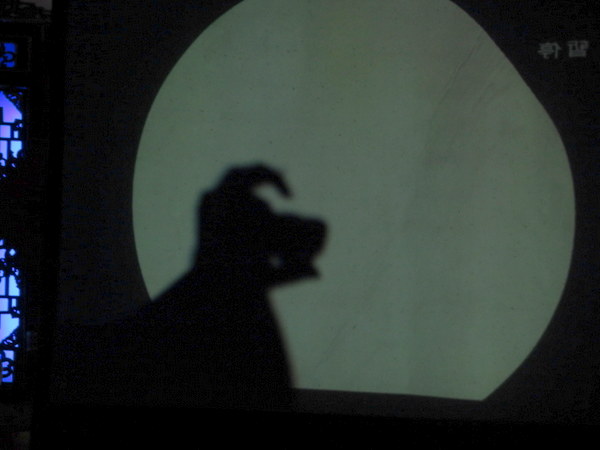
Shadow puppets at the Chinese Opera
The next act was a skit with a hand puppet that moved realistically. A musician played a small brass instrument that seemed to be a little like a bugle but was the size of a recorder. We all loved the lady doing shadow puppets. Using only her hands, she made birds, rabbits, wolves, dogs, owls, cats and other animals. There was a costume skit about two wise men who used their wisdom to trick an evil warlord and one about a henpecked man that included some balance and acrobatics stunts.
The final act was costume changing with is very popular in China. Singers came out in traditional robes of warriors with masks. They would change the color of their robes in the flash of an eye, too quick to discern how they removed their robes to reveal another color beneath. They then came into the audience and changed masks in similar fashion. We were amazed with the skill and precision of the actors and had a great evening. In addition, the skits changed frequently enough that it kept us engaged.
This performance was nothing of what we expected from a Chinese opera but we certainly enjoyed it.


Monday, September 24, 2018

Dazu Grotto

Entrance to Dazu Grotto

We woke at 5 am and put our bags out for the porter to load into the truck for our trip to Chengdu. We went to breakfast with Mark and Cindy around 6:15 and had a very good meal of mostly local breakfast items. Bacon, eggs, toast and cereal as well as other Western breakfast choices were available but we usually ate Chinese as much as possible.  Mary has really come to enjoy the bao which are dumplings filled with meats or bean paste.  I look forward to the steamed black rice and the Chinese yams and sweet potatoes.  Although the terms yam and sweet potato are used interchangeably in the US, they are very different foods from different types of plants from different parts of the world.  Fortunately, we had access to both at most breakfasts here in China.

The light rain had gotten heavier and we knew that our rain gear was in our checked bags, but Cindy and I were able to catch the porters before our bags were loaded onto the truck and retrieved our jackets. Patrick wanted to get an early start because holiday traffic was expected to be heavy, and we wanted to be at the Dazu Grotto in time to see the carvings.
After about a two hour drive in the rain we arrived at the Dazu Grotto. We walked a short distance then boarded golf carts to go to what would be called a hollow or canyon in the US. We were treated to hundreds of elaborate carvings in the limestone. The carvings were started over 1400 years ago but have continued by faithful Buddhists over the centuries. Detailed panels depict Buddhist gods, prophets and disciples. Interpretations of Heaven and Hell teach the consequences of good and bad behavior. Carvings illustrate how good Buddhists should live.  There are also depictions from Confucian and Taoist teaching. This illustrates the blending of these belief systems that is so common throughout much of China.
The beauty and craftsmanship of the panels were amazing enough but considering that the panels have been in place for over a millennium is even more impressive. During the Cultural Revolution Communist Chinese soldiers destroyed religious artifacts and locations on orders from Chairman Mao. However, farmers in the area who realized the importance of Dazu Grotto did not tell the soldiers about it. The remote location of the carvings in the hollow did not let the soldiers have a clue that they were there.
We were amazed with the detail and size of the carvings.  We thought there would be a few old statues, but we were treated to over 50,000 statues in the rock walls of Dazu Grotto.  Although the carvings started around 650 AD during the Tang Dynasty the work there continued until 1911 in the Qing Dynasty.
The Dazu Grotto was designated as a UNESCO World Heritage site in 1999. Until then the site was closed to all foreigners. Only Chinese Buddhists could come here to worship before 1999. Even when we were there most of the visitors were Chinese. Many visitors kneeled down to pray before the carvings. It was quite impressive and was one of the highlights of the trip. Even though we had to walk around the grotto in a steady rain, it was still a memorable visit.
We walked back to the bus in the rain then rode for three hours to get to Chengdu. This city of over 16 million is probably best known to westerners because of the Szechwan or Sichuan style of Chinese food from this area. Although there are several things that we want to learn about Chengdu, we certainly want to try the local Sichuan cooking.
We arrived at the St. Regis Chengdu at 5:30. Patrick needed our passports to check us in and he had our room keys ready for us when we arrived. When we got to the rooms our bags were already in the rooms which were spectacular. We have a huge bedroom with a king size bed, two desks, a multidirectional shower, a fully automated bidet, a television with Bose sound that sinks into the desk and automated lights and curtains. Our corner room looks out on a beautiful view of the city.
We dressed for dinner but decided to step over to the McDonald's across the street. They had a number of local Chinese and Sichuan choices available. Mark and Cindy tried some popcorn chicken and fries to see how they are different from McDonalds in the US.
We went to dinner at the St. Regis a little after 7 pm and had a large array of Chinese and specifically Sichuan choices. We had several meat and vegetable choices as well as fruits and cheeses. Mary and Cindy finished with a coconut crème brule. We all enjoyed our meals. We went up to get some sleep since we leave for a visit to the museum in Chengdu at 8 am.