Showing posts with label Lijiang. Show all posts

Saturday, September 22, 2018

Old Lijiang

Once again we awoke early and did some reading in our room at the Intercontinental Hotel. We used Google Hangouts to call Gran and the girls just to say hello. We went to breakfast in the hotel which was a good mix of Chinese and western breakfast choices, We tend to choose Chinese foods since we can have eggs or oatmeal any day when we are back home. It isn’t every day that we can have Himalayan breakfast foods.
Meat markets in Old Lijiang
We prepared for our morning trip into old town Lijiang after breakfast. Those from the group who wished to go out met with our local guide, Janice, at 9:30 am. As we waited in the lobby of the Intercontinental Hotel we chatted with a nice young man who is in training to be a Buddhist monk. He shared a number of parables with us that are especially meaningful to him. Much of the teaching in the Buddhist faith is taught through illustrative stories to teach lessons on how to live a good life.  After Janice arrived we walked into the old historic section of Lijiang starting in the local market.
Chicken feet for sale in Old Lijiang
The market is huge, noisy, smelly and chaotic. There are streets for each food category. There was a meat street, fish street, mushroom street, potato street, pickle street and noodle street. We entered at the meat street where we saw chickens, ducks, geese, rabbits and other animals being sold alive then slaughtered and dressed to order right there in the market.
Market in Old Lijiang
There were also parts from pigs, yaks, cattle, sheep and goats being cut up and prepared for sale. We saw a lot of potatoes especially purple potatoes which are a regional specialty. There were giant bags of peppers, mushrooms and other food being sold by the pound. All the while there were many people visiting each of the vendors to buy food and small trucks and motorbikes mixed in along the paths between vendors. It was nearly impossible to walk. Each area had a very characteristic smell. The animal area smelled like a slaughterhouse anywhere would smell. The earthy smells of the mushroom and potato streets gave way to fragrant smells of flower stands and noodle shops. We decided that we could locate our whereabouts blindfolded just on the characteristic smell. 
One of the many mushroom markets in Old Lijiang
In some ways the Lijiang market wasn’t much different than the Milton flea market. There were stands selling cheap junk as well as shops selling staples for existence. The market definitely caters to local Lijiang residents. I think we were the only non-Chinese in the market today.
From the market, Janice led us through other historic areas of Lijiang. We then headed for the home of Mu, the leader and Shaman of the Lijiang Naxi community. The Mu had a complex of living quarters and center of civic government. We walked through the area and looked at the statues and locations that were important
Residence of the Naxi Mu
to the Naxi culture. We noticed that the thresholds to rooms in the Mu’s complex were especially high. As we learned earlier in the week the high thresholds were intended to keep evil spirits from entering the dwelling according to Chinese superstition.
There were a number of children and families in the courtyard near the Mu’s residence making and decorating moon cakes.  These dense sweet cakes are a traditional celebratory food for the Mid-Autumn Festival sometimes called “Moon Cake Day”.  This holiday is celebrated on the day of the full moon in late September or early October. 
Children making Moon Cakes
After leaving the Mu’s residence we walked through some of the shops in town and stopped at a shop doing embroidery on silk similar to the gallery we visited in Shanghai. Several people bought things after a period of haggling over the price. There was a speaker and demonstration of the hieroglyphs that make up the Naxi written language. Although most people in Tibet and Eastern China now use the simplified Chinese written characters, many people of the Naxi minority use the traditional hieroglyphs as well.
Traditional Naxi hieroglyphs
After leaving the silk store we went to a restaurant that Janice recommended for lunch. We sat with Gary, Robin, Darla and Sherry who we learned met while working for the FFA in Anchorage. We ordered a family style meal with yak meat, corn, Naxi potatoes and steamed lotus. We had tea to drink. When we got the bill for the four of us we were shocked that it was less than 200 Yuan which is about $31.
After lunch we walked around the ancient city again including the market which was far less crowded now that the morning rush was over. Most of the vendors were there but fewer than a quarter of the shoppers were in the market by afternoon. We continued walking through the stands and small stores until a heavy rain hit. A huge crash of thunder shook us and then the rain soaked us. We took shelter for the heaviest rain then went back out to walk around the old city of Jijiang. We walked up the hill in search of a geocache then headed back to the hotel in a light mist of rain.
Naxi woman selling purple potatoes in Lijiang market
We met Janice again in the hotel lobby at 6 pm and walked to a wholesale tea vendor in old town Lijiang. We tasted several varieties of Pu-er tea and learned correct and incorrect ways of making tea. The shop owner poured water over the tea leaves and disposed of the water twice after a steep of only a couple of minutes. He then put hot water in again for a slightly longer soak and made cup after cup of delicious tea. Through Janice as an interpreter, he told us that he can make 30 runs on a set of tea leaves. He made a pot of tea from a dried tangerine that was hollowed out and filled with Pu-er tea. We bought a cake of good quality Pu-er tea and a bag of tea tangerines for 300 Yuan each. Mark and Cindy bought a stash of tea as well.
We walked back to the hotel where we had an excellent buffet dinner of Chinese and Naxi foods in the hotel dining room. We had to get our checked bags out in the hallway that evening for our flight to Chongqing that night so we headed out to our rooms.

Friday, September 21, 2018

Visit to Naxi Village near Lijiang

Our local guide in Lijiang, "Janice"

We were awakened by the sound of the ship’s crew docking at Chongqing around 4 am. We did some last minute preparations for the flight then went to the lobby to put the gratuities for the Viking Emerald staff on the credit card. By then Mary was down for breakfast.
When we were leaving the ship we saw the local men at the dock with bamboo poles hoping to carry luggage up the stairs from the dock to the bus. Since our backpack carry-on bags are fairly light we opted to just carry them ourselves. The bus ride from the dock to the airport took only about 30 minutes. I was called to security because my GPS showed up on the luggage scan. Once they saw it was a GPS they were fine. We all had a complete pat down at the security check point then went on to our gate. We were pleased to see that we were seated in business class which meant a little more legroom for us. The flight to Lijiang was only about 80 minutes but included a snack of traditional Chinese airline food. Mary had chicken with noodles and I had curry chicken with rice. Our bags came quickly at the Lijiang airport and our only slowdown was because a member of our group left his Kindle on the plane. We boarded a bus at the airport and met our local guide, “Janice”, who is a Tibetan woman from Lijiang.
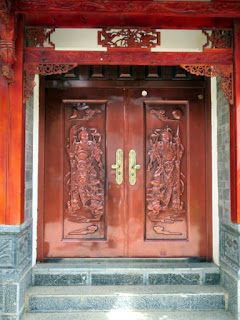
Carved door in Lijiang
We took the bus into town to a local restaurant where we had a family style lunch with favorite meal items of the locals. Like many meals in China, dinner was served at a circular table for eight with a large glass lazy Susan at the center.  We started with a wooden bucket filled with sticky white rice. We had several dishes that included chicken, vegetables, pork and yak meat. Everything served in the town is locally produced and organically grown. I had never eaten yak but it is a very flavorful meat that is like a very lean beef. We ate with Daljip and Catherine, Scott and Marlene and Darla and Sharon. They were good lunch companions.
Traditionally dressed Naxi women in Lijiang
After lunch we took the buses out of town into the Himalayan Mountain rural community where we had tea at the home of a traditional local family. Many of the families in this community are subsistence farmers of the Naxi culture. They consider themselves a separate ethic group from most Chinese. The Chinese government recognizes 56 separate ethnic groups in the country. Most of the women in the area dress in the traditional attire. Most of the men now wear western style clothing. The home that we visited is very old but is well maintained and the wooden carvings are beautiful. At the 10,000 foot altitude here the sheep wool and yak fabric are certainly appropriate for most of the year.
This area is very beautiful. At 26 degrees north latitude, Lijiang is about the same latitude as Miami. However, the altitude makes the weather much cooler. There is a nice mix of tropical and temperate plants growing here. There is abundant water available making the plant life lush. It is no wonder that this area was the inspiration for ShangraLa. We could see this as a paradise.  Historically, Lijiang played important roles in the Tea and Horse Road by facilitating trade and transport of both commodities.  There are still many horses in use in the area that are descended from two bloodlines.  There are small Himalayan horses as well as large heavy bodied horses from the mounts of the Mongols who invaded and traded in the area many times.
The Naxi were nomadic people who raised yaks and sheep. They made many foods from the meat, skin and milk of these animals. They were important in assisting trade during the Silk Road era. Even now they are a very proud and self-sufficient people who adhere to their religious beliefs that are a blend of Taoist and Buddhist religious practices.
Naxi woman selling flowers on the street in Lijiang
After our tea with the family we walked the short distance to the home of Dr. Joseph A. Rock, an Austrian-American who wrote about China for National Geographic in the 1920s and 30s. Dr. Rock is still highly regarded in the town and his home has been converted into a museum of his life here. There were a lot of artifacts and items from his life on display. After walking around the area we got back to the bus and rode to the Intercontinental Hotel in Lijiang This hotel is really nice. We and the Whittingtons were in a villa that is very elegant as well as roomy. Everyone agreed that this is the nicest hotel we have ever stayed in. We were happy to be away from the smog and humidity of the previous week. We were also happy to have faster Internet.
Our evening meal was at a local Naxi restaurant and was served family style. There was plenty of food prepared in Tibetan style. We finished our meal and walked back through Lijiang to the Intercontinental Hotel. Since we were all tired we went to our rooms.