As usual, we were awake early at the Paducah Super 8. Our room was clean and quiet, our only criteria for lodging these days. We did morning language lessons then went to the breakfast room when it opened at 6 am. We had cereal and bagels before checking out of our second floor room.
We drove to Wickliffe Mounds, an archeological site from the Mississippian culture dating from the 1100s to 1300s. Some of the mounds are thought to be ceremonial while others are burial mounds. It is believed that the site’s leaders selected the site since it provided a strategic view of the confluence of the Ohio and Mississippi Rivers and was on a high bluff unlikely to flood. The museum on an excavated mound includes many pots and other artifacts of the civilization that built the mounds. No human remains were on display but were returned to Native groups who reburied them in accordance with their beliefs.
A short distance from Wickliffe Mounds is the site of Fort Jefferson, a stockade constructed by George Rogers Clark in 1780 on orders from then Virginia Governor, Thomas Jefferson. Kentucky was part of Virginia at that time until statehood in 1792. The fort was plagued by illness and constant attacks from Chickasaw Indians and was abandoned only a year later. Because of the site’s view of the confluence of the Ohio and Mississippi Rivers, the knoll was used as a Union post during the Civil War.
Since 1939 large crosses have been constructed at the site. The current cross was completed in 1994 using donations from the sponsorship of bricks and donations from the public. The 90 foot tall freestanding cross is constructed of aluminum and cost over $300,000 to complete. A walking trail and interpretative signage provides information on the historic forts as well as Native cultures in the area. The granite bricks surrounding the Memorial Cross carry the names of the many donors contributing to the construction and maintenance of the cross.
As we left the confluence of Ohio & Mississippi Rivers we saw a town with an interesting name. When we saw a nearby town called “Monkey’s Eyebrow” there was no doubt that we had to go there. The “town” even has its own zip code but is nothing more than a small community of a few farms. Of course, we stopped and took photos of the sign. We learned that the most likely source for the town’s name is the two small hills that are crescent shaped and were covered with brush. A local farmer remarked that the hills looked like monkey’s eyebrows and the name stuck.
On the way home, we passed through Muhlenberg County and stopped at the county seat, Central City, where we went to the plaza honoring the Everly Brothers and John Prine including statues and monuments describing their connections to Muhlenberg County. The Everly Brothers were born in the small Muhlenberg County community of Brownie before moving to Knoxville, Tennessee when the brothers were in high school. John Prine spent many summers in the town of Paradise which no longer exists. Prine’s song, Paradise, made Muhlenberg County well known to many music fans all over the world.
As we neared the Land Between the Lakes area of Kentucky, we were ready for lunch. Friends had suggested Patti’s 1880s Settlement as a great stop for a meal. We were fortunate to be seated without a wait since the restaurant is said to fill up quickly. The décor of the restaurant is intended to be a throwback to the 1880s with waitresses wearing what appeared to be feed sack dresses and items on display from the area’s rural history. Mary had a huge turkey sandwich on homemade bread and I had one of the day’s special, “sticky piggie” was a pork cutlet on a homemade bun with caramel sauce and apple slices. We both enjoyed our meals then walked around the area finding a couple of geocaches before driving back home. We got to the house by 5 pm in time to unpack, do some laundry and get ready to go to our volunteer responsibilities on Thursday morning.
Since the Paducah Super 8 was quiet, we slept well and awakened by 5 am. We did our morning language lessons then went to the breakfast room at the motel. There was cold cereal, a few cups of yogurt, toast and bananas but that was fine with us after the large meal at Strickland’s last night. We drove down to the Paducah Riverfront where we walked along admiring the beautiful murals on the floodwall. There is a long history of the influence of the Ohio on the city’s development.
We walked along the riverfront and chatted with several local walkers about the area’s attractions. The murals along the floodwall were beautiful. Each panel represented an element of Paducah’s history from settlements by native cultures, early European explorers, the Lewis and Clark expedition, the influence of railroads and steamships and the civil rights movement in the city. It was encouraging that we saw no graffiti or other vandalism on the murals. It appeared to us that the murals are touched up and maintained regularly.
Around 9 am Mary walked around the area before she went to the National Quilt Museum. As a quilter, she has wanted to visit this museum for many years. She photographed many of the quilts that interested her and learned about the quilt competitions. She learned that the maker of a winning quilt can choose to get the quilt returned or to give the quilt to the museum and accept a large cash prize. She was at the museum for over four hours before coming out to walk around the surrounding area in Paducah.
While Mary was at the museum, I drove to Blytheville, Arkansas. My motivation was to find geocaches in Arkansas since it was the only state in which I had not recorded geocache finds. I figured that my easiest and fastest way to log a geocache in the state was to go to the Welcome Center. I parked at the rest area and checked my GPS receiver which showed that I was very near the geocache hide. I looked out of the car window and spotted the tiny geocache container suspended in a small tree next to the car. I could have reached out of the window to get the geocache container. I signed the cache log then went to the rest area then made my way back to pick Mary up at the Quilt Museum.
On the drive back to Paducah, I wanted to avoid Interstate highways but to drive through part of the state included in the Jackson Purchase. In 1818, General Andrew Jackson and former Kentucky Governor, Isaac Shelby negotiated the purchase of land east of the Mississippi River with the Chickasaw Indians for the price of $200,000. Today this land makes up eight of Kentucky’s westernmost counties and is typically referred to as “The Purchase” region. This is the area where the New Madrid Earthquake rechanneled the Mississippi River to leave an area of Kentucky that 27 square miles in size that is surrounded by Missouri and Tennessee. This “Kentucky Bend” has a population of nine people.
I was struck by the topography and ecology of the area. It is very much a Delta environment with cypress swamps and river lowlands. The predominate animals that I saw along the road were armadillos.
I picked Mary up at the Quilt Museum around 2 pm then took her to Hancock’s of Paducah to look at quilt fabric and supplies. While she shopped, I sat on a bench near the front of the store which was clearly placed there for husbands to sit while their wives shopped. I chatted with several other old guys as I waited. One fellow whose wife was from California who was primarily in the area because his wife wanted to visit the Quilt Museum and to shop at this shop. She had been at the store area and purchased so much fabric that she took it back to their motel then returned to shop again this afternoon. Her husband, George, and I chatted for a long time and enjoyed each other’s company. I mentioned that we were considering dinner at Broussard’s Cajun Cuisine and he said that they may see us there.
After a short break at the room in the Super 8, we were hungry and went to dinner at Broussard’s Cajun Cuisine around 5:30. We started with a flight of Cajun stews to sample. We liked the etouffee and jambalaya but we both really liked the shrimp gumbo. I fully expected to get etouffee since that is my go-to choice when we go to Cajun restaurants. However, the gumbo was exceptional. The cook came out and chatted with us for a long time as we dined. As we were leaving, we saw George and his wife coming into the restaurant. We chatted with them and exchanged contact information before we left the restaurant.
Before we went to the motel, we drove out Jefferson Street in Paducah to see some of the monuments and statues in the median. Back at the Paducah Super 8, we did our evening language lessons then turned in.
We had been hoping to make a trip to Western Kentucky since we moved to Georgetown in 2020. I have been fascinated by the 1811 New Madrid Earthquake that rerouted the Ohio and Mississippi Rivers leaving bits of Kentucky in Indiana and Missouri. A few years ago, we traveled to Henderson, Kentucky where we crossed the Ohio River into Indiana and back into Kentucky. We hiked along the former Ohio River bottom then stopped by the nearby former home of artist, John J. Audubon.
There were several recent motivations for the trip this year. Mary has wanted to visit the National Quilt Museum in Paducah for some time. I had logged finds of geocaches in every US state except Arkansas. Since Paducah is less than two hours from the Arkansas border, I decided to take the state off my to-do list. The last major motivation for the trip at this time is the Kentucky Garden Trail. On a field trip with Scott County Master Gardeners in June, we visited the Waterfront Botanical Gardens in Louisville and really enjoyed it so we decided to visit all 12 of the botanical gardens in the state. Two gardens on the list are in Western Kentucky.
After breakfast and exercise at Planet Fitness, we left home picking up the Bluegrass Parkway outside of Lexington. The trip would take about four hours but would seem like three hours since we would cross into the Central Time Zone as we traveled west. We stopped for fuel in Bardstown where we had lunch of cold cut sandwiches that we brought from home. We had corn nuts to snack on as we drove. At Elizabethtown, we picked up the Western Kentucky Parkway and continued through towns like Dawson Springs, that had been wiped out by a tornado in 2021.
Our first stop was in Madisonville, at Mahr Park Arboretum where we admired the beautifully groomed 265-acre municipal park. The Mahr family owned the property from 1964 until donating the land to the city of Madisonville in 2009. We enjoyed the well-labelled trees and shrubs throughout the park. We chatted with the volunteer at the park entrance for some time and got stamps for our Kentucky Garden Trail Passports then decided to continue on to Murray, Kentucky.
The drive to Murray from Madisonville was only about 90 minutes through the beautiful Western Kentucky landscape.
 |
| Doran Arboretum |
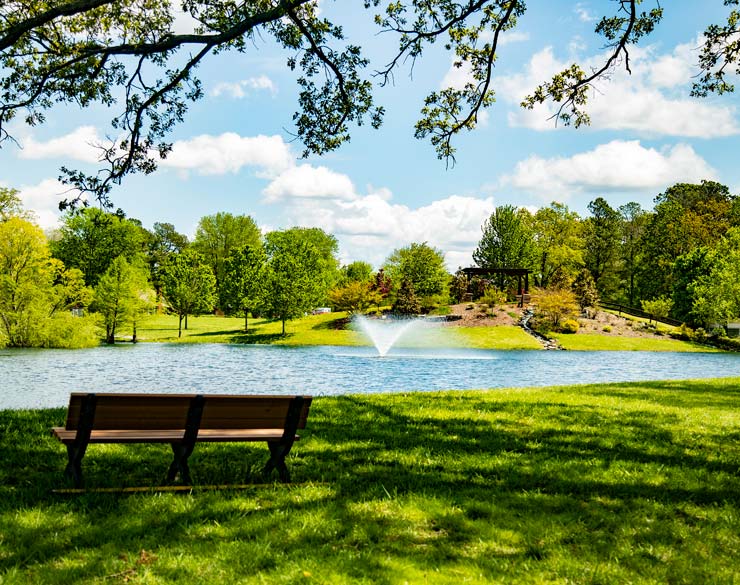
There was no attendant at the Doran Arboretum at Murray State University but we were directed to a large mailbox where we could pick up the Garden Trail Passport stamp. The only other person we saw was a young woman on a mower who we gathered was a Murray State student. The grounds of the arboretum were beautiful with trees, shrubs and perennial flowers displayed and labeled. We walked out to the apiary where several bee hives were active. The whole property was very impressive.
 |
| Mantle Rock |
From Murray, we started toward Paducah but saw a trailhead for Mantle Rock Preserve and decided to stop. We learned that the trail that we were on was part of the Trail of Tears, the path that the Cherokee were forced to travel to Oklahoma in 1838. In total over of 60,000 members of the “five civilized tribes” and their black slaves were removed to western territories between 1830 and 1850. In the winter of 1838-39, nearly 1,800 Cherokees took refuge at Mantle Rock since the extreme cold winter had make the Ohio and Mississippi Rivers difficult to cross.
As we drove, we saw that Possum Trot, Kentucky was nearby so we couldn’t resist stopped by. As expected there was really nothing in the small village but we took a few snapshots of the sign then continued on to Purple Toad Winery. Although we seldom drink wine, we had seen wine from this winery at our Kroger store and stopped to see what we could learn. The visitor center offered free tastings of eight wines and four distilled spirits of our choice. All of their wines and spirits are made on site at the Paducah location. We each tasted our eight wine choices and liked a few. Most of the wines from Purple Toad are very sweet dessert wines but their information sheet identified each wine’s sweetness on a 1-5 scale. We picked out a couple of bottles to buy then sampled some of the spirits. Several spirits including vodka and moonshine are made using their grapes as the based material for fermentation. We sampled some of the bourbons and clear spirits and found them to be fine but not exceptional so we elected to only buy the wine.
When we arrived at the Super 8 Motel in Paducah we checked in quickly and found the motel to be clean and quiet. We were very happy with the daily rate on the room and moved our things into the second floor room.
After changing clothes and relaxing a bit, we checked restaurant ratings and decided on Strickland’s Seafood House which was just a few blocks from our motel. We both ordered the Harris Platter which is an assortment of fish, crabcake, clams and shrimp. Our meals were very good and we returned to the Super 8 where we read then turned in for the night.


