Showing posts with label Yangtze River. Show all posts

Thursday, September 20, 2018

Shibaozhai Temple


Sampan on the Yangtze
Once again we awoke early so we did a couple of Duolingo German lessons, read the hometown newspaper online and reflected on the prior day. We tried calling Emily at 6 am which would be 6 pm on Wednesday. The Internet connection onboard the ship was too slow to support a Google Hangout call. By going through the VPN we could get around the block on Google that exists in China, but we just don’t have the bandwidth here.
Mary and Cindy went to their last Tai Chi class this morning. Both enjoyed the exercise very much and plan to continue on their own back at home. The instructor offered to give them some of her videos if they bring a USB drive. They plan to do that this afternoon.
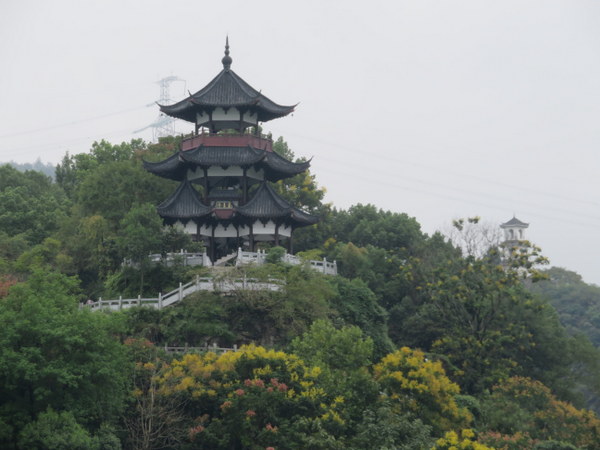
Shabaozhai Pagoda
Our usual breakfast was good with a variety of traditional stuffed Chinese dumplings, eggs, meats, cereal and fruit. We ate a little earlier than usual since we left the ship at 8:30 for a walking tour of the Shabaozhai Temple. The temple was originally from the ancient Ba culture who were a Neolithic people inhabiting the area from about 13,000 BC until about 300 BC. The temple and connecting pagoda were used for several functions including as a fort over the centuries. The wooden pagoda was constructed of local timber without the use of nails. The present pagoda was built in the early 1800s and has remained fairly unchanged since. The statuary, art and relics were destroyed in Mao’s Cultural Revolution but through recent relaxation of austere Communist policies banning religion, many of the artifacts have been reproduced.
Mary at Shabaozhai Pagoda
There was a heavy rain as we left the ship. Street vendors were lined up along the mile long route between the dock and the temple. We slogged through the rain and past the insistent merchants to a swinging suspension bridge leading to the temple and pagoda. Although Mary wasn’t anxious to cross the bridge, she did well as long as she didn’t look down or I didn’t shake the bridge.
Once at the pagoda we walked up 99 steps to the top of the pagoda leading to the temple’s entrance. The view down to the Yangtze River was spectacular even in the rain and fog. We took a number of snapshots then made our way back to the dock to board the ship after passing through security. The rain continued through the entire time that we were. In Shibaozhai.
We had a little time before lunch so we dried ourselves out and started packing things for the departure from the Viking Emerald and our flight on Friday morning. Since the requirements for baggage in China are different that in the US we had to shuffle some things around so that we not only made weight but had items in the carry on that are prohibited in our checked bags. For instance, China does not accept any batteries in checked bags but has no problem with them in carry on. Also, while the US permits 40 pounds in a checked bag, China allows 42 pounds.
Steve having chicken feet for lunch
Lunch today was an “interesting” choice that should be experienced visitors to China. While sandwiches, hamburgers and salads were available, the featured menu items were Phoenix claws (chicken feet), pig snouts, pig ears, pig tails, lotus roots and other traditional Chinese delicacies like duck, roast chicken and pork. I tried a title of each but was generally unimpressed with the chicken feet, pig ears and tail. There was just so little meat on the bones that I was hardly worth the effort. A chef was making lo mein noodles through traditional stretching and folding. We had some of the noodles, and they were fine. Everyone enjoyed the pork, sweet bean and vanilla custard dumplings. We all had a small square of Chinese style pumpkin pie for dessert.
After lunch the ship continued up the Yangtze River. The area where we are sailing now is considered the foothills of the Himalayan Mountains. The topography on either side of the ship continues to change as we move further and further up the river. We sat on the sub deck or in the observation room depending on the weather. It is still very humid, but the temperature seems to be cooling some.
Wheelhouse of the Viking Emerald
We came in at 2 pm for a tour of the bridge and to see how the captain and crew operate the ship. The high tech navigational aids and a well-trained crew keep the vessel safe and on course. We learned that three crew members are required at the bridge at all times. They serve a four hour shift then are off for eight hours before returning. Although our visit to the bridge was only 20 minutes we learned a lot about the operation of the ship.
After our tour the cribbage game continued while I sat on the sun deck to enjoy the cooler day after the rain had passed. Mary, Cindy and Mark attended a demonstration by the chef on his techniques for making Chinese dumplings. All agreed that although the demonstration was interesting, they will probably just buy their Chinese dumplings already made. There is a lot of work and skill involved in preparing the dough and making the many precise folds in the buns.
Pagoda along the Yangtze River
At dinner we sat with Larry and his wife from Bangor, Maine. Earlier in the week some of the Chinese people were taking selfies with Larry and pointing at him. We later learned it is because they thought he was Sean Connery. Larry is a Master Naturalist in Maine so we shared some great conversation. Mary had an excellent beef tenderloin and I had a very good baked cod filet. We all enjoyed our meals.
We returned to our rooms to pack for the flight from Chongqing to Lijiang. We needed to have our bags in the hall by 11 pm. We wanted to turn in early because breakfast was at 5:30 and we needed to board the bus for the airport by 8 am.

Wednesday, September 19, 2018

Goddess Stream

There was a good deal of noise throughout the night since the Viking Emerald was traveling through locks. I awoke a couple of times in the night but was able to go back to sleep. We slept nearly until 6 am then got our showers for the day. Mary and Cindy went to Tai Chi, Mark rode an exercise bike and I read on the sun deck. It was a beautiful morning with fog on the tops of the hills around the gorge. I took a few snapshots and appreciated the day. We went to breakfast around 7:30 siting with Peter and Jane from Fort Collins and Bob and Rod, a couple from Hawaii. Bob is quite a character and kept the table in stitches throughout our breakfast although his husband, Rod, was much more subdued. Of course, Peter and Jane argued the entire meal, as usual.
Tourist Sampan in the Goddess Stream area of the Yangtze
After packing our things for the day we left the Viking Emerald and walked along a series of docks to board Sampans which are traditional Chinese small boats. Of course the ones we were on are modern and produced specifically to transport tourists. Each of the Sampans held about 20 of us to travel up the Goddess Stream of the Three Gorges area. This part of the gorge is very narrow with deep water. The sheer cliffs were covered with vegetation some of which was still blooming with orange and purple flowers. It was a beautiful ride. The local guide told us a lot of the local legends about the goddess for whom the area is named and a little of the geology of the formation of the area. This area appears to be very popular with Chinese tourists since there were many tour boats in the area with Chinese people. Most of the visitors were anxious to greet us in the English phrases that they knew.
Goddess Stream area of the Yangtze River
On the short walk back to the Viking Emerald there were a number of vendors set up at tables although they appeared to be marketing to the Chinese visitors. We did notice a great deal more floating garbage in this section of the Yangtze River than we had seen in prior days. There were floating rafts of Styrofoam, bottles and other debris that are nearly an acre in size.
Pagoda along the Yangtze
We took lunch soon after returning to the ship. There were a number of Chinese and western choices, but I decided to go with the fish and chips with mushie peas on the side. It wasn’t spectacular but what English food is all that great? We ate with Keith and Virginia from Australia and they were very good lunch company.
Our afternoon was pretty lazy. There were a number of talks available on various decks and lounges of the ship, but we opted to take a brief power nap then sit on our stateroom veranda to sight-see as we continued up the Yangtze. We went by a place where the ancient Ba people placed their dead in burial chambers that are small caves in the rock face. Many homes or villages had small shrines facing the river. There were a number of temples visible to us as we sailed by. At one temple we saw what we thought were squirrels playing on the roofs and walls. On closer examination with the binoculars we learned they were rhesus monkeys romping and doing what monkeys do. We traveled along and saw a number of factories some of which were under construction and several places that appeared to be mines or quarries.
We attended a discussion by the program director on plans for Thursday then met with our tour escort, Patrick, to plan for Friday morning’s disembarkation and flight to Chongqing. Dinner was very good as usual. We were joined by Bob, Tammy and her 24 year old son, AJ. They are from the DC area and were good dinner companions. Mary had sesame chicken, and I had a very spicy beef with chili peppers. For dessert I had the blueberry ice cream, and Mary had fried rice balls with a cream sauce. We exchanged halves and enjoyed both choices.
We didn’t stay up too long after dinner. Mary and Cindy played cribbage, Mark read and I chatted with Hamish on the ship’s bow as we traveled. Hamish had some great stories of serving in the Scottish Navy stationed in the Middle East for much of his career. We skipped the crew variety show and the late musical entertainment in favor of turning in early. 

Tuesday, September 18, 2018

Three Gorges Dam


For the first time since we arrived in China we had a full night’s sleep. We were so pleased to sleep until 6 am and feel rested on awakening. Mary and Cindy went to Tai Chi at 7 and I sat out on the sun deck and talked with a couple from Fort Collins, Colorado. Peter is a retired veterinarian and Jane is a former educator. They are both characters and made great conversation. Mark, Cindy,
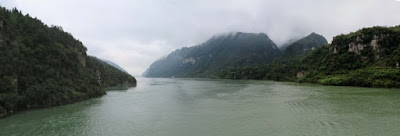
Three Gorges area of the Yangtze River
Mary and I met up at breakfast then went back to the sun deck. At 9 am one of the guides, “Elliot,” did a talk on the Three Gorges area.  We learned that the hydroelectric generation at the Three Gorges Dam is the largest hydroelectric generating dam in the world.  As we listened to Eliot we prepared to travel through the easternmost of the locks on the Yangtze. Our ship was a tight fit for the first lock, but we were shocked at how quickly water filled the lock chamber to raise the boat the 20+ meters to the upstream side of the dam. Once the lock gates closed it may have taken only 3 minutes to raise the ship to begin exiting the lock.
Pagoda along the Yangtze River
We sat with Peter and Jane as well as a couple from Alexandria, Virginia for lunch. Mary had a pumpkin/coconut soup with a ground beef and sautéed green bean dish. I had chicken cordon Bleu with a garden salad. We all had the crème Brule.
We had only a short amount of time after lunch to prepare for our afternoon visit to the Three Gorges Visitor Center. Of course we had to pick up our shore leave passes as we left the ship to walk to the buses. There was a swarm of street vendors waiting on us to pass through them to get to the buses. They were selling hats, shirts, maps, books and who knows what else. One more persistent lady was following me and pushing me to buy her book on the Three Gorges. I made the mistake of telling her “maybe later.”
Three Gorges Dam Visitor Center
The bus ride to the visitor center was short and uneventful. It was nothing like the wild ride to the school the day before. On arrival at the Three Gorges Visitor Center, we had to pass through security once again before getting back on a bus to the area where we would make our way to the dam viewing area. We noticed that there were a lot of grapefruit trees that were hanging full of fruit. I just didn’t think of China as a location for grapefruit although it is certainly at a very southern latitude.
Typical Chinese toilet
Some of the people on the trip received a surprise when they went to the toilet at the visitor center. In areas where there are few western tourists, the toilets are not porcelain stools but rather just porcelain lined holes in the floor over which one would squat for bodily functions. This was a bit disconcerting for some of our group, but we had seen these when we arrived at the Shanghai airport where there were the traditional hole toilets as well as western stools. In addition, most toilets in China do not come equipped with toilet paper.  It is expected that visitors bring their own paper to the toilet with them. We came to refer to these toilets as the “squatty potties” of China.
Three Gorges Dam Visitor Center
We traveled up a series of escalators to the top of a hill where we could look down on the dam housing the power generating turbines, the ship lock in multiple stages and the ship elevator. The elevator can take a small ship of less than 3000 tons through the locks in only 14 minutes as compared to 4 hours required with the traditional locks. Unfortunately our ship is too large to take the elevator but we will lock through late on Tuesday night while we sleep. The dam system is an intricate set of dams, locks and hydroelectric power plants. The largest dam was only completed in 2009 but has had a major impact on the economy, environment and culture of the area.
Three Gorges Dam
We were told that the electric power produced at the Wu Gorge dam provides about 5% of all of the electricity used in the country. It has also permitted a great deal more shipping to and from cities in the upper Yangtze valley to markets in Wuhan and Shanghai. Over 1.5 million residents of the area had to be relocated because of the flooding of areas behind the dams. The spin that we heard from our Chinese guides is that the residents were well compensated for the loss of their farms and could afford to get a condo in a city and find a manufacturing job or open a small business. There were also major environmental impacts from the dams. They attribute this to the kindness of the government. Not only were wild river ecosystems changed, but the farmlands and alluvial plains were inundated. Anadromous fish like the sturgeon are now unable to negotiate the Yangtze tributaries for spawning. Since the dams are so high, the construction of fish ladder was considered impractical.
Three Gorges Dam
Because of the importance of the dams there was very tight security in the area. A breach in the dam would be a disaster for many millions of Chinese people downstream on the Yangtze. The flooding would drown millions and displace many millions more. In addition, the power loss would be devastating to the national economy. Evidence of the security was seen in the screening that we saw and the military presence. As we were leaving we saw uniformed Chinese soldiers standing guard reminiscent of the guards at Buckingham palace. For a time we thought they were mannequins but were eventually able to see them breathing.
We stayed at the dam viewing area only about an hour then boarded the buses to return back to the dock on the Yangtze to board the Viking Emerald. There was one problem. The street vendors that we eluded were waiting or our buses when we returned. The persistent Chinese lady to whom I said “maybe later” was waiting on me. I was finally able to shake her as we made our way back to board the ship after passing through security once again.
Temple near the Yangtze
We had a little time before the evening events and dinner so we showered and changed then walked about on the sun deck. As repeat Viking guests, Mary and I are members of the Viking Explorer Society and were invited for a cocktail hour before dinner. We had little appetizers of breads, cheeses and. Caviar. The crew joined us in a toast of traditional Norwegian aquavit then we made our way to dining room for the evening meal. Because aquavit is basically a vodka flavored with caraway, we have never had a taste for it but we took a polite sip as the toast.
We have noticed some differences not only in the prior trip on the Rhine but across the time that we have been on the ship. In Europe there were two dining areas on the ship. One was the formal dining room where most passengers took their meals and the informal grill in the bar area. In Europe, there was a dress code for the dining area, especially for the evening meal and guests who were not appropriately dressed were asked to take their meal in the grill. Because there is only one meal area on this ship, everyone comes to the dining area for meals. While most of the passengers arrive dressed for dinner we had a few who showed up in Harley Davidson T-shirts and jeans shorts. We have seen that as the trip has progressed passengers have started dressing a bit better, at least for the evening meal.
Lights on one of the locks on the Yangtze
We were joined by a very nice couple from the DC area for dinner. Bob and Hsing are both retired from the US Department of Defense and spend a great deal of time traveling the world. We found them both very interesting. Hsing is a very opinionated lady from Taiwan. We remarked that she always referred to mainland China as “Red China” and showed some disdain for the government here.
Most of us had the lamb chops with sautéed green beans. Dessert was a choice of mango ice cream, a brownie or chestnut mousse. We all enjoyed our meals then sat out on the sun deck waiting to pass through the locks at Wu Gorge. Since the river is a little low at this time of year we only had to pass through four of the five lift stages to travel up the Yangtze. Once we entered the ship locks we turned in for the night.


Sunday, September 16, 2018

Cruising on the Yangtze

We were happy to sleep until after 4 am this morning. We read until around 5 then I went up to get tea for us. A little before 7 am Cindy came over so she and Mary could do their Tai Chi class. I went up to the 6th level observation deck and looked over the fields and quarries that we passed. There was a good deal of haze from the fog as well as smoke from fields that were being burned. There was a lot of barge traffic, mostly stone but we saw loads of sulfur and other cargo.
Tai Chi demonstration on the Viking Emerald
Mary, Cindy, Mark and I went to breakfast around 7:30 which included Chinese and Western choices. I enjoyed the rice porridge (congee) which is a local favorite. This hot cereal isn’t sweet at all but has a meat stock and other savory flavors. We all enjoyed the yogurt which is made by the chef onboard the ship. Cindy and Mary reported that they enjoyed the Tai Chi class but they needed to watch some follow up videos to reinforce what they learned. They are looking forward to lessons throughout the week
After breakfast there was a mandatory safety drill, required by Chinese law. This necessitated everyone returning to their staterooms to don life jackets then reporting to muster stations. The drill only took a few minutes and provided some amusement getting into and out of the life jackets.
Sampan on the Yangtze River
Since the ship would be traveling up the Yangtze all day there were a number of optional programs onboard for passengers to choose. At 10:30 the ship’s physician did a presentation on traditional Chinese medicine. He started by having his assistant demonstrate Tai Chi and discussed the health benefits from the daily physical and spiritual exercise. The doctor’s assistant is the instructor for the onboard Tai Chi class. He went on to discuss acupuncture, acupressure and cupping as techniques for the treatment but mostly prevention of a list of ailments. Near the end of his session he pulled two people from the group to demonstrate. The lady we met from Cincinnati had been troubled with sore feet so he used acupuncture to relieve her discomfort. An older gentleman is scheduled for knee replacement and has pain when we walks. The doctor used cupping on his leg to extract bad blood and toxins that were causing him pain. It didn’t appear that either of the demonstration subjects was overly impressed with the techniques. However, in fairness, the doctor made it clear that nontraditional medicine is seldom a single treatment solution and may require weeks or months of treatments. He was not a terribly compelling speaker and, in some ways, reminded us of a faith healing televangelist or a traveling snake oil salesman. In any case, the presentation gave us an interesting insight into traditional Chinese medicine.
Water buffalo grazing along the Yangtze
Lunch was interesting. I tried the poached fish which was a large carp covered in Chinese vegetables. I was able to get past the issue of eating a fish that is considered a trash fish in the US. However, after a few bites I confirmed why it is considered a trash fish. The flesh was flaky like a good whitefish fillet but had an odd flavor that seemed oily. The major problem is the tiny bones throughout the fish. I gave up on the fish and opted other lunch choices. There were many fresh and dried fruit options so I was able to get a good lunch. Mary & Cindy had soup and salad and Mark had a sandwich.
After lunch, the program director, Angie, did an interesting presentation on the Yangtze River. She had a lot of old maps and photos showing what life was like along the river before completion of the Three Gorges Dam and how the dam has changed the economy, agriculture and culture of the area.  We learned that the Yangtze is the longest river in Asia and the third longest in the world.  It is the world's longest river that drains a single country.  It has the sixth largest water discharge of the world's rivers.
The next presentation was by the river guide, Elliot, with a lesson on Chinese language. He went over the characters a bit but focused on common phrases and pronunciation of the very tonal language. He had a very useful handout with translations words and phrases that we may need out in the towns. Elliot’s English was perfect. He is educated as an English teacher but told us that he lacked the patience for the job. He said that he has been speaking English so long that he is now more comfortable with English than his native Mandarin.
The afternoon concluded with 4 pm tea and a lesson in Mahjong. It wasn’t unexpected that Mary and Cindy took to the game quickly and became proficient soon after learning the rules. In some ways the game reminded me of gin rummy since players draw and discard in an effort to get a run or three of a kind. They played for a little over an hour before returning to their preferred cribbage games while Mark and I sat up on the sun deck watch the landscape go by as we sailed upriver. Many areas along the banks of the Yangtze are planted in neat grids of trees. We do not know what kinds of trees these are but we suspected that they are being grown for possible transplant to more urban locations. Perhaps they are just there for erosion control. We saw several crops that we were unable to identify. One looked like it might be sugar cane since farmers were cutting the stalks in arranging them tepee style in the fields. There were also extensive fields of what appeared to be a grain crop. We wondered if it could be sorghum, milo or canola.  We could not find anyone on the ship who knew either of these crops. We saw several herds of goats as well as cattle and water buffalo. Many of the cattle are large heavy bodied animals with long thick horns. The water buffalo were much larger than we expected. These animals were often along the river bank as we sailed past.
We returned to our staterooms to dress for dinner. Prior to dinner there was a champagne toast with the captain and crew. With the help of Patrick as translator, I enjoyed talking with the captain about his 35 years as a ship captain on the Yangtze. He was very pleasant and was happy to answer my questions about the river and the ship. I look forward to getting a tour of the wheelhouse later in the trip.  After the social with the crew our program director gave us a brief preview of Monday’s schedule of activities then we made our way to dinner.
The evening meal was a traditional family style Chinese dinner where items were placed in serving dishes on a lazy Susan in the center of the table. There were scallops, braised pork ribs, sweet and sour fish, duck breast, Shangri-La beef and Kung Pao chicken. We had a choice of mango pudding or green tea ice cream. We enjoyed the others who shared our table, a couple from Chicago, Jim and Mary Sue, and a couple formerly from Michigan currently living in South Carolina. Because their home is on the western part of the state they were not threatened by damage from Hurricane Florence.
We were tired after dinner so we opted to not attend the demonstration of painting inside a bottle; that was offered. We weren’t ready for bed yet so Mary and Cindy continued the cribbage game until 9:30. We hope to get a good sleep before our full day of activities on Monday.

Saturday, September 15, 2018

Arriving in Wuhan

We managed to sleep this morning until 3:15 am which is an hour later than yesterday. We read and watched CNN which is the only thing we could find in English on the hotel television. We made our way to breakfast at 6:30 joining a nice couple from Denton, Texas. Mark and Cindy joined us around 7:15. The breakfasts at the hotel have been very good with a nice mix of Chinese and western choices. Since we had sent our checked bags out to be loaded the night before, we only had to gather our carry-on items before checking out of the Shanghai Four Seasons. It is a very elegant downtown hotel that obviously caters to well-to-do business people.  Viking typically uses exceptionally nice hotels for their land based touring.
Bronze container at Hubei Provincial Museum
We boarded the bus at 8:15 and made the drive to the Shanghai airport about an hour away. Security at Chinese airports is very tight. We were sent through security screening just to enter the terminal. We had a second screening to get to the departure area that was similar the TSA screening in the US except was much more extensive. After passing through security we walked around the concourse for nearly an hour until time to begin boarding for our flight to Wuhan.
Unlike our flight into Shanghai, the majority of the passengers other than our group were Chinese who were traveling between the two large cities of Shanghai and Wuhan. We were pleased to have an interesting seatmate in an older lady, Joan, from New Zealand who currently resides in Nova Scotia. Her brother, Mike, was accompanying her.  He resides in Australia.  Joan is quite a character and provided interesting conversation during the 80 minute flight. She was upset because she had a small spike under the tip of her cane that was helpful when walking on ice in Nova Scotia.  The Chinese security clipped the spike off with wire cutters when she sent it through security.  Lunch on the flight was very traditional Chinese. Mary had chicken with noodles and I had a spicy beef with rice.
Ancient bronze bells at Hubei Provincial Museum
On arriving at Wuhan we only needed to confirm our checked bags and get on the bus to go to the Hubei Provincial Museum in Wuhan.
A special exhibit at the museum is on the Warring States period around 475-221 BC. A feudal lord, Marquis Yi, had an impressive set of 64 gold inlaid bronze bianzhong bells that are perfectly tuned to a five octave range. We also saw a number of artifacts from the period including many jade carvings and bronze castings. Our guide, Patrick, took us around the museum speaking to us through the earpieces we were issued earlier in the trip. We spent about 90 minutes in the museum then boarded the bus for our short drive to the Emerald Viking River ship moored on the Yangtze River. 
Even though it is mid-September, the weather was very warm in the upper 80s. Because of the typical heat, Wuhan is called one of the three furnaces. The population of Wuhan is “only” a little over 10 million although the metro area has over 18 million people.  We still can’t get over the staggering size of Chinese cities.
Ancient bronze bells at Hubei Provincial Museum
We unpacked in our staterooms then walked around the ship a bit. There are a number of differences in the ship we took on the Rhine. The Emerald has only one dining area unlike our prior ship which had a formal and informal area for meals. The sun deck is much smaller but the cabins may be larger and each cabin has a small balcony with a couple of chairs. We sat on the sun deck briefly and watched some of the kites that people were flying to heights that were pretty impressive.
The western style dinner at 7 pm was very good. There were several menu choices and we were all pleased with our selections. We were joined at our table by two interesting couple, Willie and Mary with Minnesota and Dave and Sandra from York, England. Dave, a retired York police officer, was interesting and Willie provided entertaining dinner conversation.
Jade carving at Hubei Provincial Museum
After dinner there was a cruise briefing by the program director, Angie Wang, and the hotel manager, Enrico. We concluded our evening by siting on the observation deck and watching the light show on the buildings of Wuhan along the Yangtze. The ship cast off at 10 pm to travel up the river, so we made our way down to our second floor staterooms and turned in hoping to be able to sleep in longer. Mary and Cindy were planning to attend the Tai Chi classes on the fifth floor deck each morning at 7 am.