Monday, September 17, 2018

Touring in Jingzhou


Typical store in Jingzhou
Despite our best efforts to sleep in, we awoke at 3 am today. We did a little reading then went up to the 5th deck for a cup of tea. It wasn’t long until we heard the Viking Emerald docking at Jingzhou which the Chinese refer to as a “small city” because the population is just under 6 million. There were a number of people swimming in the Yangtze around the port as well as many people fishing with long poles of fiberglass or graphite.
Crazy drivers in Jingzhou
Mary and Cindy went to Tai Chi class at 6:45 then we met up for breakfast at 7:20. We had an excellent breakfast with Scott and Monica and Daljit and Katherine, two Indian brothers and their wives. They are all very pleasant company and good conversation. We noticed that the weather was markedly cooler, and there was a strong breeze. We suspect that the change in weather may be related to Typhoon Mangkhut that made landfall in Hong Kong over the weekend causing significant damage.
To leave the ship we needed to pick up shore leave passes. However, we forgot to get ours but fortunately it wasn’t a problem this morning. We boarded the buses for the visit to the primary school in Jingzhou. The bus trip was quite an experience. We rode in the front seat of the bus which is positioned in a glass bubble above the driver. The drive through Jingzhou was a terrifying experience. The driver swerved across lanes of busy traffic missing pedestrians, scooters and other vehicles by millimeters. He even passed a police car on the double line and into oncoming traffic. I could not imagine driving in this or any other Chinese city.
Students in Viking School in Jingzhou
The school we visited is a private school that receives some funding support from Viking River Cruises. There are groups from Viking touring the school about every ten days. When we arrived the children did a performance of singing and dancing. They were pretty cute. After the performance the students had a brief recess. They were just like children of that age from any culture. They were running, squealing and rough-housing just like any groups of elementary school students in the US. 
Students in Viking School in Jingzhou
Many of the students wanted to greet us in English, shake our hand or give us a high five. They were fascinated with Mary’s height. A number of students wanted Mary to sign their autograph books. I made a little buddy as well. A little boy, about 6 years old wanted to give me a high five then he distracted me and plucked some hair from my forearm! About 10 minutes later he came back to try to pull more hair but I had his number this time and was able to hold my arms up. Mark suspected that Chinese adults that he sees do not have the arm hair that Europeans have.
Students in Viking School in Jingzhou
We continued to a second grade classroom where the students sang for us and we sang “She’ll be coming ‘round the mountain” for them. Using our guide, Patrick, as a translator, the children told us about their students and their daily routine at school. We gathered outside the school for our return drive back to the Viking Emerald. This time we chose to sit further back on the bus for a less exciting ride.
Jingzhou City Wall
We had a nice lunch on the ship then prepared for the afternoon trip back into Jingzhou to the ancient city walls. Like many Chinese cities, Jingzhou was surrounded by a high stone wall and a moat. This provided a formidable barrier to potential invaders. At each of the main gates into the city there was a double wall so if a threat were to breach the first gate they would be trapped in a courtyard by the second gate. Archers or soldiers with hot oil could then turn the invaders away before escape. This system is somewhat like the “man trap” deterrents that are becoming used in many buildings today. 
Park in Jingzhou
While we were standing and listening to a speaker on the walled city I heard giggling behind us.  It turns out that local Chinese women were lined up behind Mary to take a back-to-back photo.  Of course, the ladies barely came to her waist.  They were fascinated because they had never seen a woman that tall.
We got back to the ship around 5 having to pass through security every time we enter and exit the vessel. Mary and Cindy played cribbage while Mark and I sat on the sun deck. The ship cast off around 5:30 to continue up the Yangtze River toward Three Gorges.
Students in Viking School in Jingzhou
We decided to sit at a table with a group of Brits. There was a couple originally from England now living in Australia and a retired Scottish navy officer named Hamish and his wife at our table. We enjoyed their company and great accents. Hamish is the stereotypical Scot with a ruddy complexion and white hair that was once bright red. He said that in his youth he resembled the actor who portrayed William Wallace’s lifelong friend, Hamish, in the movie, Braveheart.  Mark had an excellent beef tenderloin but most of us had the cashew chicken. My duck breast appetizer was quite good as well.
We skipped the evening program on traditional Chinese costumes of the various ethnic groups in China in favor of turning in early. Live music and dancing were available in the bar later but we were long since asleep by then.


Sunday, September 16, 2018

Cruising on the Yangtze

We were happy to sleep until after 4 am this morning. We read until around 5 then I went up to get tea for us. A little before 7 am Cindy came over so she and Mary could do their Tai Chi class. I went up to the 6th level observation deck and looked over the fields and quarries that we passed. There was a good deal of haze from the fog as well as smoke from fields that were being burned. There was a lot of barge traffic, mostly stone but we saw loads of sulfur and other cargo.
Tai Chi demonstration on the Viking Emerald
Mary, Cindy, Mark and I went to breakfast around 7:30 which included Chinese and Western choices. I enjoyed the rice porridge (congee) which is a local favorite. This hot cereal isn’t sweet at all but has a meat stock and other savory flavors. We all enjoyed the yogurt which is made by the chef onboard the ship. Cindy and Mary reported that they enjoyed the Tai Chi class but they needed to watch some follow up videos to reinforce what they learned. They are looking forward to lessons throughout the week
After breakfast there was a mandatory safety drill, required by Chinese law. This necessitated everyone returning to their staterooms to don life jackets then reporting to muster stations. The drill only took a few minutes and provided some amusement getting into and out of the life jackets.
Sampan on the Yangtze River
Since the ship would be traveling up the Yangtze all day there were a number of optional programs onboard for passengers to choose. At 10:30 the ship’s physician did a presentation on traditional Chinese medicine. He started by having his assistant demonstrate Tai Chi and discussed the health benefits from the daily physical and spiritual exercise. The doctor’s assistant is the instructor for the onboard Tai Chi class. He went on to discuss acupuncture, acupressure and cupping as techniques for the treatment but mostly prevention of a list of ailments. Near the end of his session he pulled two people from the group to demonstrate. The lady we met from Cincinnati had been troubled with sore feet so he used acupuncture to relieve her discomfort. An older gentleman is scheduled for knee replacement and has pain when we walks. The doctor used cupping on his leg to extract bad blood and toxins that were causing him pain. It didn’t appear that either of the demonstration subjects was overly impressed with the techniques. However, in fairness, the doctor made it clear that nontraditional medicine is seldom a single treatment solution and may require weeks or months of treatments. He was not a terribly compelling speaker and, in some ways, reminded us of a faith healing televangelist or a traveling snake oil salesman. In any case, the presentation gave us an interesting insight into traditional Chinese medicine.
Water buffalo grazing along the Yangtze
Lunch was interesting. I tried the poached fish which was a large carp covered in Chinese vegetables. I was able to get past the issue of eating a fish that is considered a trash fish in the US. However, after a few bites I confirmed why it is considered a trash fish. The flesh was flaky like a good whitefish fillet but had an odd flavor that seemed oily. The major problem is the tiny bones throughout the fish. I gave up on the fish and opted other lunch choices. There were many fresh and dried fruit options so I was able to get a good lunch. Mary & Cindy had soup and salad and Mark had a sandwich.
After lunch, the program director, Angie, did an interesting presentation on the Yangtze River. She had a lot of old maps and photos showing what life was like along the river before completion of the Three Gorges Dam and how the dam has changed the economy, agriculture and culture of the area.  We learned that the Yangtze is the longest river in Asia and the third longest in the world.  It is the world's longest river that drains a single country.  It has the sixth largest water discharge of the world's rivers.
The next presentation was by the river guide, Elliot, with a lesson on Chinese language. He went over the characters a bit but focused on common phrases and pronunciation of the very tonal language. He had a very useful handout with translations words and phrases that we may need out in the towns. Elliot’s English was perfect. He is educated as an English teacher but told us that he lacked the patience for the job. He said that he has been speaking English so long that he is now more comfortable with English than his native Mandarin.
The afternoon concluded with 4 pm tea and a lesson in Mahjong. It wasn’t unexpected that Mary and Cindy took to the game quickly and became proficient soon after learning the rules. In some ways the game reminded me of gin rummy since players draw and discard in an effort to get a run or three of a kind. They played for a little over an hour before returning to their preferred cribbage games while Mark and I sat up on the sun deck watch the landscape go by as we sailed upriver. Many areas along the banks of the Yangtze are planted in neat grids of trees. We do not know what kinds of trees these are but we suspected that they are being grown for possible transplant to more urban locations. Perhaps they are just there for erosion control. We saw several crops that we were unable to identify. One looked like it might be sugar cane since farmers were cutting the stalks in arranging them tepee style in the fields. There were also extensive fields of what appeared to be a grain crop. We wondered if it could be sorghum, milo or canola.  We could not find anyone on the ship who knew either of these crops. We saw several herds of goats as well as cattle and water buffalo. Many of the cattle are large heavy bodied animals with long thick horns. The water buffalo were much larger than we expected. These animals were often along the river bank as we sailed past.
We returned to our staterooms to dress for dinner. Prior to dinner there was a champagne toast with the captain and crew. With the help of Patrick as translator, I enjoyed talking with the captain about his 35 years as a ship captain on the Yangtze. He was very pleasant and was happy to answer my questions about the river and the ship. I look forward to getting a tour of the wheelhouse later in the trip.  After the social with the crew our program director gave us a brief preview of Monday’s schedule of activities then we made our way to dinner.
The evening meal was a traditional family style Chinese dinner where items were placed in serving dishes on a lazy Susan in the center of the table. There were scallops, braised pork ribs, sweet and sour fish, duck breast, Shangri-La beef and Kung Pao chicken. We had a choice of mango pudding or green tea ice cream. We enjoyed the others who shared our table, a couple from Chicago, Jim and Mary Sue, and a couple formerly from Michigan currently living in South Carolina. Because their home is on the western part of the state they were not threatened by damage from Hurricane Florence.
We were tired after dinner so we opted to not attend the demonstration of painting inside a bottle; that was offered. We weren’t ready for bed yet so Mary and Cindy continued the cribbage game until 9:30. We hope to get a good sleep before our full day of activities on Monday.

Saturday, September 15, 2018

Arriving in Wuhan

We managed to sleep this morning until 3:15 am which is an hour later than yesterday. We read and watched CNN which is the only thing we could find in English on the hotel television. We made our way to breakfast at 6:30 joining a nice couple from Denton, Texas. Mark and Cindy joined us around 7:15. The breakfasts at the hotel have been very good with a nice mix of Chinese and western choices. Since we had sent our checked bags out to be loaded the night before, we only had to gather our carry-on items before checking out of the Shanghai Four Seasons. It is a very elegant downtown hotel that obviously caters to well-to-do business people.  Viking typically uses exceptionally nice hotels for their land based touring.
Bronze container at Hubei Provincial Museum
We boarded the bus at 8:15 and made the drive to the Shanghai airport about an hour away. Security at Chinese airports is very tight. We were sent through security screening just to enter the terminal. We had a second screening to get to the departure area that was similar the TSA screening in the US except was much more extensive. After passing through security we walked around the concourse for nearly an hour until time to begin boarding for our flight to Wuhan.
Unlike our flight into Shanghai, the majority of the passengers other than our group were Chinese who were traveling between the two large cities of Shanghai and Wuhan. We were pleased to have an interesting seatmate in an older lady, Joan, from New Zealand who currently resides in Nova Scotia. Her brother, Mike, was accompanying her.  He resides in Australia.  Joan is quite a character and provided interesting conversation during the 80 minute flight. She was upset because she had a small spike under the tip of her cane that was helpful when walking on ice in Nova Scotia.  The Chinese security clipped the spike off with wire cutters when she sent it through security.  Lunch on the flight was very traditional Chinese. Mary had chicken with noodles and I had a spicy beef with rice.
Ancient bronze bells at Hubei Provincial Museum
On arriving at Wuhan we only needed to confirm our checked bags and get on the bus to go to the Hubei Provincial Museum in Wuhan.
A special exhibit at the museum is on the Warring States period around 475-221 BC. A feudal lord, Marquis Yi, had an impressive set of 64 gold inlaid bronze bianzhong bells that are perfectly tuned to a five octave range. We also saw a number of artifacts from the period including many jade carvings and bronze castings. Our guide, Patrick, took us around the museum speaking to us through the earpieces we were issued earlier in the trip. We spent about 90 minutes in the museum then boarded the bus for our short drive to the Emerald Viking River ship moored on the Yangtze River. 
Even though it is mid-September, the weather was very warm in the upper 80s. Because of the typical heat, Wuhan is called one of the three furnaces. The population of Wuhan is “only” a little over 10 million although the metro area has over 18 million people.  We still can’t get over the staggering size of Chinese cities.
Ancient bronze bells at Hubei Provincial Museum
We unpacked in our staterooms then walked around the ship a bit. There are a number of differences in the ship we took on the Rhine. The Emerald has only one dining area unlike our prior ship which had a formal and informal area for meals. The sun deck is much smaller but the cabins may be larger and each cabin has a small balcony with a couple of chairs. We sat on the sun deck briefly and watched some of the kites that people were flying to heights that were pretty impressive.
The western style dinner at 7 pm was very good. There were several menu choices and we were all pleased with our selections. We were joined at our table by two interesting couple, Willie and Mary with Minnesota and Dave and Sandra from York, England. Dave, a retired York police officer, was interesting and Willie provided entertaining dinner conversation.
Jade carving at Hubei Provincial Museum
After dinner there was a cruise briefing by the program director, Angie Wang, and the hotel manager, Enrico. We concluded our evening by siting on the observation deck and watching the light show on the buildings of Wuhan along the Yangtze. The ship cast off at 10 pm to travel up the river, so we made our way down to our second floor staterooms and turned in hoping to be able to sleep in longer. Mary and Cindy were planning to attend the Tai Chi classes on the fifth floor deck each morning at 7 am.


Friday, September 14, 2018

Old Shanghai

Because our internal clocks are still running on Eastern Time, we both awoke at 2 am this morning. I guess our brains still recognize it as 2 pm. We did some reading and watched the British CNN before showing and dressing to go to breakfast at the Shanghai Four Seasons Hotel at 6:30. We ate with a nice couple from Cincinnati. The breakfast was very good. There was a nice mix of American and Chinese traditional breakfast favorites. We especially liked the fruit selections although it took a while for us to recognize the cut dragon fruit. 
Shanghai Skyline
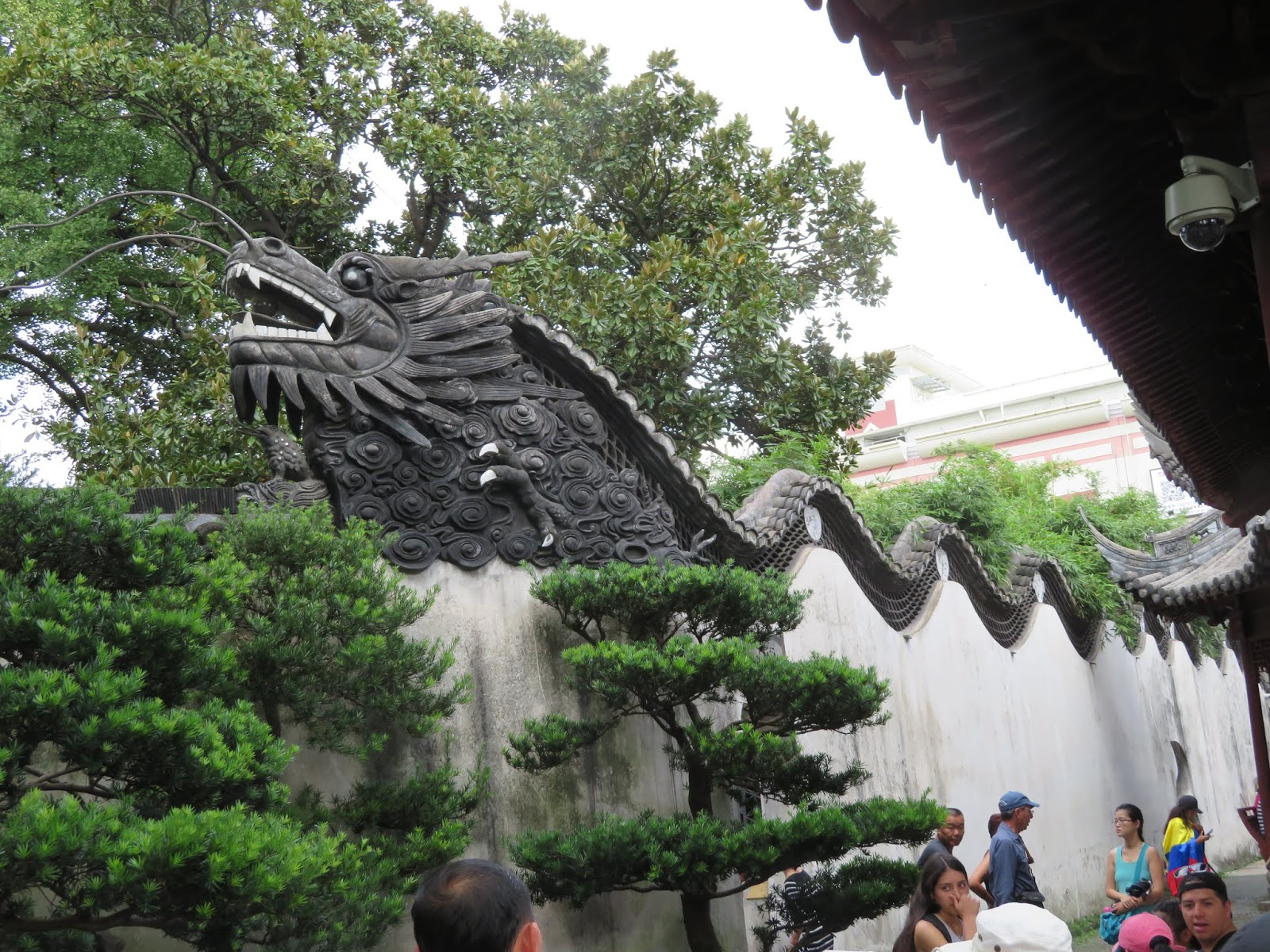
From breakfast we boarded thee buses to drive to the Huangpu River that divides old and modern Shanghai. Our guide, “Patrick” pointed out many of the buildings in both areas and their importance or history. Our group especially enjoyed the beautiful buildings in the Bund area that were built in the late 1800s when Shanghai was an important link between the East and West.  We watched the shipping traffic on the river then drove to the Old Shanghai Quarter where we went to the historic Yu Gardens. This area is only about 2 acres in size and didn’t have a lot of variety of flowers but had many carvings and rockeries. We admired the many carved stone figures, lions and dragons throughout the gardens and on the walls.
Zig zag bridge at Yu Gardens
Although small, the Yu Gardens were beautiful and interesting. We were struck by the zig zag paths, bridges and walkways. We later learned that Chinese traditional belief holds that evil forces are unable to go around sharp turns. Similarly, many of the buildings in the Yu Gardens as well as throughout older areas of China have a high threshold at the doors. This is because they believed the evil spirits could not get over this obstacle.
Rooftop dragon at Yu Gardens
After leaving Yu Gardens we walked around many of the shops in Old Shanghai. We stopped in a couple of tea shops and sampled the selections of tea being sold. Shanghai has a long history in the preparation and marketing of tea. We went to a shop selling silk clothing that is operated by the Chinese government. Silk also has been a major part of the Shanghai economy for centuries. This shop sells only the highest quality silk and is priced very high. Cindy picked up a couple of scarves but we were priced out of most items.
Hand embroidered red panda on silk
On the way to lunch we stopped at shop where hand silk embroidery is done on silk cloth. These beautiful images typically take months for the artist to create. Patrick told us that in the past young women of high social standing would do beautiful embroidery to demonstrate their suitability as a wife.  The silks were priced from $2000 to $10,000 US dollars which makes sense given the time and skill required. We did fine until Mary saw a hand embroidered red panda cub. It was priced at $5000 but the salesman said that we would come down on the price since the frame had a scratch on it. He said that a similar item from the same artist recently sold for nearly 70,000 Yuan which is about $10,000 US dollars. We considered the art but kept moving as she thought about it. When he offered it at $2400 including shipping we decided to make the purchase. We didn’t want it shipped until after October 2 since we will be here in China until then. Also, October 1-8 is a national holiday in China so it will be mid-October before it will ship. The little panda is pretty cute and will be a great addition to our new home.
Mary & Cindy shopping in Old Shanghai
We had a dim sum lunch that had many traditional Chinese foods. We especially liked the dumpling which is a bread or dumpling surrounding a bit of pork, There was rice, noodles, meats, soups and vegetables that were placed on a turntable in the center of our table so we could eat family style. Everyone enjoyed the meal.
After lunch we had some free time in Old Shanghai that we spent walking around and checking out local shops and attractions before taking the bus to the Shanghai Museum. Our guides, Patrick and Sissy, provided us with devices that we could use to tell us more about selected exhibit items in English by pressing buttons on the remote control sized devices. The museum was large with many rooms on each of the four floors. We decided to start in the jade room of the fourth floor where we saw ancient items made of jade that have been dated to be as much as 4000 years old. Ceremonial swords and disks called bi were carved of jade stone at a time when no metal tools were available. From the jade rooms we went to the furniture rooms and saw ornately carved and lacquered chairs, thrones, beds and other items made from exotic Asian, Indian and African woods like sandalwood, rosewood and ebony. There were also items that were finished with the red lacquer that is so unique to Chinese furniture. We realized that we were nearly at the end of the 90 minutes that we had available for the museum.
Steve & Mary on the bus in Shanghai
We caught out bus back to the Four Seasons for a brief rest and to prepare for the evening activity. Since we will be flying to Wuhan on Sunday we did some packing and preparing for the next week. We went to the hotel restaurant for dinner which was a lot of seafood, sushi and many other Chinese and western foods. For desert, I had a bowl of ice cream, a small scoop each of ginger and matcha which is a flavor from tea. Both were very good.
After dinner we went to the room to prepare for the evening activity, a show of Chinese acrobats at the Portman Ritz Carlton. The bus arrived at 7 pm and the show started promptly at the advertised time of 7:30. The acrobats were very talented and put on a great show. I guess we expected the kind of plate juggling stunts that our generation used to see on the Ed Sullivan show but there was a nice variety of comedy, romantic and artistic scenes that concluded promptly at 9 pm as scheduled. We kept nodding off during the show not because it wasn’t good but rather because we are off our sleep schedules.
We finalized our packing and put our bags out to be taken to the airport for our part of the trip that will be on the ship.


Thursday, September 13, 2018

Arriving in China

We departed our home in Georgetown at 9 am for our 1:30 pm departure from Cincinnati airport. As we have done on prior trips from CVG, we used the OneStopParking through the Hilton Hotel near the airport. We arrived at the Hilton in less than an hour and caught the included shuttle to our gate at 10 am. We both made it through security quickly and easily and had our lunch at the gate after walking around the concourse several times. There are nice displays in the concourses from the Cincinnati Museum Center as well as beautiful photos of iconic Cincinnati and Northern Kentucky attractions. We knew that our flight would be long and we wanted to move as much as possible before we had to be confined to an airplane seat.
The connecting flight to Detroit departed and landed on time. We were surprised that the Detroit airport was rather small and appeared to serve only Delta flights. However, while the airport is generally small, the main concourse is extremely long. There is even an overhead train that transports passengers to stops within Concourse A. Since we had a 90 minute layover we walked through the long concourse A as well as much smaller B & C. We were very surprised that there were no displays for tourists on the industrial or music history of the city. We would have thought that a display of vintage cars or photos of early factories would be set up. About the only “Detroit thing” was that in the tunnel between concourses there was Motown music playing.
Our flight from Detroit to Shanghai departed on time for the over 13 hour trip over the North Pole. The aircraft was as comfortable as it could be for a flight of that length. Passengers were a mix of tourists, business people and Chinese nationals returning home. Meals on the flight were good having choices between American or Chinese dishes. The seatback screens offered a good variety of classic and newer movies. I watched Won’t you be my Neighbor?, Chappaquidick, and several others in addition to turning the language option to German to watch classics like Back to the Future
We arrived in Shanghai around 6:30 pm local time which was 6:30 am by our body clocks. Getting through entry to China was interesting. We had completed a through application for our tourist visas then filled out more forms at the airport. Coming through the entry we were photographed again and fingerprinted. Since this is for all non-Chinese citizens, it took a while to get through. One Asian woman ahead of Mary in line took forever to get an electronic scan of her fingerprints. We picked up our bags and quickly found the Viking representatives who took us to the bus carrying us from the airport across the city to our hotels. A quick stop in the bathrooms provided our first surprise in China. Although there were some western style toilets, most of the bathroom stalls were porcelain holes in the floor. There were symbols on the doors of the stalls identifying which kind of facility was in that stall. We made a note for future reference to look for the US toilets if possible in going to the bathrooms.
We were surprised to learn that Shanghai is the world’s second largest city with over 25 million residents. Another 10 million commute in from the surrounding area each day. With a total of 10 million residents, New York City is dwarfed by Shanghai.  As we drove in our guides pointed out local landmarks and attractions. We are anxious to see more of the city.
Our hotel, the Four Seasons, is a beautiful luxury downtown hotel. Our room on the 22nd floor is very nice, and the Whittingtons are just up on the 24th floor. Our guides told us to only drink bottled water in China using tap water only for washing. We meet our guide, Patrick, at 8 am on Friday for a tour of the city including the famous gardens. We are sorry that we will be unable to meet up with my former student, Keri, and her family while we are here but the schedule is just packed full.


Thursday, May 17, 2018

Castle and Key Distillery


The Old Taylor Distillery near Frankfort, Kentucky has long interested us because of the appearance of the limestone structures that resemble a European castle.  Built by the flamboyant Col. E. H. Taylor in the late 1890s after a trip to Europe where he was taken with the beauty of the medieval castles. 
Aristocratically born and descended from two U. S. presidents (James Madison and Zachery Taylor), Col. Taylor had expensive tastes and was accustomed to getting what he wanted.  His title of Colonel was not from service in the military but, like Colonel Sanders, was because he was a Kentucky Colonel.  Taylor came to distilling because of his role as a banker in funding several distilleries.  He was very innovative in his introduction of copper fermentation vats, column stills and the use of steam heat in rickhouses.  Perhaps his greatest contribution to the bourbon industry was his influence in establishing the Bottled in Bond Act of 1897.  This provision assured purity of bourbon at a time when getting unadulterated spirits was nearly impossible.  The Bottled in Bond Act required bourbon sold with the designation “Bottled-in-Bond” to be 100 proof, be distilled in one six month season, stored in government inspected warehouses for a minimum of four years.  Bottled in Bond bourbon labels included the location of distillation and bottling in the U. S.  Probably not coincidentally, many of the provisions of the Bottled in Bond Act favored Col. Taylor’s bourbon operations.
Castle and Key bourbon in storage
After launching Old Fire Copper (OFC) Distillery (now called Buffalo Trace Distillery) in Frankfort, Taylor wanted to build a distillery that was a destination center.  While most distilleries at the end of the 1800s were intended to produce whiskey quickly, Col. Taylor wanted to make his distillery as well as the bourbon to be an attraction.  He set to have the grounds of the distillery beautifully landscaped and prepared for visitors.  His political influence brought a rail line to run by his distillery along with many visitors.  He also had the world’s longest masonry rickhouse.  This steam heated storage facility could age an unbelievable quantity of bourbon barrels to maturity.  The distillery was in operation from 1897 through 1972 when it closed and was abandoned.  The facility began a decline that appeared to lead to demolition over the 40+ years that the facility sat empty. 
Restored gardens at Castle and Key
Since the former Old Taylor Distillery is just a stone’s throw from the Woodford Reserve Distillery along Glenn’s Creek near Millville, Kentucky, we have driven past the abandoned structure many times.  We have admired the beauty of the limestone castle and wished that we could walk through it.  A couple of years ago it appeared that our wish would some day be granted when we saw renovations taking place.  Although the temptation to trespass to see the progress of the restoration was very tempting, we settled for taking photos from the road.  When we read that a group was planning to return the Old Taylor site to the former glory of 100 years ago, we were overjoyed.  We learned that a talented young master distiller was recruited who has big plans to make great spirits in an inspiring location.  The name, Castle and Key, was chosen because of the castle appearance of the main distillery building and the keyhole shaped spring from which the water for the bourbon is drawn. 
Keyhole shaped spring
My pal, Greg, is just as taken with the idea of touring Castle and Key as I am so we had to go visit.  Advance tickets for tours were sold on a very limited basis and tours of the distillery are to end in late May 2018 so renovation and restoration can continue on pace.  We were happy to be able to get into the facility before many changes are made. 
We left Huntington around 9 am and drive to Central Kentucky stopping at Rural King to pick up a few items.  I needed additional diesel tanks for the tractor fuel and Greg wanted to look at the bargains on blue jeans. We stopped by the Georgetown house to drop off some things and to let Greg drive the tractor around some.  We left shortly for the drive to Castle and Key arriving about 30 minutes early for our 2:30 pm tour.  We started in the original yeast room that was done in white tile that would have been easy to clean for maintaining the yeast cultures.  
Steel fermentation vats
We went to the fermentation room and was shocked to learn how many large fermentation tuns were in the room.  I didn’t fully understand why the steel tanks with a thin coating of oxidation didn’t cause problems with the fermentation.  I know that iron is the enemy of bourbon which is why the barrels have no nails so I want to learn more about the steel vats.  Our guide told us that the distillery is currently making spirits for other distillers until production gets in full swing on Castle and Key products. 
Stainless steel column still for making vodka and gin
We saw where the giant old column still once stood which was removed to make way for a smaller Vendome copper bourbon column still that is more efficient on the scale that is expected at Castle and Key.  There also a small stainless steel column still for making vodka and gin.  This still has a chamber that can be packed with botanicals.  The gin can pass through the chamber as a vapor to pick up flavors to give the gin the characteristic flavors. 
Formal gardens for event venues
We walked through the beautiful gardens that will once again host weddings, corporate gatherings and other events.  There is also a garden where herbs are grown to be used in the making of gin and flavored vodkas.  These gardens were so overgrown that the restoration crew didn't even know that there was a concrete pond at the center.  The over half century of neglect had nearly destroyed all of the structures that were once so elegant.  We continued to the huge brick rickhouse where the barrels of bourbon are stored.  They also store many barrels for other distillers to help make ends meet until the Castle and Key bourbon is ready to sell in about four years.  It was interesting to learn that the income from storing other distillers’ barrels ($2 per barrel per month) keeps the company in the black even before any bourbon is sold.  
Large brick rickhouse
Because time had done so much damage to the rickhouses, a lot of work had to be done to make it functional as a place to store bourbon for many years.  Although we were unable to enter it, we saw another large concrete rickhouse that had been gutted and all of the metal barrel racks had been sold for scrap.  New racks are being constructed for the facility that will return as a rickhouse once completed. 
We completed our tour in the bar area adjacent to the gift shop.  Our guide served mixed drinks to us made from Castle and Key gin and vodka since it will be several years before there is bourbon.  Although neither Greg nor I are fans of vodka and gin, we enjoyed the drinks.  We took a few photos on the way out and started the drive back to Huntington.  We stopped at Mount Sterling so Greg could get his Krystal Burger then we drove on to Owingsville near Morehead where we stopped at good local Mexican restaurant for dinner. 
Barrel ramp
We had a great day at Castle and Key.  Getting to spend a day with Greg was fun enough but getting to see the Old Taylor Distillery being brought back to life was a thrill.  We hope to come back for future tours as the renovations progress. 


Thursday, May 3, 2018

Maker's Mark Ambassador Barrel

Special ambassador label
When we visited the Maker's Mark Distillery in May 2011 Emily and I decided to become Ambassadors. This gets us on the mailing list including a nice gift each year at Christmas for our Maker's Mark bottles. It also gets our names placed on a newly distilled barrel of Maker's Mark with an invitation to come to the distillery in a few years once the bourbon is sufficiently aged. 
Bill Samuels Jr.
This spring I happily received my "golden ticket" to come to Loretto, Kentucky to take a special heritage tour and to purchase and wax seal bottles from our barrel. After checking calendars and plans I invited my good friend, Rex Dillinger, to be my guest for the day at the distillery.
Ambassador seal in wax
We spent the night at our home in Georgetown before rising early to get some breakfast followed by a stop at Frank's Donuts.  We drove through the beautiful Kentucky countryside on a nice spring day toward Maker's Mark.  We were at the distillery in plenty of time for our 10 am tour and visited with several other guests who were also ambassadors whose barrels were being opened at about the same time as mine. 
What we didn't know is that our tour leader would be Bill Samuels, Jr., CEO of Maker's Mark and son of the founders of the brand.  We found Bill to be a great host with interesting stories of how is parents built the distillery following the repeal of prohibition including throwing out the recipe for the family's T. W. Samuels bourbon and starting over with a new recipe for a wheated bourbon.  Even the unique bottle and logo designs came from Bill's mother who had a vision for what Maker's Mark could become.  
Steve with Bill Samuels, Jr.
We were fascinated to learn that some of Samuels' ancestors were part of the gang that traveled with the James brothers.  In addition, some of his ancestors were part of the renegade guerrilla army led by William Quantrill during and after the American Civil War.  Bill told us that when Quantrill's men finally surrendered they chose to hand over their weapons in his family's living room.  He still has a pistol from the surrender which may have been the last weapon confiscated after the Civil War.  We were also interested in the cast of characters that frequented his home when he was a child.  Julian (Pappy) Van Winkle and Col. Harland Sanders were frequent guests and his godfather was Jim Beam.  
Barrels of Maker's Mark 46 receiving secondary aging

Bill took us through the fermentation vats and to the giant stills producing Maker's Mark.  In the bottling room his told us about how his parents struggled to get a wax for sealing the bottles that was just right.  As with other tours of Maker's Mark or any other distillery, the last stop is usually the tasting room.  The difference this time is that Bill shared how he oversaw the development of Maker's 46 which is secondarily aged with staves of French oak.  We also heard how he likes to drink his bourbon.  While all bourbon must be sold at least 80 proof, Bill says that he thinks that the flavors are best at around 70 proof so he adds a little water or ice.  He told us that high alcohol content will anesthetize the taste buds and prevent getting the full flavor profile of good bourbon.  
We enjoyed the generous samples of Maker's, Maker's 46 and cask strength versions of each as we listened to Bill's captivating stories of a lifetime in the bourbon industry.  
Steve dipping the top of an ambassador bottle in wax.
After our tastings, Rex and I picked up the bourbon from my barrel and dipped them in the characteristic red wax with assistance from the staff at the visitor center.  Because the bottles came from a special ambassador barrel, we were able to stamp the top of the wax with a special seal.  I picked up enough of the bottles for everyone back home including 4 for Cindy to take back to Oregon.  

Saturday, April 21, 2018

Terracotta Army Invades Cincinnati

My birthday gift this year was a visit to the Cincinnati Art Museum with the entire family.  The special reason for the visit here was an exhibit on China's terracotta army.  The exhibit included over 120 period artworks as well as 10 of the life sized terracotta warriors.  
 We had seen a similar exhibit at the Children's Museum of Indianapolis in September 2014.  Since this was in Cincinnati we had to go, especially since we will be at the site in China later this year. 
We are fascinated with the find of clay warriors, horses and chariots that were found in a farmer's field in the mid 1970s where they were hidden since they were made around 210 BC.  It is believed that there are over 8,000 soldiers and many hundreds of horses buried in the pits in China's Lintong District.  We loved looking at the differences in the features and faces of each warrior that are said to be unique from one to another and may have even resembled the appearance of one of the craftsman making the figure.  It is believed that nearly three quarters of a million people worked on making the soldiers, horses and chariots.  When the figures were placed in the pits it is believed that they were painted with bright colors that were typical of a human army of the time.  However, in the 2000 years of burial most of the paint has washed away from the figures.
All of this were done to honor the first emperor of China, Qin Shi Huang who founded the Qin Dynasty (pronounced "Chin") in 201 BC.  He ascended to the throne at the age of 13 and saw the size of his Chinese state expand greatly under his reign.  He ordered the fragments of wall structures found throughout much of China to be unified into what we now know as the Great Wall of China.  He also oversaw the construction of a network of roads that became a national transportation system. To assure the continued unification of China, he abolished feudalism and arranged the country into administrative units. He standardized units of measurements for the nation to assist trade and commerce within the country. Shortly after becoming emperor, he ordered the construction of a giant mausoleum that included the terracotta army.   There is speculation whether the 700,000 workers who built the tomb and warriors were paid workers or slaves but there is some agreement that everyone who worked on the tomb or knew where is is located was killed to preserve the secret.
We had a great day at the museum.  After walking through the terracotta army exhibit, we were entertained by Peter in the children's play area of the museum.  I can't think of a better birthday than to spend the day with my family and to visit an exhibit on the fascinating aspect of ancient Chinese history.
We stopped by Jungle Jim's on the way home to get a bag of our favorite tea then on to Georgetown to drop off Ian and Emily.