 |
| First petroglyph panel - Nine Mile Canyon |
We left the Airbnb around 8 AM to go by the Wellington, Utah, post office to mail postcards. We stopped at Miller's gas station (formerly Walker’s) at the intersection of Nine Mile Canyon Road and US 6 to look for new post cards. Millers didn’t have much choice in postcards, so we picked up one of the guides to Nine Mile Canyon and continued on. We had a small booklet on Carbon County and a link to download an app that provided an audio track that used the phone’s GPS location to provide information on specific rock art, dwelling ruins or a granary. We found the app to be very helpful, giving us good information on finding some of the evidence of the ancient Fremont culture living the area hundreds of years ago. We also used a pamphlet that Emily and Ian had picked up a few years ago when visiting the area.
 |
| Nine Mile Canyon |
When the girls were small, we visited Nine Mile Canyon almost every summer. Of course, the weather was always sweltering hot while we were there, but we looked forward to it regardless. Back then we would put the kids in the back of a pickup with binoculars to spot sites along the smooth rock of the cliff faces. The road was gravel back then, and we traveled slowly allowing us to see most of the things along the way. At that time we used some old printed material from Boy Scout projects or student research at the College of Eastern Utah as guides to the rock art. Now the road is paved the entire way, and there are many print and electronic resources to help find pictographs, petrographs, dwellings and granaries.
 |
| Ruins of a Fremont dwelling - Nine Mile Canyon |
It is believed that the Fremont culture occupied Nine Mile Canyon starting around 300 AD. While they lived about the same time as the Anasazi culture to the south, there is little evidence of interaction between the two. The Fremont built stacked stone semi-subterranean dwellings with vegetation for the roof on benches above the floodplain. They were not only hunter/gathers but also farmed ancestral corn, beans and squash. The stone and mud granaries in cracks of the cliffs may have been used to store grain although some believe that the crops left in these caches were offerings to their deities. It is not certain whether the rock art was an actual depiction of people and animals of the area or whether the forms communicated other meanings. For example, the antlers on a pictograph elk may have communicated the direction and distance to a water source or other important location.
 |
| Coyote spreading the stars - Nine Mile Canyon |
After driving about 25 miles out the now paved canyon road, we stopped at the first petroglyph site. These panels have a number of human and animal figures, so we took a lot of snapshots before driving on. We were pleased to spot the petroglyph of Coyote, an important figure in the mythology of the Southwest’s native people. In nearly all cultures, Coyote is a trickster who is not to be trusted and can even bring evil. This petroglyph depicts Coyote placing the stars. According to Hopi legend, Old Spider Woman gives Coyote a sack filled with stars that he was a place in the sky. After climbing to the top of the tallest mountain, he begins placing the stars nearly in the heavens creating the constellations. However, Coyote soon grows weary of placing the stars in the sky and throws most of the stars in the sky explaining why most stars are not neatly arranged.
While stopped along the road looking for a granary, Cindy talked to a girl from Custer Co., ID, who was in the area assisting with the building a Jehovah’s Witnesses church. She was very pleasant and was also enjoying the day in Nine Mile Canyon.
 |
| Pregnant buffalo - Nine Mile Canyon |
We hiked out to the pregnant buffalo site that appears to show an adult female bison with a smaller bison inside. Like many of the panels in Nine Mile Canyon and other places in the area, there was evidence of activity after the original rock art from nearly 2000 years ago. Ranchers and cowboys in the mid to late 1800s also marked the rocks. In many places more recent additions from the Utes join the ancient Fremont work. After looking at the panels for a time, the newer additions are discernable since the animals appear to be more realistic. In addition, horses and people with bow and arrow are found in the additions made after 1500 AD. Sadly, a good deal of vandalism exists from the 20th century and beyond. Guides to the area implore visitors to not touch the panels, but some vandalism still occurs.
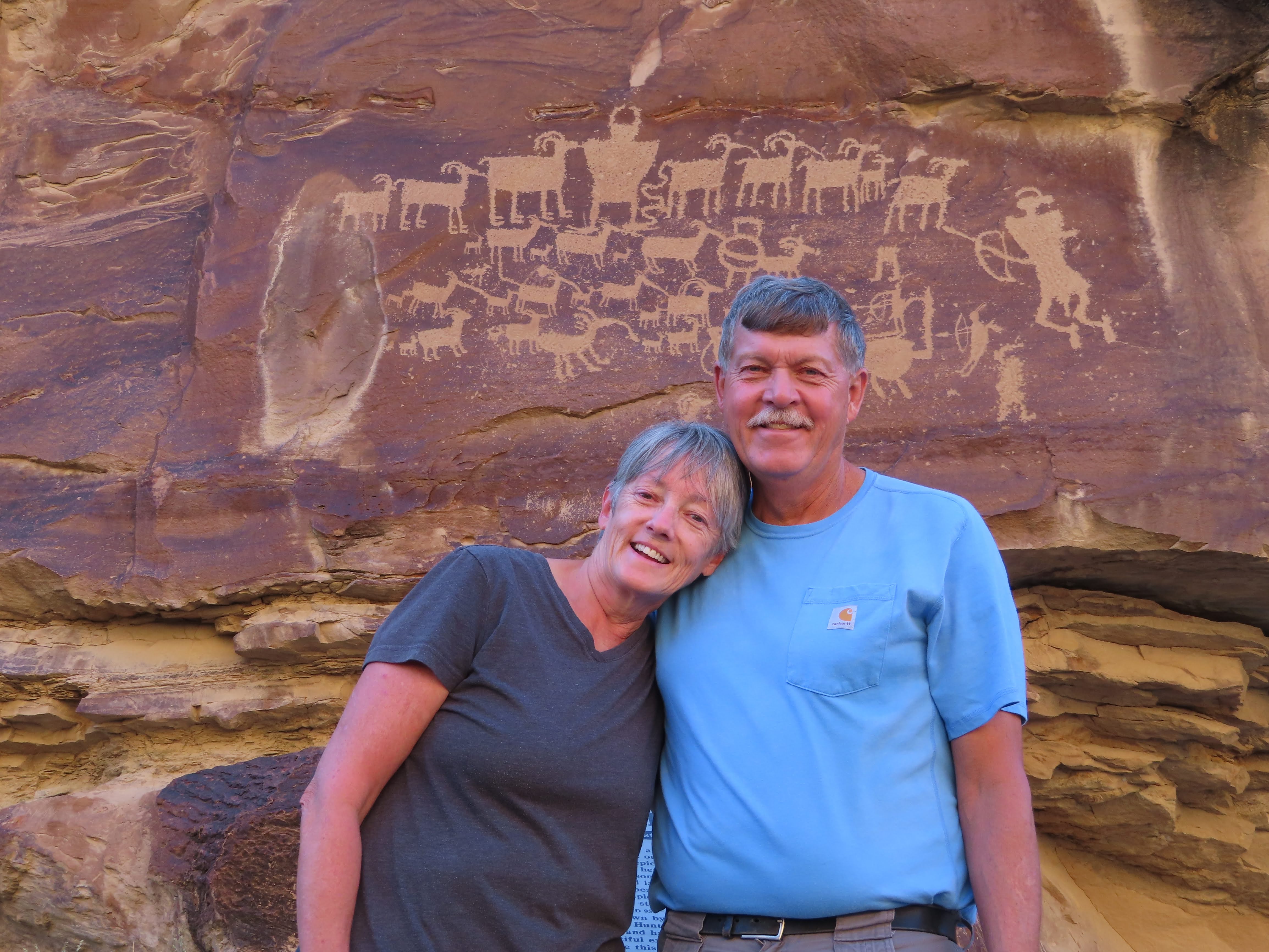 |
| Mark and Cindy at the Great Hunt Panel |
Our last stop in Nine Mile Canyon is the most popular panel, the Great Hunt Panel. Photographs of this panel have been printed in many publications including National Geographic. Some archeologists believe that the panel was started as early as 8,000 BC. It has been modified many times since including, more recently, by Utes in the area. This panel includes at least 30 bighorn sheep and 8 human-like figures.
To our surprise, we saw very little wildlife today and only one deer while we were in the canyon.
We got back to Price around 6:30 and stopped at Walmart for bagged southwest salad and General Tso’s chicken from the deli counter. We enjoyed the meal in the kitchen of the Airbnb in Price.
After dinner, we watched another episode of Dark Winds, season 2 before turning in.


