Showing posts with label Owensboro. Show all posts

Wednesday, September 23, 2026

Green River Distillery

Because we were not accustomed to Central Time, we were up early at the Owensboro Super 8. We showered and did our morning language lessons before I went downstairs to get cups of tea and hot water for us. The breakfast area opened at 6 am so we made our way down for biscuits, eggs and fruit. Most of the people staying at the motel were construction workers who came to the breakfast area to grab something to eat then take off to the job site.

Smother's Park in Owensboro, Kentucky

We left the motel around 8:30 am and drove to Smother’s Park along the Owensboro riverfront. The “Mayor’s Mile” is a stretch of riverfront that has been developed for tourism. Along the walking path there are plentiful benches, small amphitheaters, statues, veteran’s memorials and a tremendous playground. There were a number of work boats on the Ohio River as we walked by the conference center and several hotels and performance centers. The morning was cool in the upper 50s but there seemed to be less wind so the walk along Owensboro’s riverfront didn’t seem as cold. However, after temperatures in the 90s just a few days ago, the day seemed cold to us.


The drive to the Green River Distillery was less than 10 minutes for our 9 am tour. We were the only ones on the tour and met our guide, Nathaniel Thomas when we arrived. Nathaniel is a retired musician from Louisville who has a lot of knowledge of bourbon and the history of Green River Distillery. This distillery opened in 1885 as Medley Distillery, the 10th licensed distillery in the state giving it a DSP of KY-10. Today, DSP numbers for new distilleries are over 20,000. There was no production this week, but Nathaniel took us through where the grain is delivered, tested and stored. Like many area distilleries, the corn and wheat are locally sourced, but the rye and barley are from the Pacific Northwest.

Stills at Green River Distillery

Unlike some distilleries using cypress tubs, the fermentation vats at Green River are stainless steel, making them easier to clean. Distillation takes place in a three-story tall stainless steel Vendome column still that leads to a copper doubler. We were surprised at the scale of Green River Distillery's production.  In 2024, the output of spirits was nearly equal to that of Four Roses Distillery.  Spent stillage grains are given to local farmers at no cost. There are some aging rickhouses on the site of the distillery but much of the bourbon is aged off-site in palletized buildings.

Once back at the visitor center, we enjoyed a tasting of Green River’s spirits with Nathaniel. We had the standard Green River Bourbon (90 proof), Wheated Bourbon (90 proof), Rye Whiskey (95 proof), Barrel Proof Bourbon (117.3 proof) and Barrel Proof Wheated Bourbon (109.3 proof). Of these, we liked the Barrel Proof Wheated Bourbon best. We didn’t buy any bottles from the gift shop since our local Kroger carries a full line of Green River spirits and frequently runs a sale on them. Before we left, Nathaniel recommended Barrel Head Liquor Market as a good place to buy liquor and wine. Barrel Head also has a tasting bar with shots at $1 each. Since the store was on our way home, we decided to stop to see if they might have some John J. Bowman that our friend Steve Minor enjoys.


When we arrived at Barrel Heads, they had a very large selection of wine and spirits at good prices but no Bowman. However, Mary was able to find some dry Reisling wine at reasonable prices, so we picked up three bottles to try. We topped off the gas at the station adjacent to Barrel Heads because gas was about $.40 lower than we had when we left home.

We decided to take US Rt. 60 for much of the drive back east toward home. The drive was relaxing without much traffic. We stopped for lunch at a McDonalds around Hardinsburg, Kentucky, just west of Ft. Knox. We picked up Interstate 64 east of Louisville and arrived home before 5 pm.


Tuesday, September 22, 2026

Western Kentucky Botanical Garden and Bluegrass Music Hall of Fame and Museum

We left home at 7 am for the three-hour drive to Owensboro, Kentucky. We had packed a lunch of cheese, hummus, crackers, pretzels and fresh fruit. Driving on Rt. 60 then on to the Western Kentucky Parkway was easy and there was little traffic. We really enjoyed the time that we spent in Owensboro in 2021. This time, we wanted to visit the Western Kentucky Botanical Garden as part of the Kentucky Garden Trail. Of course, we also wanted to revisit the National Bluegrass Music Hall of Fame and Museum and the Green River Distillery.

Mary at Western Kentucky Botanical Garden

The weather last week was in the mid-90s and the humidity was very high. Today we had a dramatic cool down with temperatures in the 50s and low 60s. There was a light mist as we drove west and crossed into the Central Time Zone. At a Walmart in Owensboro, we bought some warmer clothes. Mary picked up a knit cap, and I got a long-sleeved T-shirt since we would be outside for a few hours at the Western Kentucky Botanical Garden.


The volunteer at the garden took our $5 senior entrance fees and gave us a map of the property. Mary got stamps for us in the passports for the Kentucky Garden Trail. We did a quick walk through the 1880 home now serving at the headquarters of the garden. The house was very well restored and preserved. On the second floor of the house there were several bedrooms, each with an ensuite bathroom. The kitchen was busy preparing for a private lunch on the grounds.


Walking around the grounds we were impressed with the variety of annuals and perennials with sculptures scattered among the plantings. Most plants were clearly labeled and planted in areas with specific themes such as medicinal plants, pollinator gardens, hostas and daylilies. A large event venue was being built that will be able to accommodate weddings, corporate workshops and large parties. There was a large stainless-steel sculpture of a basket with a butterfly on the handle. Visitors can turn a crank to make the butterfly’s wings move and the caterpillar bob.


The greenhouse had an assortment of orchids and tropical succulents with an attached meeting room and restrooms. A paved path around the gardens was calibrated to a quarter mile for visitors wishing to do exercise walking. The volunteers were starting to place Halloween decorations through the garden displays as well as preparing the gardens for the coming autumn weather.

We sat in the parking lot to have the lunch that we packed before leaving this morning. Since it was only noon, we decided to spend the afternoon at the National Bluegrass Music Hall of Fame and Museum. Parking throughout Owensboro was free although limited to two hours in some areas. We were able to park beside the museum although we saw some spaces right in front of the entrance. We recalled how much we enjoyed the small facility in 2021 and were anxious to revisit the displays.


The volunteer at the entrance charged us the senior rate of $12 each and gave us a map of the displays and a narration device on a lanyard for the self-guided tour. We started in the room for musicians where some high-end guitars, banjos, mandolins and Dobros were hanging for visitors to play. The first exhibit was for the most recent inductees in the Bluegrass Music Hall of Fame. These were Arnold Shultz, a roots musician from the 1920s and 30s, The Bluegrass Cardinals, a pioneering bluegrass group in the 1970s and 80s. and Hot Rize, a bluegrass group in the 80s, 90s and 2000s. We had seen Hot Rize and their alter ego, western band, Red Knuckles and the Trailblazers several times at Mountain Stage in the 1980s and 90s. We have since seen frontman, West Virginian, Tim O’Brien, several time since.


We followed the displays through the origins of bluegrass music where we learned more about Bill Monroe and saw his Uncle Pendleton Vandiver’s fiddle. There were numerous video screens with interviews of musicians, promoters, industry executives, historians and others throughout the exhibits. A large room had photos of bluegrass festivals beginning in the late 1960s and peaking in the 1970s. These multiday events had many of the musicians and bands that are now included in the Hall of Fame. People like Doc and Merle Watson, Del McCoury, the Osbourne Brothers, the Stanley Brothers, Tony Rice, Ricky Skaggs and so many others were featured in the displays. There was a section on the popularity of bluegrass music outside of the US including albums by a very popular Japanese bluegrass band.

The last set of displays on the ground floor was dedicated to the influence of the Cincinnati-Dayton area on bluegrass music. In the period from the 1930s to the 1960s, many rural Appalachian families from West Virginia and Kentucky came to southern Ohio for better paying jobs. These mountain people brought the music from their backgrounds to the Ohio cities where they found clubs and radio stations ready to play their music and promoters anxious to put out records and organize tours.

On the second floor of the museum there were brass plaques for each inductee into the Bluegrass Music Hall of Fame. The plaques ran from the initial inductees Bill Monroe, Lester Flatt and Earl Scruggs to the aforementioned 2025 inductees. There was a room housing a temporary exhibit to the late John Hartford. A video interview with Hartford showed his love of riverboats and how he came to learn how to pilot a vessel on the Mississippi River. The final exhibit was a video station where visitors could click on a current or past inductee to watch video interviews and learn more about the life and career of each inductee.

Before we knew it, we had spent four hours in the museum, so we drove to the Super 8 motel across town. The motel was good when we stayed here in 2021 and the rate for our stay was under $100 so it seemed an easy decision to return here. Checking in was fast and we passed by the free Dunkin Donuts at the front desk to walk up to our second-floor room. The motel was recently remodeled, and our room was quite comfortable. There were plenty of AC and USB outlets in the lamps and alarm clock. The flooring was new LVT and the bathroom had a new shower with plenty of hot water. The room was very quiet and was plenty dark for sleeping once the window shade was closed.


We relaxed in the room for about an hour then drove to Moonlite Bar-B-Q, a very popular Owensboro restaurant specializing in signature mutton barbecue. Another specialty in the area is burgoo, a traditional stew that was said to include at least three types of wild game. Today, burgoo can be made with chicken, pork, mutton or other meats as well as mixed vegetables and broth.

When we arrived at Moonlite Bar-B-Q we were seated near the buffet and got a plate of sliced mutton, chopped mutton, beef brisket, pork barbecue and chicken barbecue along with beans (with huge chunks of meat), broccoli casserole, salad, coleslaw and other sides. There were many desserts from which to choose including cherry or blackberry cobbler, pies (chocolate, peanut butter, buttermilk, pecan and lemon) and ice cream.


The restaurant was busy but not crowded and workers were constantly refilling the buffet. We had plenty of time to enjoy our meal and try items from the bar that looked interesting. On our way out of the restaurant, we saw photos of the many celebrities who had eaten there including Merle Haggard and Bill Clinton.

Back at the restaurant we watched a little television while we digested our dinner. Although the clock said 9 pm, our bodies were still running on Eastern Time so we turned in and slept well through the night.


Tuesday, November 9, 2021

International Bluegrass Hall of Fame and Museum

World's largest sassafras tree
The bed at the Super 8 was very comfortable and appeared to be new. After 9 pm the second floor room was quiet, so we slept well. We walked down to the motel’s breakfast area where scrambled eggs, sausage links, fresh fruits, cereals, toast and the ever present Dunkin Donuts were available. 

After checking out and assuring that there was no charge, we drove north on Frederica Street to what is reported to be the world’s largest sassafras tree in the yard of an insurance agency next to the Owensboro Public Library. The sassafras trees were quite impressive and believed to be over 100 feet tall and 250-300 years old. 
Fountains in Smothers Park

We then drove to the river where we parked at Owensboro’s Smothers Park along the Ohio River. This was one of the nicer riverfront parks that we have visited. It reminded us of the river walks in Pittsburgh and other revitalized cities. There were a good many locals walking on the wide concrete path overlooking the river. A geotrail has several easy geocaches for visitors to find. Three fountains sprayed water in orchestrated patterns to the music. There were nice public bathrooms and a fantastic playground. We spent a lot of time walking on the paths that were being decorated for Christmas and through the playground. An older lady approached me because I was wearing a Marshall University sweatshirt. She said that she was inspired by the We Are Marshall movie and had a lot of respect for the football program. She told us that she once made a detour on a family trip to stop by the Marshall campus. While leaning over a railing, a pair of sunglasses got dropped into an empty water feature, so I jumped the fence and retrieved them before security could see me.

We made the short drive to the Green River Distillery, formerly the O. Z. Tyler Distillery, early for our 10 am tour and tasting. Our guide, Taylor, welcomed us at the door, and we spent a few minutes in the gift shop until we left on the tour. Taylor was well acquainted with the history and process at Green River Distilling despite having worked there less than a year. She took us through receiving and milling the grain to where the mash is blended and cooked then to the stainless fermentation vats. 
Unlike cypress mash tuns that we have seen at some other distilleries, these are sealed containers to precisely control the temperature and environment of the fermentation. In addition, Taylor told us that the stainless vats can be completely steam cleaned permitting the fermentation of different mashbills in the vats from one batch to another. The large Vendome column still produces the low proof distillate that is then sent to a doubler where the high proof “new make” whiskey is prepared for entry into the char 4 barrels. 

We learned that Green River Distillery is the tenth distillery to be licenced in Kentucky (KSP-10) and is now the fourth largest producer of bourbon in the state. Green River Distillery began operation in 1885 and produced award winning whiskey. A fire at the distillery in 1918 caused the distillery to shut down before prohibition. The distillery was rebuilt in 1936 and the property changed hands many times since. In 2014 the distillery reopened as the O. Z. Tyler Distillery and in 2020 the distillery regained the Green River Distillery name. 

We have had the O. Z. Tyler Bourbon and liked it and were disappointed that it is no longer being made. However, we were familiarized with the other excellent bourbons being produced. At the tasting we sampled Kentucky 10 Bourbon, made with wheat as the secondary grain, and Yellow Banks, named for the frontier name of Owensboro, with rye as the secondary grain. We also saw several bourbons that are made at Green River including Bradshaw (for Terry Bradshaw), Duke (for John Wayne’s estate), Quarter Horse and others. We also tasted Ladder 9, a cinnamon flavored bourbon. We expected it to be like Fireball but were pleased that the cinnamon was very subtle in the finish of the bourbon. We were very impressed with the quality of the spirits made at Green River and purchased a bottle of Yellow Banks for us and a bottle of Ladder 9 for one of Mary’s former co-workers.

Moonlite Bar-B-Q
After leaving the distillery, we drove to Moonlight Bar-B-Q for more Western Kentucky mutton barbecue. After looking at the buffet, we decided on that option since we could try many of the menu choices to see what we liked best. Both of us enjoyed the mutton barbecue as well as pulled pork and the buttered corn.

After lunch we drove to the International Bluegrass Hall of Fame and Museum, which is very near the park where we walked this morning. Our senior admission was $10 each down from the regular fee of $12. The first area we entered had 20 or more stringed instruments hanging that visitors were welcome to play. The guitars, mandolins, banjos and violins were all good quality instruments from makers such as Martin and Gibson. From there we walked around the displays documenting milestones in bluegrass music. 

Uncle Pen's fiddle
Large video screens positioned around the museum’s first floor featured interviews with notable bluegrass musicians such as Ricky Skaggs and Del McCoury as well as others like Yale University’s president who is a bluegrass fan. Artifacts such as Earl Scruggs’ banjos and a fiddle belonging to Bill Monroe’s Uncle Pen are displayed.

Earl Scruggs' banjos
From there, we went to the second floor where we stopped at a set of touch screens that accessed interviews with bluegrass musicians and industry officials. 
Disposable earphones for listening to the videos were provided. One room held a display of banjos produced by a notable maker showing various stages in the production of a hand-crafted instrument. The last room we visited held biographical plaques of all inductees into the Bluegrass Hall of Fame. We enjoyed reading these and had seen most of the performers at live shows or on the televised Grand Ole Opry.

Although the museum was not large, the exhibits were well displayed and interesting. There are several events at the museum in most years and we would seriously consider returning if an event interested us.

We left Owensboro around 3:30 pm and arrived back home around 6:30. Traffic around Louisville was bad but the trip was otherwise uneventful. We both agreed that the trip was a great time and we plan to return to Owensboro soon.
 

Monday, November 8, 2021

John J. Audubon State Park

A stretch of warm dry weather in early November we decided to take a couple of days to drive to parts of Western Kentucky that we hadn’t seen. After our normal omelette breakfast, we drove toward Eagle Slough Natural Area, mostly on I-64. This area is near a part of Kentucky that is across the Ohio River into Indiana. This is because the Kentucky state line is defined as the low water mark on the Ohio River as of 1792. The New Madrid Earthquake of 1812 caused changes in the river’s course making an area approximately one mile wide by four miles long on the north side of the river part of Kentucky. An elevated path through the area followed an abandoned railroad bed overlooking wetlands and leading to a small open lake. We were surprised to see bald cypress growing native in this area. We were used to seeing cypress swamps in the Everglades but not in Indiana and Kentucky. The trail has a number of interpretive signs and a few boardwalks in need of repair. We saw one gentleman on a bicycle going out the path to enjoy his morning coffee. We chatted briefly and he recommended Sloughs Wildlife Management Area for a hike. A nice observation deck at the end of the mile-long trail overlooks the small lake. We saw numerous Canada geese and some smaller waterfowl but didn’t spend much time there. We found a few small geocaches along the trail then returned to the car to drive to Sloughs WMA.

Great Blue Heron at Eagle Slough
Because we started our walk around 10 am (Central Time), the air was still a little cool so we were wearing jackets and hats. By the time we returned to the car, it was nearly noon and the air was much warmer so we took off our jackets and hats along with the binoculars and cameras for the short drive to Audubon Wetlands across the river near Henderson Kentucky. As we turned from the Eagle Slough access road onto Rt. 41 south, we heard something bounce off the roof of the car, hit the trunk and land on the road. Because the divided highway was very busy, we had to drive a couple of miles into Kentucky before we could do a U-turn to come back and retrieve the item. It turned out that Mary’s Samsung A51 was on the highway after being run over by many cars and large trucks. There was little remaining of the cell phone to pick up, although we gathered up what we could.

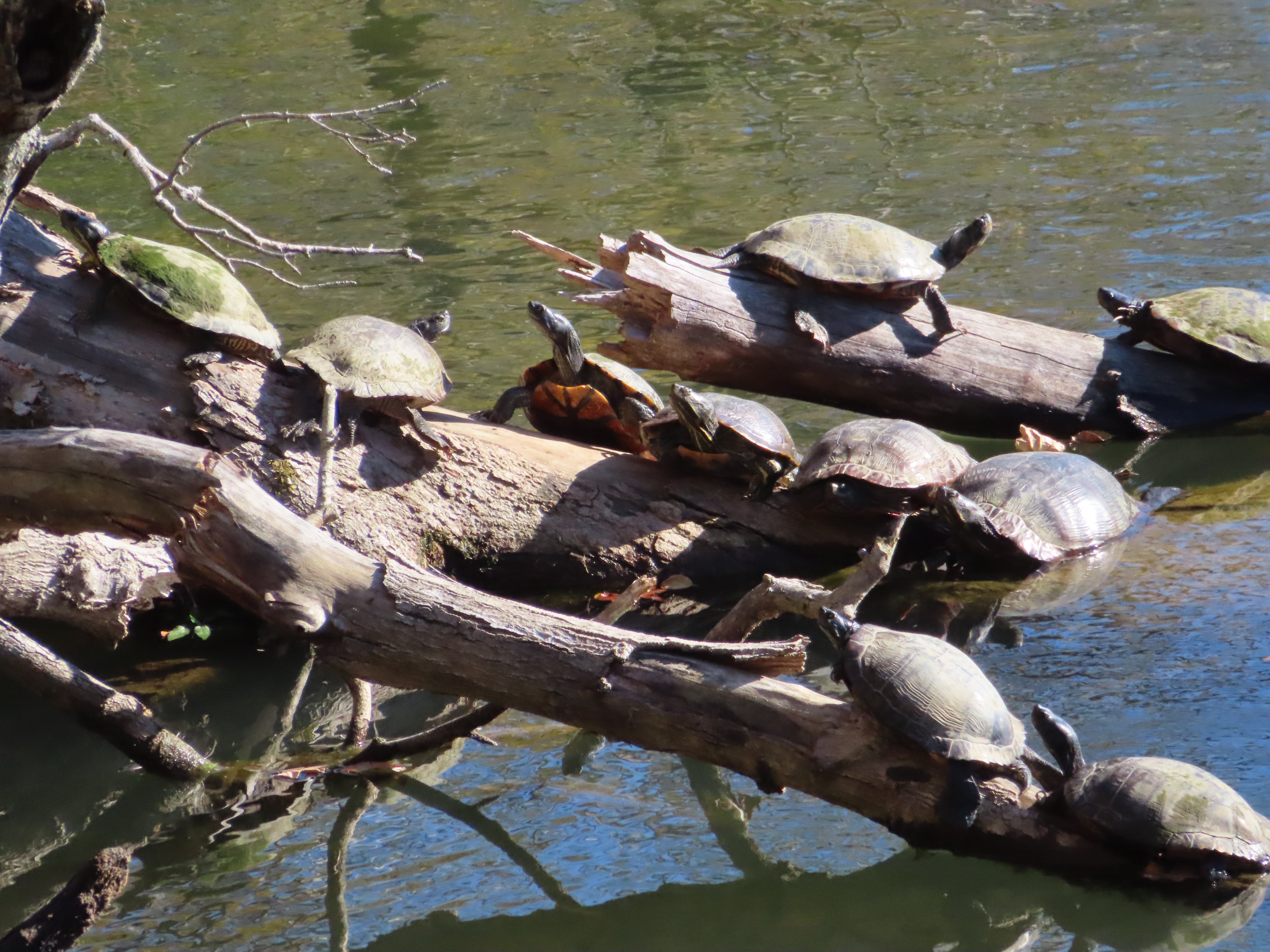
We drove back across the Ohio River to the wetlands. The Island Loop Trail begins with a 750-foot boardwalk across the wetlands, followed a mile long dirt trail through the woodlands.  We saw several Great Blue Herons and turtles from the boardwalk. The forested path was surrounded by lots of pawpaw groves and led by a lake and slough.  We walked the loop then made the short drive to the main part of the John James Audubon State Park.

The main trail at Audubon State Park
Upon arriving at the park, we ate the packed lunch of a turkey sandwich and apple in the parking lot at the park visitor center. Like many of the state parks in the area, buildings here were constructed by the WPA and appeared to be well built and in good repair despite being over 80 years old. It appeared to us that the craftsmanship was better than some of the parks built by CCC camps that we had visited before. We were a bit surprised that the visitor center had almost a Tudor look with an unusually steep roof. 

We learned that the swamps in the area were drained in the 1930s by a Civilian Conservation Corp (CCC) group from West Virginia. The CCC team also built roads and constructed the lakes in the area that is now Audubon State Park. The WPA built the major structures in the park. There are a lot of interconnected trails in the 700 acre Audubon State Park of all levels of rigor. We hiked out Warbler Road and were amazed by the number of pawpaw trees in groves along the trail. We took the Scenic Overlook Trail and the Wilderness Lake Trail, chatting with several other visitors as we walked. On our return to the parking area, we took the short King Benson Trail where we saw a large black rat snake sunning on the path.

Turtles basking at John J. Audubon State Park
While there, we learned that John J. Audubon lived in Henderson, Kentucky from 1810 to 1819 when Henderson was a small town on the Western frontier. Although we didn’t take time to visit the park’s museum, we learned that it houses one of the world’s largest collections of Audubon’s art as well as artifacts from his nine year stay in the area.

We drove further west to Sloughs WMA, but it appeared to be a few small observation towers overlooking wildlife food plots. 

We drove about an hour east to Owensboro, Kentucky, where we would spend the night and the day on Tuesday. Like Georgetown, Owensboro is a fast growing small city in Kentucky. The city has capitalized on their Ohio River frontage, frontier history and proximity to population centers to become a mecca for festivals, hosting about 30 each year. I had been to Owensboro in the mid 1980s while a UK graduate student, but I really didn’t remember anything about the city. Our first stop was to Best Buy and Target to shop for a replacement cell phone for Mary. She decided on a Samsung A52 to replace her damaged A51. Although it was more than she hoped to pay, she was happy with the phone’s features. Once at the motel, we recovered the SIM card and memory chip from the old A51 and put them in the new A52. To her surprise, once she logged in to Google, all of her apps and settings returned to the new phone.

The Super 8 in Owensboro was very nice, having been remodeled recently. The room was spacious and had new flooring, furniture and bathroom fixtures. Because we have points with Wyndham Hotel Group, we were able to stay without charge. The lobby had fresh Dunkin Donuts for free through the day including the seasonal pumpkin spice donuts.

Sliced mutton dinner at Old Hickory Bar-B-Que
Friends have been telling us about how good the mutton barbecue is from Western Kentucky. One of the restaurants in Owensboro getting top reviews was Old Hickory Bar-B-Que. After looking at the menu and consulting the waitress, Mary had smoked turkey, barbecued beans and coleslaw, while I ordered the sliced mutton shoulder barbecue with coleslaw and a cup of burgoo. Burgoo is a traditional stew that was made on the frontier using a variety of wild game with available seasonal vegetables. This burgoo appeared to be made from mutton, beef and pork with a few beans and potatoes. It was quite good and reminded us a bit of chili. Both of us enjoyed our meals greatly and were glad that we came. 

We returned to the Owensboro Super 8 and turned in after a long day of hiking. Since our bodies were on Eastern Time we were happy to go to bed a little early.