|
| Clement, Francis and Mary at a huge hollow baobab tree |
For our game drive in Lower Zambezi National Park, Francis, a National Park ranger, met us at the lodge. The four of us along with Clement, Francis and Alex, got into the truck for a walking safari in the national park. Francis was armed with a .375 high powered rifle for our protection. We also learned that Alex was a National Park ranger prior to becoming a safari guide.
 |
| Cape buffalo skull |
After driving into the park for 30 minutes, we left the truck and walked through the national park. Clement, Alex and Francis pointed out tracks of hippos, elephants, lions, baboons, impalas, water bucks and hyenas. We spotted a small group of zebras and a large herd of Cape buffalos. There are lots of impalas and baboons with a fair number of elephants. We stopped at an especially old baobab tree that was hollow inside. The tree had gained significant damage from elephants.

Clement showed us difference in dry wood termites, fungus eating termites and harvester termites. The many termite mounds found throughout Central Africa are fungus termites that join saliva and soil to make the mound. They bring sections of leaves into the mounds to grow a fungus that is eaten by the termites.
 |
| Elephants crossing the Lower Zambezi River |
After returning to the truck, we had tea while we talked with Clement, Alex and Francis. We took the 30 minute drive back to camp and had about an hour before we were to leave for a shore lunch at a nearby landing. The guides talked with us about the Arab slave traders who came to the area obtaining people to be sold to Europeans. They also talked to us about how the tribes dealt with each other and warfare over land. They told us that when Zambia gained independence from Great Britain in 1964, they made a concerted effort to focus loyalties to the country rather than individual tribes. They also told us how villages were displaced when the dams were built on the Zambezi River. We found several artifacts including an abandoned grinding stone and some pot shards.
During the short boat ride to lunch, we saw three male elephants crossing the Zambezi River which was quite a sight. As we neared the landing, we saw that lunch appeared to be quite elegant. The meal was being prepared by the kitchen staff from Sausage Tree Camp at a scenic spot on the river. They had our table set up with the usual white tablecloth and napkins.
 |
| Shore lunch on the Zambezi River |
During the short boat ride to lunch, we saw three male elephants crossing the Zambezi River which was quite a sight. As we neared the landing, we saw that lunch appeared to be quite elegant. The meal was being prepared by the kitchen staff from Sausage Tree Camp at a scenic spot on the river. They had our table set up with the usual white tablecloth and napkins.
 |
| Mary, Steve, Mark & Cindy at an elegant shore lunch |
The cooks had prepared beef and chicken skewers, a three-bean salad, couscous and a garden salad. Dessert was a lemon tart. As usual, everything was delicious. They had a good selection of wines as well as gin and tonic using local Zambian gin. After lunch and drinks, Clement brought us back to the camp where we had a couple of hours to relax, nap, read and record in the journal. I took a brief nap in the hammock while I listened to Lexington’s oldies country station. We saw an African sand snake just off the boardwalk leading to our tent.
We went to the lodge for high tea at 3 pm then met Clement for our evening game drive. Joining us was Leonard, a young apprentice guide, who was very pleasant and helpful. We drove over some very rough roads to the eastern side of the National Park where we looked for African wild dogs.
 |
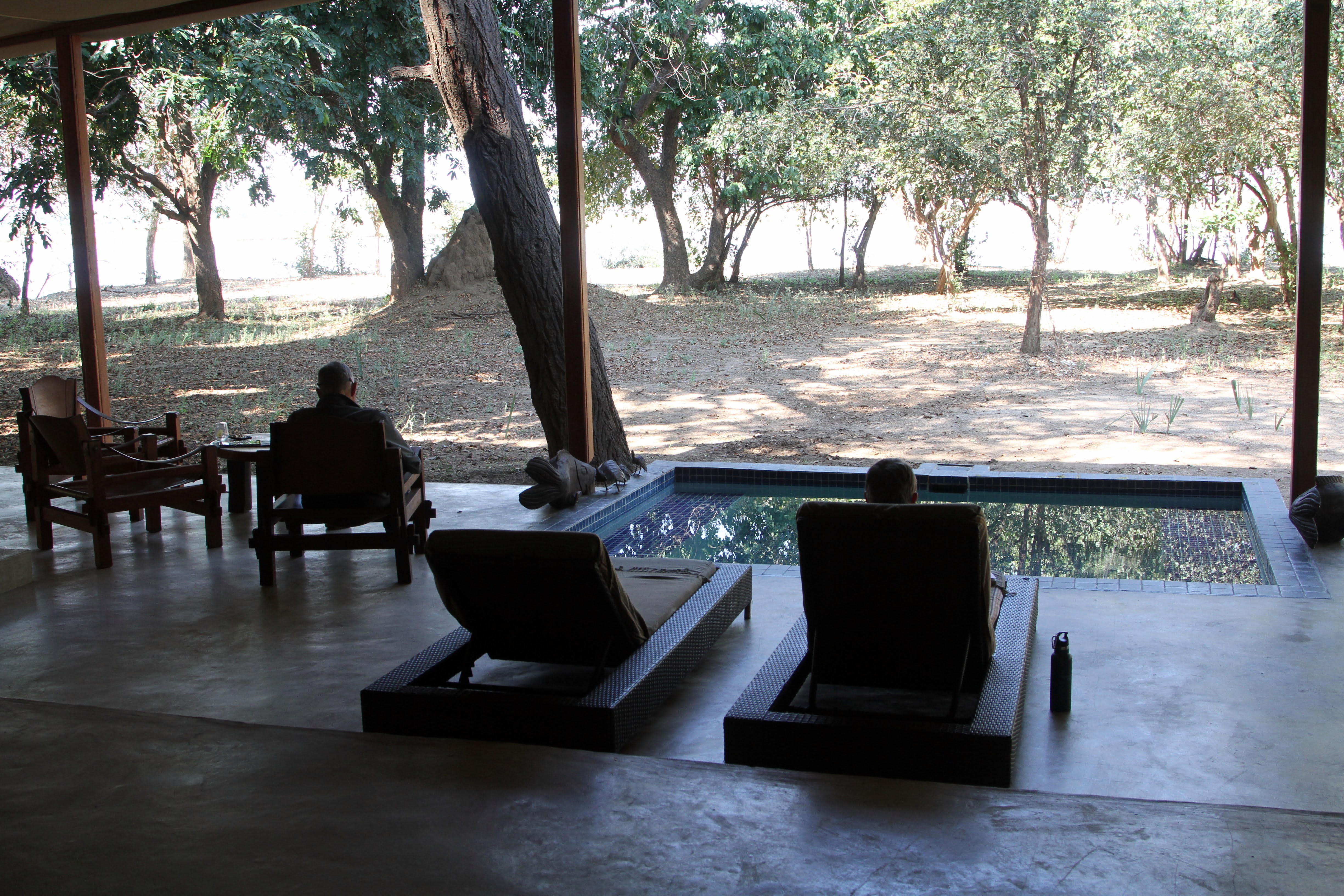
| Mark relaxing at the tent before high tea |
We went to the lodge for high tea at 3 pm then met Clement for our evening game drive. Joining us was Leonard, a young apprentice guide, who was very pleasant and helpful. We drove over some very rough roads to the eastern side of the National Park where we looked for African wild dogs.
 |
| Wild dog pack in Lower Zambezi National Park |
Along the drive we saw many elephants making their way to the mountains. There were impalas, baboons, water bucks and guineafowl. Clement told us that he had heard of a wild dog sighting and suggested that we head that way and not pause to view more common game.
 |
| Wild dogs watching an impala herd |
We bumped over the deeply rutted sandy roads to where 15 adult wild dogs were resting in the shade. It appeared that the dogs were still full from a kill earlier in the day. We had heard that the dogs were the most efficient predators in central Africa killing a very high percentage of game that they pursue. Clement said that the dogs killed their prey in the most brutal fashion. Lions, leopards, cheetahs and other cats kill by biting at the neck resulting in a quick death. However, the African wild dogs bite the abdomen to disembowel the prey. They begin feeding the prey animal while it is still alive.
After watching the dogs lounging in the shade for about 30 minutes, we decided to drive about a kilometer away to have a sundown drink of gin and tonic. Once we got the drinks poured, the dogs started in pursuit of a herd of impala. They didn’t run far but watched the impala. We suspected that they were still full from their earlier meal and didn’t really need to make a kill.

We noticed that one of the dogs had an injury and appeared to be in poor health. The other dogs licked the injured dog’s wounds and urinated on the injured dog. Clement said that the other dogs would care for injured pack mates and bring food following a kill.
When we saw that dogs were unlikely to go after the impala, we started back toward camp. By then it was nearly 7 pm and in midwinter in the southern hemisphere, it was dark. As Clement drove, Leonard used a powerful light to scan for animals. He took care to not shine the light in the eyes of possible prey animals since they might become temporarily blinded and would be easy prey.
As we drove, we passed several groups of elephants sometimes waiting for them to get off the jeep trail so we could pass. We saw a young elephant ahead on the left side of the trail and the mother on the right side. We knew that could be trouble, so we waited until the baby crossed the road and joined the mother. Once the two were reunited we started along the road. The young elephant trumpeted as we passed then in response the mother elephant trumpeted and began to pursue our vehicle. We wasted no time in leaving the area.
As we were nearing camp, we saw that an elephant had placed a large branch over the jeep trail, making it impassable. Mother elephants often break branches from trees, allowing young elephants to browse. We were unable to move the large branch since it would be dangerous to exit the vehicle when the elephants maybe nearby. In addition, there may be lions or other predators in the area.
Clement backed the truck to a point where he could turn it, so we backtracked to take a longer trail back to camp arriving at 7:30.
The couple from Ottawa was at dinner as was a foursome from New York City. They had been to Tongabezi Lodge not far from where we had been in Sindabezi Island Lodge. They were very pleasant and looking forward to their African adventures.
Dinner was a variety of curry. Mine was chicken curry while Mary had chickpea curry. Both meals had rice on the side and mixed vegetables. We all had pinot grigio with the meal. Our valet escorted us back to the room.
When we arrived at the room we saw that the valet had arranged leaves on the floor of the text wishing us safe travels back home. The tub was filled with bubbles and candles were arranged in the sleeping area and bathroom. As we fell asleep we heard the call of an unknown African night bird.
After watching the dogs lounging in the shade for about 30 minutes, we decided to drive about a kilometer away to have a sundown drink of gin and tonic. Once we got the drinks poured, the dogs started in pursuit of a herd of impala. They didn’t run far but watched the impala. We suspected that they were still full from their earlier meal and didn’t really need to make a kill.

We noticed that one of the dogs had an injury and appeared to be in poor health. The other dogs licked the injured dog’s wounds and urinated on the injured dog. Clement said that the other dogs would care for injured pack mates and bring food following a kill.
When we saw that dogs were unlikely to go after the impala, we started back toward camp. By then it was nearly 7 pm and in midwinter in the southern hemisphere, it was dark. As Clement drove, Leonard used a powerful light to scan for animals. He took care to not shine the light in the eyes of possible prey animals since they might become temporarily blinded and would be easy prey.
As we drove, we passed several groups of elephants sometimes waiting for them to get off the jeep trail so we could pass. We saw a young elephant ahead on the left side of the trail and the mother on the right side. We knew that could be trouble, so we waited until the baby crossed the road and joined the mother. Once the two were reunited we started along the road. The young elephant trumpeted as we passed then in response the mother elephant trumpeted and began to pursue our vehicle. We wasted no time in leaving the area.
As we were nearing camp, we saw that an elephant had placed a large branch over the jeep trail, making it impassable. Mother elephants often break branches from trees, allowing young elephants to browse. We were unable to move the large branch since it would be dangerous to exit the vehicle when the elephants maybe nearby. In addition, there may be lions or other predators in the area.
Clement backed the truck to a point where he could turn it, so we backtracked to take a longer trail back to camp arriving at 7:30.
The couple from Ottawa was at dinner as was a foursome from New York City. They had been to Tongabezi Lodge not far from where we had been in Sindabezi Island Lodge. They were very pleasant and looking forward to their African adventures.
Dinner was a variety of curry. Mine was chicken curry while Mary had chickpea curry. Both meals had rice on the side and mixed vegetables. We all had pinot grigio with the meal. Our valet escorted us back to the room.
When we arrived at the room we saw that the valet had arranged leaves on the floor of the text wishing us safe travels back home. The tub was filled with bubbles and candles were arranged in the sleeping area and bathroom. As we fell asleep we heard the call of an unknown African night bird.