Thursday, March 5, 2020

Abu Simbel

Nubian boatman steering the felucca
After waking on the Steinberger Legacy, we had a nice breakfast with our Road Scholar Ramses family. Then we met Eman to walk the short distance to the dock where we boarded a felucca, a traditional Nile sailing boat that has been used in Egypt for thousands of years. 
Mark & Cindy on the felucca
Because there was so little wind, our felucca was towed by a small motorized boat. We went along the cataracts of the Nile at Aswan, passing by the Elephantine Islands whose large boulders appeared like the body parts of elephants to the Egyptians. As we sailed, small children in canoes who would paddle up to our boat. They held squares of cardboard in their hands to use as paddles and could make their small boats move quickly. These canoes were hardly more than surfboards.
Nubian children coming to our felucca
Once alongside our felucca they would sing traditional Nubian songs, as well as songs that they thought we may know, asking for tips. The boatmen sang and danced with our group for tips then brought out items that were made in small Nubian villages for sale. Mary bought a pretty hematite necklace for herself and a carved wooden crocodile for Peter.
Performance of Nubian songs and dances
We came to shore near the historic Cataract Hotel where Agatha Christie lived while her husband was working as an archeologist. In this hotel she wrote her novel, Death on the Nile. We had watched the movie staring Peter Ustinov only a few days before leaving for this trip.  This is the area where there were rapids or cataracts in the Nile River required adjustments to river traffic before dams controlled the flow of the Nile River.
Outside the Seti Hotel
We boarded a bus that took us to the Aswan Airport, where we would fly to Abu Simbel. The aircraft was small, and our group of 16 comprised most of the passengers, so we had plenty of extra seat room. The flight took less than an hour and brought us into the heart of Nubia. As we flew, we noticed that there was nothing but extreme desert all around. We wondered how people could have colonized this barren area in ancient times.
Great Temple of Abu Simbel
A motor coach picked us up at the tiny Abu Simbel airport and took us to the Seti Hotel for lunch. This is a beautiful spot on Lake Nassar with carefully landscaped grounds and three inviting pools that look out over the lake. Our lunch was quite good and included foods prepared slightly differently that we have had them in other areas of Egypt.
Ramses II slaying his enemies
After our lunch we boarded the bus, and Eman told us how the temples of Abu Simbel, as well as several others, were threatened with flooding from the construction of the Aswan High Dam in the 1960s. An international effort was launched to save these precious artifacts. A problem was that much of Abu Simbel was monolithic, made from a single huge block of sandstone, and would be impossible to move in one unit. The solution that the team found was to cut the temple into blocks that could be moved by machinery and reconstruct the temple on higher ground that would not be flooded as Lake Nassar was formed.
Ramses II defeating his enemies
The Temple of Ramses II was constructed around 1244 BC and celebrates his victory over the Hittites at the Battle of Kadesh in 1274 BC.  The larger temple was dedicated to the Ra and deified Ramses II.  The smaller temple was dedicated to the goddess Hathor and Ramses favorite wife, Nefertari. Her name translates to “beautiful companion,” and she was highly educated.
We checked in at the temple entrance, going through the usual security scan that is at the entrance to every attraction in Egypt. Because Abu Simbel is just so far south, just a few kilometers from the Sudan border, the temperature gets very hot. Even though it was an early March day, the temperature was nearly 100 degrees. While a nice breeze helped, the standing in the sun was very uncomfortable. Several in our group opted to take the golf cart from the parking lot to the temple, which was a great idea for those in our group who are less mobile.
Great Temple at Abu Simbel
The scale of the Ramses II Temple is unbelievable. Because this monument was carved into a cliff, the engineering to move the huge blocks of stone is impressive, but the construction of the artificial mountain housing the temple was even more astounding. Using multinational support from UNSECO, teams of archeologists were able to slice each element from the original temple in order to relocate where it would not be covered by rising Lake Nassar.  Between 1964 and 1968, following the construction of the Aswan High Dam, the 40-million-dollar project moved the entire complex to the present site at the edge of Lake Nassar, out of harm’s way.  An artificial mountain was created with an internal steel framework into which the giant stone sections of the temples were placed.  We found the place to be amazing, and it explains why Adu Simbel is one of the most visited places in Egypt, second only to the pyramids of Giza.
Sanctuary in the Great Temple at Abu Simbel
The Great Temple (Ramses) stands nearly 100 feet tall and over 100 feet wide with two colossi of Ramses on either side of the entrance.  Smaller statues depict Ramses defeating his enemies, the Hittites, Nubians and Libyans.  The temple is oriented to the east so the sun shines directly into the sanctuary of the Great Temple on February 21 and October 21 to illuminate the interior statues of Ra-Horakhty, Ramses and Amun-Ra.  A third statue of Ptah, god of the underworld, is never illuminated at any time and is kept in constant darkness.
Smaller Temple at Abu Simbel
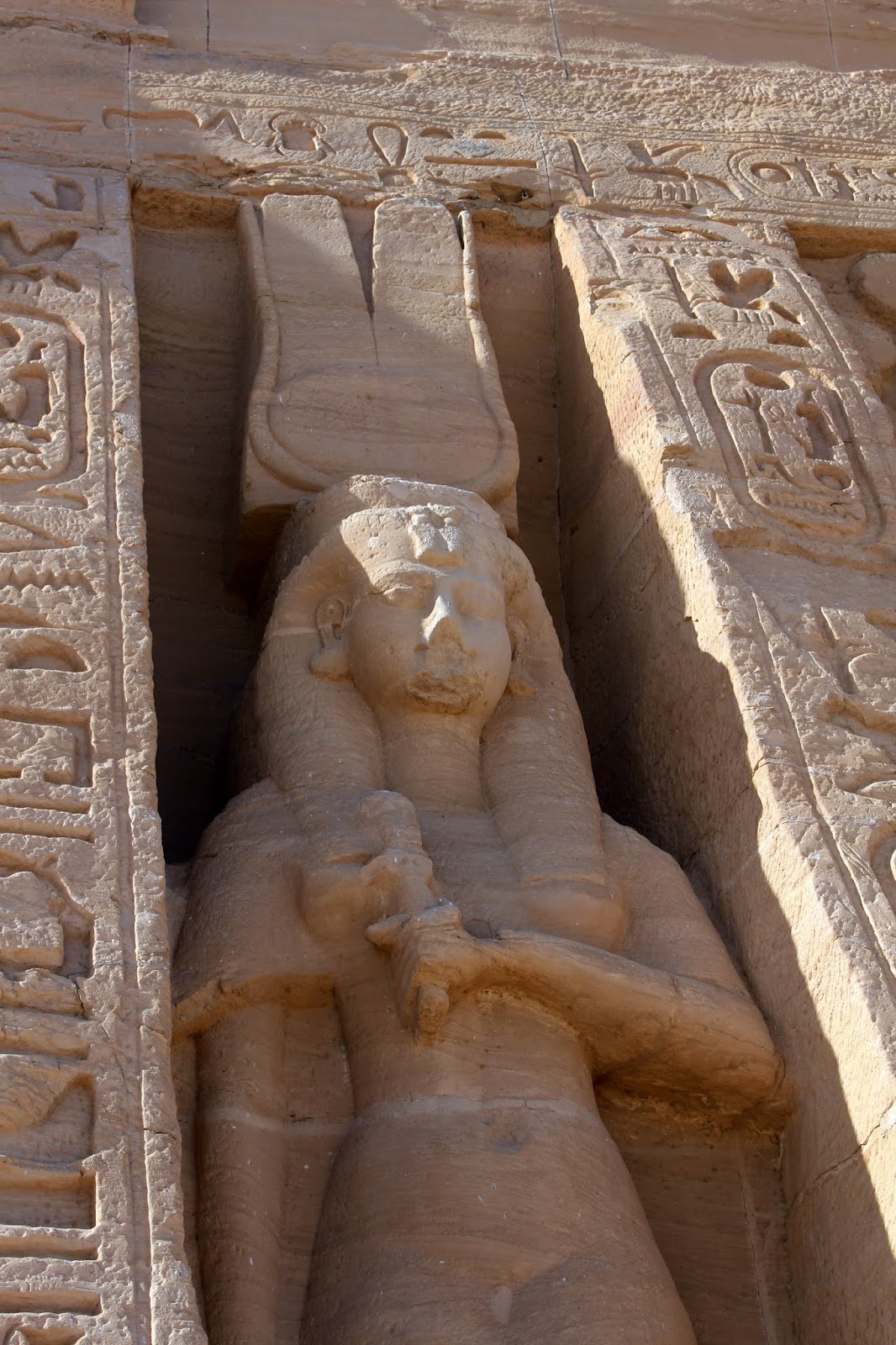
From the Ramses II Temple, we walked the short distance to the Nefratari Temple. Although the temple was smaller than Ramses, the statures and hieroglyphs were similarly impressive. This temple is 40 feet high and nearly 100 feet wide.  Three colossi on either side of the door depict Ramses and Nefertari.  While three of the six colossi were of Ramses and three of his queen, Nefertari, it is important to note that statues of queens were almost always much smaller than those of the kings.  However, in this case, all colossi were 32 feet in height.
Nefertari
We walked back through the ever present bazaar outside of tourist attractions and to the bus.  A few of our group bought things, but most of us had become skilled in rejecting the vendors.  We learned to avoid eye contact, never point at item that is for sale and to haggle with persistence, not hesitating to walk away.  As we saw earlier, the vendors in Nubia are far less pushy than those in lower Egypt in the Cairo and Alexandria areas.
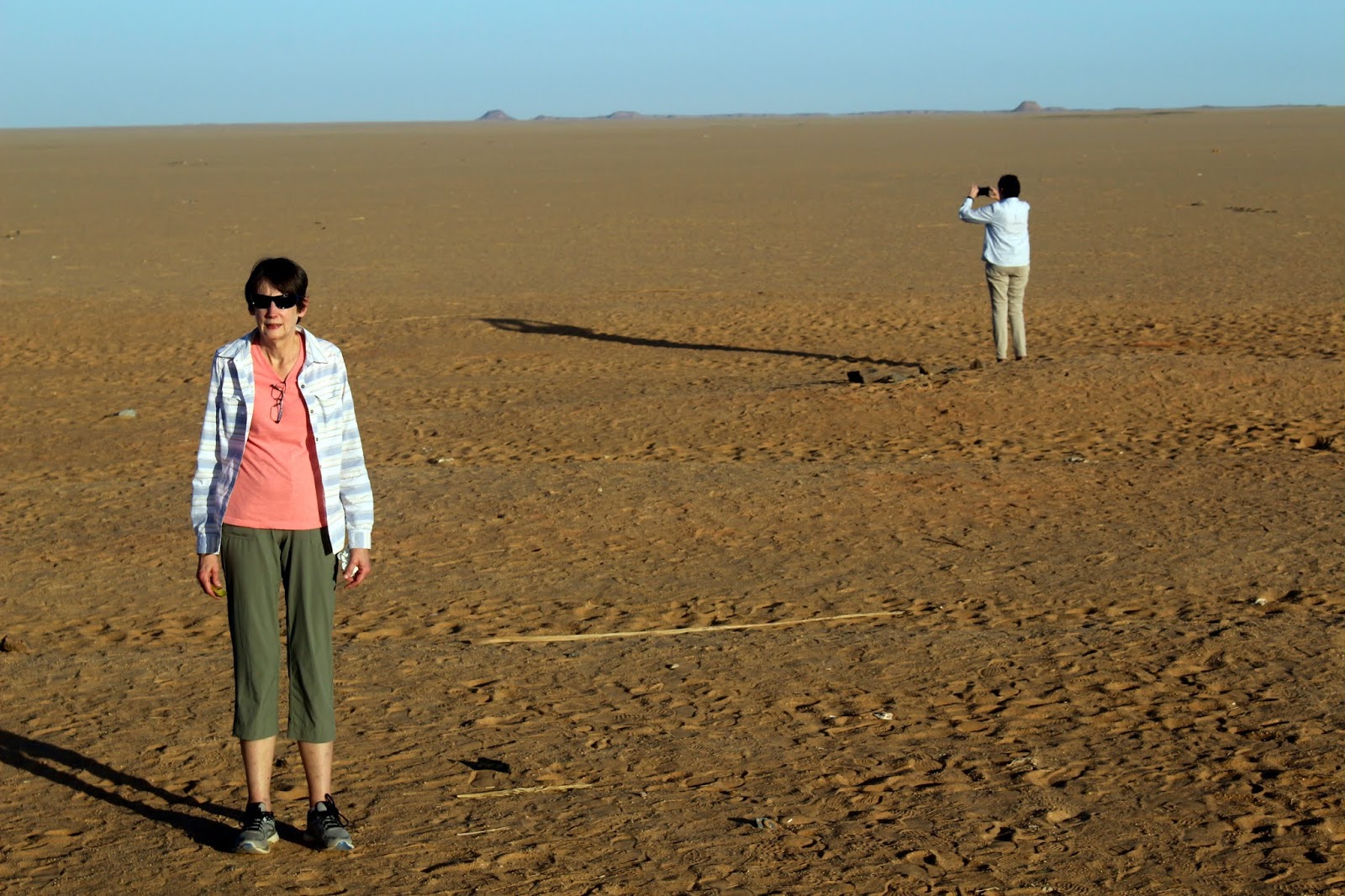
Mary & Cincy in the Nubian Desert
Rather than flying back to Aswan, we rode our coach north through the desert. The terrain looked like we expected Egypt to look, flat with sand dunes everywhere. This scope and desolation of the area amazed us.  We stopped at an oasis in the desert to get drinks or snacks then to continue north toward Aswan. While stopped, we took the opportunity to walk out in the desert and look around.
We arrived at our ship, the Steigenberger Legacy, around 7:30 pm and made our way to the last dinner onboard the ship. The meal of Egyptian food was very good as always. There was a show of traditional Nubian music and dance in the bar area, but Mary and I elected to shower and turn in since we were very tired from the travel and heat. We also needed to pack for our departure from the ship and have our bags outside the door by 7 am.

Wednesday, March 4, 2020

Edfu and Kom Ombo

Towel crocodile
We generally slept well on the Steigenberger Legacy last night, although we were awakened a little after 3 am when the ship went through on the locks on the Nile. We managed to get back to sleep, but I don’t think restfully. We were awake well before our 6 am wake up call.  We were still chuckling over the towel figurine of a crocodile left on our bed by the ship’s housekeeping team.
Carriage ride to Edfu
We were expected to depart the ship at 7:30 to explore the Edfu Temple, but the ship was delayed at the locks and was only able to moor after 8 am. Unlike our outings in Cairo and Alexandria, we did not have a bodyguard with us at Edfu.  We walked down the gangway off the ship and up the bank to meet the carriage drivers who would transport us to the temple by horse. Our driver kept the horse at a gallop and made very good time getting to the site from the ship. He even agreed to take a few photos for a small gratuity. We met with the rest of our team outside the temple grounds then walked through the ever-present vendors at the bazaars outside the temple on our way to the pylon.
Pylon at Edfu
This temple to the falcon god, Horus, is a nearly complete temple that was constructed during the Hellenistic Period of Egyptian history. This is when Alexander the Great’s rule extended into Egypt.  The Temple at Edfu is believed to have been completed in 57 BC, relatively recently when compared to other sites we visited.  
Over the centuries the temple was nearly completely covered with drifting desert sand and silt until it was discovered in 1798 by French explorers.  Only a small tip of the giant wall stuck up from the accumulated silt, sand and homes that had been built directly on top of the temple. Nearly 40 feet of sand accumulated between the homes and the ruins. Excavation began to uncover the temple in the 1860s.  After many years of excavation, archeologists learned that the accumulated, wind-blown sediment had protected the temple from weathering, which makes this one of the best preserved ancient Egyptian sites.  Edfu has only become a major tourist attraction in the last 15 years or so, and research continues to make the site more historically significant.
Hypostyle at Edfu
Because this temple was constructed by the Egyptians during the Ptolemaic Period, the figures are far less detailed or accurate There wasn’t much color, whether the pigments hadn’t yet been applied or if they had weathered away. 
Most of the damage to the temple was done when the Coptic Christians came to the temple in 391 AD and attempted to remove any figures of the pagan religions. The heads of Isis, Osiris and Horace have been defaced and even removed in some cases. Panels that are higher on the pylons and walls escaped much of the intentional destruction.  A number of panels tell stories of Egyptian mythology, which shed great insight into the beliefs of the Egyptians of the time.
Barque at Edfu
Perhaps one of the most interesting things at Edfu was a replica of the nearly intact solar boat that was found in the “Room of the Gods.”  The original boat (barque) is now in the Louvre in Paris.  Like Khufu’s solar boat that we saw in Giza, this vessel would have been to carry the pharaoh’s spirit into the afterlife.  We spent about an hour at the site and took a lot of photos.
Statue of Horus at Edfu
We were happy that we went to Edfu early in the morning since the temperature got to the mid 90s by the time we left. We are in the south of Egypt where the temperatures stay very hot all year long. We left the site around 10:30 and got our horse drivers to take us back to the ship. There was a tour by the captain of the ship’s bridge and galley, but we elected to sit up on the observation deck. 
The Nile is a very different river than when we were on it yesterday. We are above a couple of locks. We believe that the river is cleaner, and the Nile Valley is much more narrow than in Lower Egypt. We saw several flocks of geese and many wading birds such as herons, egrets, and ibis. Cindy and Mary played cribbage while Mark and I watched the bank and occasionally snoozed. Local fishermen on small boats waved as we passed, and we watched farmers moving cattle to fields along the river.  Because we had been so busy the day before, we welcomed a more relaxed day.  Our outing to the Valley of the Kings had been quite a day, so we appreciated the time on the ship to discuss what we had seen and consider our observations in the context of Egypt at the time.
Cobras at Kom Ombo
We went to lunch at 1 pm in the ship’s dining room then returned to the observation deck where Mary, Cindy and Nichole played Mexican Train Dominos. Mark and I watched television until it was time to prepare for our afternoon outing to the Temple of Kom Ombo
Our ship was still behind schedule because of the wait at the locks last night, so we waited until the ship docked along the Nile River at the small Nubian town of Kom Ombo.  We disembarked for the short walk to the temple dedicated to Sobek, the crocodile god, which is best known for the display of crocodile mummies. 
As we walked to the temple, the usual street vendors were pushing their wares. This spot seemed to have more children working to sell the items of clothing, books and cheap Chinese made jewelry. There was even a man with a couple of cobras. For a tip he would let visitors take a photo of the snakes. For a larger tip you could hold the snake for photos. The snakes almost certainly had their fangs removed.  While at Kom Ombo and throughout Nubia, we did not have nor did we feel the need for a bodyguard.
Kom Ombo Temple
The temple is small but attractive. It suffered damage in recent earthquakes, one of which took a large section of roof down. Like the Temple of Edfu, Kom Ombo is a more modern structure that was built in the Hellenistic Period, probably from 332 BC to 47 BC.  Additions to the temple were made as late as 395 AD to honor the falcon god, Horus.  There were many carvings of Sobek, Horus and other prominent Egyptian gods. The site was very busy with visitors, and areas got crowded as the evening waned. Eman pointed out panels showing the surgical tools that were in use in the Aswan area over 2000 years ago. There were even panels telling proper procedures for surgery.
Horus and Sobek at Kom Ombo
As the sun was setting, we went to the Nilometer that measures the volume of the Nile River and determined the tax that farmers paid for the use of the water by the farms. The Nilometer looked like a large deep stone-lined well. We walked by the roof sections that had fallen to see the hieroglyphs and ornamentation up close
We made it to the crocodile mummy museum after dark and walked around mummified crocodiles of all sizes. The museum only permitted cell phone photography; we were only there a short time since the museum was very small.
Crocodile mummies at Kom Ombo
We walked back through the gauntlet of vendors. Both Mary and Cindy bought a few Egyptian scarves from the street vendors for prices ranging from $4 to $10. Once at the ship we prepared for dinner in Egyptian costumes. Mary had on a nice pair of slacks and a middle eastern looking shirt. I had a black galabayya with gold trim that I bought for $10 from the canoe sellers as we traveled up the Nile . I also had one of the nice El Gazela scarves that I bought and a turban from one of Cindy’s scarves. I looked like Johnny Carson as Karnak the Magnificent.
Mary & Steve on the Steigenberger Legacy
Dinner was a middle eastern meal, and many on the ship were dresses in some sort of Egyptian attire. We decided to pass on the after party in favor of going up on the observation deck so Mary and Cindy could play cribbage. The 90 degree day had cooled down nicely, which made for a pleasant close to the day. I was happy to get out of the Egyptian clothing and back into shorts and tennis shoes.

Tuesday, March 3, 2020

Valley of the Kings


We were up early because we knew hot air balloons would be launching on the West Bank of the Nile in Luxor. We were up on the observation deck by 5:30 am and watched as 12 balloons of all colors and designs rose up and drifted down the Nile River. We saw a thick layer of smog over the fields on the western side of the river. The air was cool, which caused fog to rise over the warm water coming from equatorial areas in Africa. This fog met with the smoke from the sugar cane fields that were being burned in preparation for replanting to create the thick smog. We watched with binoculars for about 30 minutes then came inside to shower and prepare for breakfast and our trip to the Valley of the Kings.
Road Scholars Ramses Family at Hatshepsut;s Temple
We have come to enjoy a couple of Egyptian favorites for breakfast.  In addition to the feteer, we have developed a taste for the seasoned soft cheeses that are eaten on wedges of fresh pita.  We also came to enjoy the foul or ful (pronounced fool) that is very reminiscent of Mexican refried beans.  Locals mix a variety of spices and garnishes on this dish of mashed fava beans for any meal, but it is especially enjoyed at breakfast.
Valley of the Kings
After breakfast, we were in the lobby of the Steigenberger Legacy by 7:15 am and had water bottles, cameras and binoculars ready. Along the 40 minute drive Eman told us about the burial sites at the Valley of the Kings. The tombs are only open a few days a month to reduce the impact of visitors on the hieroglyphs and to assure that the air quality in the chambers is healthy for visitors.  The tombs that were open each day rotate to allow visitors who wish to see all of the tombs an opportunity to do so with a multiday visit.
Workers digging at the Valley of the Kings
We learned that kings had placed their bodies in conspicuous pyramids for several dynasties but came to realize that thieves would break into the tombs soon and would steal all of the items with any value. In fact, most of the burial chambers in the pyramids were robbed within a few years of burial. Therefore, in the 1500s BC. - 18th Dynasty, Pharaoh Amenhotep I decided to have his burial chamber hidden in an obscure mountain region. His advisors pointed out that the isolated mountain was a natural pyramid and that little had to be done to dig tunnels deep into the mountain to prepare chambers for burial and the accompanying artifacts to carry the king into the afterlife.  Since the underlying mudstone was easy to dig and provided an excellent cover for the tombs the area was used for burial of many pharaohs and nobles from the 16th to the 11th Century BC.
Inside the burial chamber of Ramses IV
The guides are not typically permitted in the burial chambers since they tend to hold people longer as they explain the hieroglyphs and discuss their meaning and history, The guards only allow a small number of visitors to enter the tombs at any time and frequently evacuate the burial chambers when the air quality diminishes. The carbon dioxide detectors in each of the burial chambers let the security guards know when to move people out.  When air quality dips, the guards clap as a signal to move out of the tomb.
Mary at the tomb of Ramses IV
Eman took us to the tomb of Ramses IV, where she talked with us outside the tomb, letting us know which hieroglyphs to especially notice. I had purchased a photography pass for an additional fee which, permitted use of a camera in most areas of the Valley of the Kings. We walked down a long ramp deep into the tomb and viewed the symbols on the walls then walked around the sarcophagus of Ramses IV before having to exit when the air quality fell below allowable levels. Some of the paint on the walls was still very vivid and in good condition. There was surprisingly little vandalism in this tomb.
Cindy & Mark inTausert & Setnakht tomb with a local photobombing for a tip
From there, our group split up based on preference and level of  exertion to enter the tombs. Our passes allowed us to enter three tombs, and we purchased a separate ticket for the tomb of King Tut. We elected to go to the deepest and furthest burial chambers of two rulers, Tausert (a queen who ruled from 1191-1189 BC) and Setnakht (1189-1186 BC). Setnakht is believed to have initiated the construction of the Karnak Temple, which was completed by his son, Ramses III.  The narrow, winding tunnel led down over 500 feet into the mountain to the two burial chambers. This is believed to have occurred when Setnakht usurped the tomb of Tausert and extended it to include his own burial chamber.  These areas have some of the best painting on any site we have seen. Because the entrance to the tomb was so far up the mountain from the visitor center and the tunnel down from the entrance to the burial chamber was so long, few visitors choose this to visit. Although this tomb has been known since antiquity, it was not excavated until the mid 1980s.
Inside the tomb of Ramses III
Our last tomb, before we went to King Tut, was for Ramses III who ruled from 1217-1155 BC. This tomb was much like the tomb of Ramses IV with many of same scenes and about the same quality of preservation. There was a moderate amount of walking, not nearly as much as the two queens but more than Ramses IV. The temperature outside today was approaching 90 degrees, but the inside of the tomb seemed even hotter since there was no air moving and people had been going in and out all morning.
Tomb of King Tutankhamun
Out final visit was to King Tutankhamun’s tomb. This was the smallest tomb that we visited with the shortest passageway. All artifacts, jewelry and furniture, as well as, the sarcophagus have been removed. Most are in the Egyptian Museum, but some items tour the world visiting many museums. King Tut ruled as pharaoh for 19 years until his death at 19 years of age in 1324 BC.
Walls in King Tut's tomb
Because this tomb wasn’t discovered and opened by Howard Carter until 1922, the quality of the artwork and artifacts was pristine. Tut’s mummy was laid out showing the resemblance to his father, Akhenaten who had very feminine features. We were not allowed to photograph the mummy. Even though photographs were prohibited in the tomb, we were able to bribe the security guard to let us take photos in the tomb although not of the mummy.
Tomb of King Tut
Because the discovery of King Tut’s tomb was in modern times, there is a lot of folklore surrounding the tomb.  Howard Carter’s sponsor, Lord Carnarvon, visited the tomb after Carter’s discovery then died shortly thereafter.  This has led to the “curse of the mummy” myths that anyone who enters a pharaoh’s burial chamber will die.  There was also a belief that Tut was murdered by priests who didn’t agree with the religious beliefs of his father.  Current thought is that the hole in the back of Tut’s head was made during the mummification process rather than as evidence for foul play.
Mortuary Temple of Queen Hatshepsut
We reconvened with the group and boarded the bus to drive past the tombs of priests and workers as well as the Valley of the Queens to the Temple of Hatshepsut. This three level temple was a shallow temple built into the face of the mountain. Because the stepson of Hatshepsut became ruler after her death, he had much of her temple destroyed. Eman took us around and pointed out significant features. We saw the remains of henna trees that Hatshepsut brought back to Egypt from Punt (now Somalia) in the 15th Century BC. There were several panels documenting her trip to Punt to trade for rare items to bring back to Egypt. Eman is very knowledgeable about Hatshepsut and her importance to the country.
Henna brought to Egypt from Somalia
Across the road from Hatshepsut’s temple was the complex where the archeology team from Poland lived and worked in the 1940s when much of the work in the area was being done. Their working conditions were difficult, but the 1940s were good years to be out of Poland. They made remarkable accomplishments during the time they were there, and really set the process of restoration and preservation into motion.
Colossi of Memnon
We got back on the bus and rode the short distance to the Colossi of Memnon, two giant statues of Pharaoh Amenhotep III standing at the edge of the dessert. These 60 foot tall statues of Amenhotep III are believed to have been erected about 1350 BC.  These two huge sandstone figures are believed to have been quarried near Cairo and brought over 600 kilometers up the Nile to their present location near Luxor.  We were amazed that the huge stones could be moved that far with the technology of the day over 3000 years ago.  A lot of art and hieroglyphics covered the bases of the figures, but we didn’t stay long and got back on the bus for the drive to the University of Chicago Oriental Institute and Epigraphy
Speaker from Chicago's Oriental Institute
This group has had a presence in the Luxor Valley for nearly 100 years recording, photographing and documenting the ruins in the Luxor area. A faculty member told us how they photograph the art then an artist adds lines on the features of the art to deemphasize distracting features. The line drawings clearly show the characters in each panel, even better that having a photograph. The nonprofit center publishes their results online in pdf format for free download. We had a walk around the grounds and viewed the wide variety of Egyptian and imported trees. After we had all of our questions answered, we started for the return drive to the ship.
Panel of Anubis from Hapshepsut's Temple
Because we knew that our morning would be long, we packed some fruit from the breakfast bar for a snack. We also had the bottles of water from the bus, as well as, one from our room on the ship. We arrived back on the ship around 2:30 pm and set sail shortly heading south up the Nile toward Edfu and Kom Ombo Temples. Lunch was the standard fare that we have come to expect on the ship. It is tasty and well prepared Egyptian and middle eastern food.
We had some free time after lunch as the ship sailed up the Nile so Mary, Cindy and a member of our group from Montreal played Mexican train dominoes. Mark and I chatted with the three ladies from California and enjoyed the moving air on the sun deck of the ship. Although the temperatures were in the 90s, the movement of the ship up the Nile made the dry desert air seem cooler.  We relaxed and chatted for most of the afternoon, occasionally spotting a bird or something interesting on the shore through binoculars.
Before dinner, we went to the captain’s greeting and cocktails. We were introduced to the staff of the Steigenberger Legacy and given some information about the ship. We were served complementary cocktails, but most of them were completely undrinkable. Some were absolutely nasty. I don’t believe that anyone finished their drink, so Eman had the ship’s bar prepare rum and cola for us which was a little better. We went to dinner at 7:30 and sat with our usual friends from New York, Montreal and California.
Steve in a galabayya
By the time we finished dinner, there were vendors outside our ship. These local businessmen fill canoes with shirts, towels, tablecloths and galabayya or jellabiya to sell. After tying their canoes to the ship, they show an item then pitch it up on the fifth floor sun deck from their canoes that are being towed by the ship. If anyone is interested in an item, they put money in a plastic bag and drop it back down to the awaiting vendors. I was looking for a locally made Egyptian scarf and an inexpensive Egyptian men’s galabayya, so the guys were throwing clothes into Mark and Cindy’s fourth floor cabin window with remarkable accuracy. I bought some scarves that I liked and a cheap galabayya, but they kept throwing things in until I closed the window and pulled the blinds. From up on the observation deck, I watched them selling to other passengers. All of these vendors speak perfect English, German, Spanish and Italian. They are very persistent in selling their items, but they are willing to negotiate. The two scarves that I wanted started at 900 Egyptian pounds (about $57) but came down to $30, about 450 Egyptian pounds. The money was worth it, if for nothing but the entertainment value. While the galabayya is cheap, the scarves are Gazelle brand, which are made from high quality Egyptian wool and are worn by many local men.  I figured after the party on Wednesday night I would bring the galabayya home to offer to Ian for a costume.  If he can’t use it, then I will give it to church for one of the wise men for the City of Bethlehem show at Christmas time.
The ship was waiting in line to go through the first lock on the Nile, so we went to our stateroom and turned in for the night.


Monday, March 2, 2020

Karnak and Luxor


Because we had a 7:30 am flight from Cairo to Luxor, we awoke at 3:30 am to shower and finish packing so our bags could be out of the room by 4:00 am. We went to a nice cold breakfast at the Cairo International Hotel Semiramis on the Corniche. There were fresh fruit, breads, cheeses and juices. We were on the bus and rolling by 4:30. We bid goodbye to the Cairo coordinator, Mohammed, and our bus driver, Emam, with gratuities for jobs well done.
Ruins of the Temple of Karnak
We were at the Cairo airport in Heliopolis in about 30 minutes since there was no traffic at that hour. We made it through check-in and security without incident. Security at all Egyptian airports is strictly enforced since there is always an elevated risk of terrorism. We passed through security as soon as we arrived at the airport then again as we neared our assigned gate. Everyone had to remove shoes, jackets and all items with any metal. Fortunately, the lines (one for men, one for women) moved quickly, and we made it through the process quickly.
Avenue of Sphinxes at Karnak
Everyone in our group was pleased to learn that we had been upgraded to business class for the one hour flight from Cairo to Luxor. It was really nice having the extra room; we had so much that we could stretch out. It was too bad that we had those seats for only a one hour flight. The flight attendants brought juice, tea and a breakfast of three small sandwiches. The flight was smooth, and we were landing at the Luxor airport before we knew it. We picked up our bags at the carousel and reported to the bus. We had a bit of a scare when one of the men from the Albany, NY group was missing, but he had mistakenly exited the secure area and was unable to get back into the airport. Once found, the bus left for Karnak Temple Complex.
Ramses II at Karnak
On the bus we learned that the region around Luxor holds one third of all known ruins in the world. In addition, new ruins are being found every day here. We also learned a bit of the history of the area and what we would see there. Having someone with the education, experience and skills of Eman leading the trip is essential since there was little signage inside the Karnak complex.  We also noticed that, unlike in Cairo or Alexandria, we did not have a bodyguard with us in Luxor.
Hatshepsut's Obelisk at Karnak
Eman purchased our tickets for admission to Karnak, and we had the QuietVox on so we could hear her descriptions of what we were seeing. She took us to the map of the complex and showed us the two axes, east-west and north-south, that defined the area and how the structures grew over time. We started our visit at first of pylons on the east-west axis which is just past a row or avenue of sphinxes with lion bodies and ram heads. This first pylon was never finished and still  had a lot of the mud bricks that made up the ramps allowing materials to be carried to the top of the structures. There were no carvings on this structure, but it was in the best condition of any pylon.
Karnak Sacred Lake
We walked through the pylon to a large courtyard where Eman pointed out features of the complex and how it was constructed from the Middle Kingdom, through the Ptolemaic Period and into the New Kingdom from 2000 BC until 30 BC. We walked to the large statues of Ramses II that were in amazingly good condition and through halls of columns that were highly decorated with hieroglyphs and cartouches. Evidence of vandalism that had taken place over 100 years ago remained, as well as, destruction caused by weather, flooding and subsequent ruling pharaohs.
We continued on to the temples of Ramses II and Ramses III. Like other temples we have seen, these structures were covered in carvings telling stories of the ruler’s life and deeds. One of the walls has evidence of early Greek and Coptic Christians covering the hieroglyphs with mortar or plaster and painting scenes over the walls.
Karnak first pylon showing mud ramps
We walked around the sacred lake then around to some of the unrestored areas of the ruins before making our way out through the gauntlet of vendors selling clothing, books, postcards and cheap souvenirs.
The bus took us the short distance to Luxor Temple, a much smaller complex than at Karnak. Built by Amenhotep III in the 18th Dynasty, about 1400 BC, this temple has some great statues and beautiful panels of hieroglyphs all to honor Hatshepsut and Ramesses II.  Luxor Temple was dedicated to Amun, Mut and Khonsu.
Luxor Temple
Although the temperatures were in the mid-80s, there was a light desert breeze so we didn’t feel too uncomfortable. We saw that tomorrow’s weather in the Valley of the Kings is forecast to be in the mid 90s so we will remember to dress appropriately.
After leaving Luxor, we boarded the bus to drive to the dock area where we got our rooms on the Steigenberger Legacy ship and went to lunch. The ship has a full passenger load of 120 representing several travel agencies from multiple countries. This ship isn’t as “luxurious” as other ships we have been on with Viking in Europe and Asia, but it is certainly very nice and well suited to our needs. We would far rather get a better rate than to pay more for expensive surroundings on the ship.
Mary at pillar
Lunch was pretty much the standard buffet fare for river cruise ships. Everything was quite good, and we enjoyed chatting with our fellow passengers. After lunch, Mark, Mary and I decided to go into town for a walk. We went past a grade school that was dismissing and saw the hordes of children streaming out just as in any school in any country. Many of the students that we saw wanted to engage us in conversation so they could practice their English. A few approached us for money. We were horrified to see the children jumping on the backs of moving trucks and hanging on the bumpers of cars. We just hoped that no one got hurt. We moved on from the school to another part of town, past carriage drivers looking for paying passengers. One especially persistent driver followed us all through the town on our walk. We had to tell him that we would be in town on Tuesday and would certainly look for him for a carriage ride.
We ended up in an Egyptian McDonalds restaurant where Mark ordered a dessert as much to see the menu as anything. We had to chuckle at menu items like McFalafel and the lack of bacon, ham and sausage on breakfast items. We came back to the ship through the phalanx of street vendors and prepared for our outing to the Luxor library to hear the evening speaker.
This gentleman speaking to us is not involved in the archeology aspect of the ruins at Luxor but in preserving the current state of the artifacts for at the sites. The government is not attempting to restore anything but rather to prevent further degradation from weather or human intervention. His photographs and talk were both very interesting.
We returned from the library to the ship where we were able to get on the internet and have dinner of Egyptian, European and American choices. After we ate, we sat on the observation deck and chatted while Mary and Cindy played cribbage.

Sunday, March 1, 2020

Mosques, Synagogues and Coptic Christian Churches


Our usual Mediterranean breakfast of fresh and dried fruit, Egyptian pita bread and cheeses was very good. Some of us had eggs or muesli, but everyone enjoyed the meal.  We found the meals at the Cairo Intercontinental Semiramis Hotel to be quite good.

Toulun Mosque
We boarded the bus before 8 am and drove to the Toulun Mosque in Old Cairo. This mosque was built in the 860s AD and suffered damages in the fires in the 1100s and 1300s. This mosque is one of the oldest in Cairo and still has over 6,000 people for prayer on Fridays. I was surprised that mosques are very open and empty. There is just a place for the Emam to deliver a short lesson and prayer and room for the people to come pray. The pattern in the carpet throughout the mosque pointed the direction to Mecca. Our guide, Eman, described a typical Friday service as being about 30 minutes in length including a 15-20 minute lesson and a 10-15 minute prayer.
Toulun Mosque
A significant feature of this mosque is the unique minaret which has a helical outer staircase similar to the famous minaret of Samarra.  It is said that a horse and rider could climb this staircase. 
The stone carvings and minaret at the Mosque of Ibn Tulun were very beautiful, and we appreciated learning more about daily life as a Muslim in Egypt.
We drove a short distance to some Egyptian Coptic churches in Old Cairo: St. Sergius Church and Saint Virgin Mary’s Coptic Orthodox Church, which is commonly called “The Hanging Church” because it is suspended by beams. These are some of the area’s oldest churches dating back to the third and fourth centuries.  Since we were at the churches on Sunday morning, services were underway. The service was in hieroglyphic spoken language, and there appeared to be a number of people at the service. We looked at the old mosaics and icons and watched as the priests delivered the service.
Cave under St. Sergius Coptic Christian
The cave under Saint Sergius Church is reputed to be one of the locations where the Holy Family stayed after escaping to Egypt shortly after the birth of Jesus is next. The cave has been enlarged and modernized in the over 2000 years since then, but it is an important site to the Egyptian Coptic Christian Church.
Mosaic at the Hanging Church
Saint Virgin Mary’s Coptic Orthodox Church is called The Hanging Church because it is built above a gatehouse. The church was built in the Basilican style and is known for the beautiful ancient icons in the church.
There was an “antique market” outside the church that Eman says sells items that are genuine and made in Egypt compared to many of the vendors who sell cheap Chinese goods. We browsed the shop for some time before Cindy bought small mother of pearl jewelry boxes and small stone scarab beetles for her managers. We bought a wooden camel for Peter and a mother of pearl jewelry box for Gran. Both seemed to be of good quality and should please everyone.
Inside the Hanging Church
We walked up to the Ben Ezra Synagogue, which was one of the only places today where we were not permitted to take photographs. This synagogue is no longer used as a place of worship,  but it is an attraction based on the age and significance of the building which predates 882 and is probably pre-Islamic.  The original building was likely destroyed in 1012 by an Islamic ruler but was rebuilt when the subsequent ruler permitted around 1025. 
We were impressed with the apparent harmony in which Coptic Christians, Roman Catholics, Jews and Muslims coexist. Since the Coptic Christian women are often veiled, it was impossible to tell the religion of people by their dress.
Khan el Khalili Bazaar
Our last visit of the day was to the Khan el Khalili Bazaar where vendors hawk cheap souvenirs to tourists. Vendors will want you to come into their small storefronts to purchase spices, replicas of artifacts, traditional Egyptian clothing, T-shirts and other items. They will attract your attention by saying things like, “I like the smell of your wallet,” “let me help you get rid of your money” or “let me tell you what I have that you need”. They were very entertaining, and several people in our group bought things from vendors. One lady in our group even purchased a belly dancing outfit that she says she will wear on the ship.  Although it looks much like a flea market found in any modern city, the Khan el Khalili Bazaar dates back to the 14th century.
Cairo at sunset
We got back on the bus, and our driver, Emam, very skillful in navigated the Cairo streets that were hardly wider than the bus. He took us to a local restaurant specializing in falafel which was quite good there. In fact, the name of the restaurant is Felfela.  Our starter course was warm pita bread, falafel and a variety of Mediterranean cold salads including tahini, pickled eggplant and several others. We all loved the falafel, which was the best that we have had since being in Egypt. We learned that Egyptian falafel, unlike other middle eastern cultures, is made with fava beans rather than chickpeas. The spices and included vegetables gave the falafel an excellent flavor and texture that everyone in the group enjoyed.
The bus took us back to the Cairo Intercontinental Semiramis Hotel on the corniche where we changed shoes and prepared for our afternoon walk. Several in our group, including us, had to have our room keys replaced since we couldn’t get them to activate the elevators. That was quickly resolved, and we walked with our group that now included Marcia and Jean. 
Tahrir Square
We walked over to Tahrir Square where the 2011 revolution began and looked at the monument being constructed there. In this revolution,  over 50,000 protesters occupied the area in support of the revolution against President Hosni Mubarak’s policies, which resulted in Mubarak’s removal from office.  After walking around Tahrir Square, we went back across the Nile and walked along the bank until we came to the next bridge and crossed back to the side where our hotel is located. We were out for about 75 minutes, which felt pretty good with weather in the mid 70s and sunny. A light breeze felt very nice. The forecast for the days that we will be in Luxor and Aswan are predicted to be in the upper 80s.