Showing posts with label tea. Show all posts

Friday, September 28, 2018

Hutongs of Beijing


We awoke early for our departure from Xi’an. Like Lijiang, we enjoyed this city and left reluctantly for Beijing. We had put our checked bags out the night before so it did not take long to check out of the Wyndham Grand Xi’an South. We boarded the bus to the airport where we would fly to Beijing. The flight was delayed nearly an hour so we ate the boxed lunch packed for us by the Tang CafĂ© at the Wyndham. There was a club sandwich, fruit and dried peas that are very popular in China. Once we took off the flight was rough but uneventful getting us to Beijing by about 2 pm. Porters collected our checked bags for delivery to the Beijing Ritz Carlton Financial Street where we would be spending the next three nights.
Rickshaw ride through Hutongs of Beijing
From the airport we took the bus directly to inner city Beijing where we took a ride in a rickshaw or petite-taxi. These bicycles are outfitted with two wheels and a covered cab behind the driver. We rode the rickshaws through the Hutongs of Beijing. A Hutong is basically a community on a city alley. The word Hutong is Mongolian that translates literally to well since these collections of homes originally formed around a shared water well.  These are collections of homes of working class people. Each home is typically composed of 3-4 buildings surrounding a small courtyard. These buildings may house an extended family. The government typically owns that buildings and charges rent to residents. Many homes in the hutongs now have running water. However, there are community toilets that serve a number of homes along the narrow streets.
The rickshaw took us to a home of a single retired lady who has lived in her home in the hutong her entire life. Her parents lived in the hutong at one time but she now shares the space with her sister and niece. She served tea to us and told us a lot about daily life in the hutong. She began hosting tours of her tiny home in 2008 during the Beijing Olympics. At that time Leonardo DeCaprio and Michael Phelps visited her home.
Mary with glass balls that were painted on the inside
She introduced her niece who is an accomplished artist who has been featured in recent local magazines. Her specialty is painting on the inside of bottles. She uses specially angled tiny paint brushes to paint scenes and Chinese characters into the glass bottles. We bought ornaments that were hand painted on the inside of the glass from the artist. We will give these to Sarah and Emily’s families as gifts from our trip.
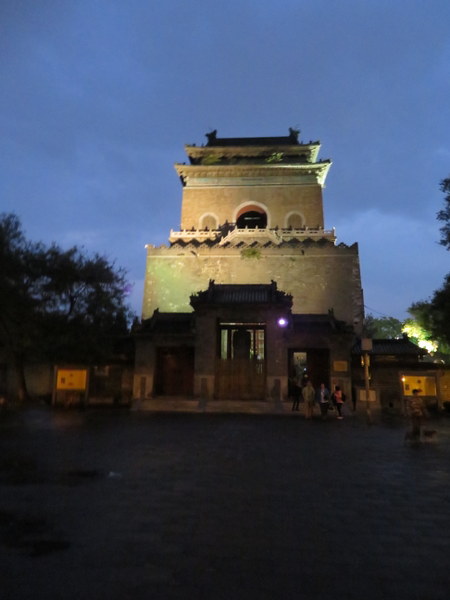
Historic Ming Bell Tower
We reboarded the rickshaws to go to Beijing’s bell tower where a bell was rung at 5 am when the city gates were opened. Another nearby tower beat at drum at 7 pm when the gates were closed. By the time we arrived at the tower there was a heavy rain so we were happy to go inside to escape the weather. The bell tower is an interesting and attractive building that was constructed in the 1200s during the reign of Kublai Kahn. 
In bell tower we were treated to a tea tasting. Our host gave us small cups of a variety of oolong, pu-er, green and fruit teas. The hostess spoke English fairly well and had a good sense of humor. She shared what Chinese folk medicine holds that each type of tea does for the body. We smelled each of the dried tea leaves and tasted each of them as brewed teas.
Sampling tea at a tea room in the Ming Bell Tower
Our bus picked us up outside the bell tower and took us to dinner then to the Beijing Ritz Carlton. This five star hotel is very elegant but a bit dated. Our 12th floor rooms were clean, comfortable and quiet which is everything we expect in a hotel. The bathroom wasn’t as fully appointed as the ones in some of our previous stays but was still extremely nice.

Saturday, September 22, 2018

Old Lijiang

Once again we awoke early and did some reading in our room at the Intercontinental Hotel. We used Google Hangouts to call Gran and the girls just to say hello. We went to breakfast in the hotel which was a good mix of Chinese and western breakfast choices, We tend to choose Chinese foods since we can have eggs or oatmeal any day when we are back home. It isn’t every day that we can have Himalayan breakfast foods.
Meat markets in Old Lijiang
We prepared for our morning trip into old town Lijiang after breakfast. Those from the group who wished to go out met with our local guide, Janice, at 9:30 am. As we waited in the lobby of the Intercontinental Hotel we chatted with a nice young man who is in training to be a Buddhist monk. He shared a number of parables with us that are especially meaningful to him. Much of the teaching in the Buddhist faith is taught through illustrative stories to teach lessons on how to live a good life.  After Janice arrived we walked into the old historic section of Lijiang starting in the local market.
Chicken feet for sale in Old Lijiang
The market is huge, noisy, smelly and chaotic. There are streets for each food category. There was a meat street, fish street, mushroom street, potato street, pickle street and noodle street. We entered at the meat street where we saw chickens, ducks, geese, rabbits and other animals being sold alive then slaughtered and dressed to order right there in the market.
Market in Old Lijiang
There were also parts from pigs, yaks, cattle, sheep and goats being cut up and prepared for sale. We saw a lot of potatoes especially purple potatoes which are a regional specialty. There were giant bags of peppers, mushrooms and other food being sold by the pound. All the while there were many people visiting each of the vendors to buy food and small trucks and motorbikes mixed in along the paths between vendors. It was nearly impossible to walk. Each area had a very characteristic smell. The animal area smelled like a slaughterhouse anywhere would smell. The earthy smells of the mushroom and potato streets gave way to fragrant smells of flower stands and noodle shops. We decided that we could locate our whereabouts blindfolded just on the characteristic smell. 
One of the many mushroom markets in Old Lijiang
In some ways the Lijiang market wasn’t much different than the Milton flea market. There were stands selling cheap junk as well as shops selling staples for existence. The market definitely caters to local Lijiang residents. I think we were the only non-Chinese in the market today.
From the market, Janice led us through other historic areas of Lijiang. We then headed for the home of Mu, the leader and Shaman of the Lijiang Naxi community. The Mu had a complex of living quarters and center of civic government. We walked through the area and looked at the statues and locations that were important
Residence of the Naxi Mu
to the Naxi culture. We noticed that the thresholds to rooms in the Mu’s complex were especially high. As we learned earlier in the week the high thresholds were intended to keep evil spirits from entering the dwelling according to Chinese superstition.
There were a number of children and families in the courtyard near the Mu’s residence making and decorating moon cakes.  These dense sweet cakes are a traditional celebratory food for the Mid-Autumn Festival sometimes called “Moon Cake Day”.  This holiday is celebrated on the day of the full moon in late September or early October. 
Children making Moon Cakes
After leaving the Mu’s residence we walked through some of the shops in town and stopped at a shop doing embroidery on silk similar to the gallery we visited in Shanghai. Several people bought things after a period of haggling over the price. There was a speaker and demonstration of the hieroglyphs that make up the Naxi written language. Although most people in Tibet and Eastern China now use the simplified Chinese written characters, many people of the Naxi minority use the traditional hieroglyphs as well.
Traditional Naxi hieroglyphs
After leaving the silk store we went to a restaurant that Janice recommended for lunch. We sat with Gary, Robin, Darla and Sherry who we learned met while working for the FFA in Anchorage. We ordered a family style meal with yak meat, corn, Naxi potatoes and steamed lotus. We had tea to drink. When we got the bill for the four of us we were shocked that it was less than 200 Yuan which is about $31.
After lunch we walked around the ancient city again including the market which was far less crowded now that the morning rush was over. Most of the vendors were there but fewer than a quarter of the shoppers were in the market by afternoon. We continued walking through the stands and small stores until a heavy rain hit. A huge crash of thunder shook us and then the rain soaked us. We took shelter for the heaviest rain then went back out to walk around the old city of Jijiang. We walked up the hill in search of a geocache then headed back to the hotel in a light mist of rain.
Naxi woman selling purple potatoes in Lijiang market
We met Janice again in the hotel lobby at 6 pm and walked to a wholesale tea vendor in old town Lijiang. We tasted several varieties of Pu-er tea and learned correct and incorrect ways of making tea. The shop owner poured water over the tea leaves and disposed of the water twice after a steep of only a couple of minutes. He then put hot water in again for a slightly longer soak and made cup after cup of delicious tea. Through Janice as an interpreter, he told us that he can make 30 runs on a set of tea leaves. He made a pot of tea from a dried tangerine that was hollowed out and filled with Pu-er tea. We bought a cake of good quality Pu-er tea and a bag of tea tangerines for 300 Yuan each. Mark and Cindy bought a stash of tea as well.
We walked back to the hotel where we had an excellent buffet dinner of Chinese and Naxi foods in the hotel dining room. We had to get our checked bags out in the hallway that evening for our flight to Chongqing that night so we headed out to our rooms.