Showing posts with label Moonshine. Show all posts

Monday, June 17, 2024

Kentucky Moonshine Trail – Day 3

The temperature was forecast to be in the mid to upper 90s today and we knew it would be too hot to work in the garden or yard. It seemed like a perfect day to visit the last distillery and optional attraction on the Kentucky Moonshine Trail. Since we would be going to Williamson first, I called my friend, Greg, and arranged to meet him for the distillery tour.

Mary & Greg at Pauley Hollow Distillery

We left the house a little before 6:30 am to arrive at Pauley Hollow Distillery for our 10 am appointment. There wasn’t much traffic on the Mountain Parkway and we arrived in South Williamson a little after 9:30. Greg called as we neared our location to double check the directions to the distillery since it was in a residential neighborhood. The information on the Kentucky Moonshine Trail lists Pauley Hollow Distillery as being in Pikeville. Actually, the distillery is 30 miles away in South Williamson, Kentucky.  As we drove to Pauley Hollow from home, we traveled the Mountain Parkway as well as Rt. 23, called the Country Music HighwayCountry Music Highway because of all of the famous musicians with roots along Rt. 23.  Examples include Ricky Skaggs, Keith Whitley, Loretta Lynn, Dwight Yoakum, and Chris Stapleton to name a few.

Owner, Josh Martin at Pauley Hollow Distillery


We were greeted by the Pauley Hollow Distillery’s owner and operator, Josh Martin. Josh’s warm personality made us feel welcome at his small but efficient operation. He shared a great deal of information on how he ferments and distills his spirits. He is very picky about the source of the water and the grains that he uses to get the best quality of products. One of his moonshines even uses water from the well on the property of Randolph McCoy of Hatfield/McCoy fame. Like many on the Kentucky Moonshine Trail, Josh gets his yeasts and some of his enzymes from Wilderness Trail.


Because of recent festivals, Josh’s stock of distilled spirits were low but we were pleased that he had bottles of original recipe corn moonshine, Fuel of the Feud, rye based moonshine and his Robert’s Reserve four grain sour mash bourbon. We sampled each of these as we chatted with Josh and looked around the metal barn that he has converted into a distillery. We were unable to get any of the apple brandy or other products at this time. Greg and I each purchased a bottle of the corn based moonshine and promised to return in the fall when his stocks of spirits would be higher.

In chatting with Josh, he mentioned that Southside Wine and Spirits in Pikeville has a large selection of his products as well as bourbon from a new distillery in Eastern Kentucky aging their barrels in former underground coal mines. Josh also told us that Deb, the proprietor, keeps a stock of Buffalo Trace products including Buffalo Trace and Eagle Rare.

We said our goodbyes to Josh and started down Kate Camp Branch when we were surprised by a young black bear crossing the road in front of us. I guess we shouldn’t have been surprised by seeing a bear in that area but it was a great way to leave the Forest Hills area of South Williamson. We wished that we could have taken a photo of the bear but it was moving too fast for us to get a snapshot.

Lunch was at Giovanni’s in South Williamson where we met Jenny, a contact for Mingo County when I worked there leading the Shewey Science Academy from 2007-2020. Jenny was instrumental in working with educators from around the county and even expanding into neighboring school districts. It was great catching up with Jenny on her son, Jordon, who was in the first group of middle school students in the Shewey Science Academy and has been with the program since. Jenny’s husband, Jerry, is now fully retired from dentistry but continues to work with sports teams in the area. I was happy that she and Greg could meet. We all enjoyed the pizza, pasta and salad buffet at Giovanni’s and the good conversation at the table.

Leaving the restaurant, we said goodbye to Jenny and Greg then drove 30 minutes into Pikeville to Southside Wine and Spirits where we met Deb and had a nice chat about our favorite spirits. We were amazed at her selection. We have been in larger wine and liquor stores in Cincinnati and Lexington but no one has the selection that I saw at Southside Wine and Spirits. She had seven bottle sets of Blanton’s with each letter on the stoppers. Every imaginable bottle release of Maker’s Mark and all of the Woodford Reserve releases. We were very pleased that she had plenty of Eagle Rare and a full display of store pick bottles of Buffalo Trace. We were very excited and bought two bottles each of Eagle Rare and Buffalo Trace.

Loretta Lynn & Crystal Gayle's homeplace

After leaving Pikeville the drive to Van Lear was about an hour. Loretta Lynn’s homeplace was our last stop in the Kentucky Moonshine Trail. A network of backroads led us to Webb’s Grocery where we got the final stamps in our passports. The young man at the counter told us that we were the first visitors to come in with completed passports. He gave us directions to Butcher Holler and Loretta Lynn’s homeplace. We drove the short 1.6 miles on the narrow winding road to the small cabin and outbuildings perched on the side of a hill. We took a few snapshots then drove back home. We had time for a snack and change of clothes before our meetings at church.


The next time we are in Lexington or Winchester we will turn our passports in at one of the distillery stops for our awards for completing the Kentucky Moonshine Trail.


Wednesday, June 12, 2024

Kentucky Moonshine Trail – Day 2

On the first day of our trek for the Kentucky Moonshine Trail we visited five of the nine stops. We planned to visit two stops today and two next Monday. On our way to Kentucky Mountain Moonshine in Ravenna, we stopped at Sam’s Club in Lexington. We needed a few grocery items for us as well as some large cans of green beans for church to serve at The Gathering Place Mission. The morning was cool for June, and we had packed a cooler so our purchases would be cool throughout the day.

Howard Arvin with a column still

We drove south on I-75 to Richmond where we drove to Ravenna in Estill County. At the Kentucky Mountain Moonshine Distillery, we were met by Howard Arvin and his wife. After throwing a ball for his dog we came into the distillery to see where Howard works his magic. Their place is an old white frame house that has been repurposed to serve as a visitor center and distillery. Howard told us a lot about the area and the history of moonshine. As a retired dentist in the area, he has extensive knowledge of Estill County. Water for the distillery comes from a well on the property and feeds one of three column stills or a small pot still. Howard is very knowledgeable regarding the chemistry of distillation and is super caution to assure that only the best distillates from his stills are made available to visitors.

The Arvins at their tasting area

After spending time in the still room, Howard’s wife prepared several drinks for us including a pickle juice moonshine drink which wasn’t our favorite. However, the peach moonshine with fresh peaches was outstanding. I purchased the smokey vanilla bean corn moonshine. Howard ages the corn moonshine in a jar with charred oak blocks then transfers the moonshine to another jar with vanilla beans for a second aging. I thought it would be very good mixed with Ale 8-1. Mary bought a cranberry flavored moonshine that she found very tasty.

Column stills at Kentucky Mountain Distillery

Howard invited us back to hike some of the trails on his property behind the distillery. We left the distillery feeling like we had made friends of the Arvin family and respect their skill in producing distilled spirits.

After leaving Ravenna, we drove the short distance to the Menards home center in Richmond, Kentucky. Our home water heater failed on Tuesday morning and Menards has the best prices on water heaters as well as the plumbing parts we would need to install the new tank in our basement. Menards had everything we needed, and we were pleased with the price that we paid and look forward to the 11% rebate offered by Menards.


Leaving Menards, we drove to Barrel House Distilling in the old distillery district in Lexington. We had been to Barrel House many times since our first visit there in 2014. Like other moonshine distilleries, Barrel House is a small operation but has a nice bar connected. The bar seems to do a brisk business with visitors in the popular area. The staff at the Barrel House visitor center were very personable and pleasant. We chatted about our previous visits to the distillery as they stamped our passports. One of the tour guides was telling us about a planned expansion to a location near Cynthiana that would be a much larger facility that could produce more spirits and accommodate more visitor groups. I asked if they would be needed tour guides when another guide there said that her husband is the head distiller and would love to have me work there part time. I took his contact information and promised to contact him soon with my inquiry about working at the distillery.

Barrel House Distillery

After leaving Barrel House, we drove the short distance home and unloaded the pickup with the water heater and plumbing. I will do the water heater installation on Thursday afternoon when I get home from volunteering at McConnell Springs Park and attending the board meeting at the Scott County Cooperative Extension Office.

We plan to visit the final two stops in the Kentucky Moonshine Trail on Monday. Hopefully our friend Greg can meet us for the visit in South Williamson. We also hope to meet our friend, Jenny, for lunch after the visit to Pauley Hollow Distillery. We hope to stop at Butcher Holler in Van Lear, Kentucky on the way home for the final optional stop in the passport.


Tuesday, June 11, 2024

Kentucky Moonshine Trail – Day 1

We left home around 7 am for the nearly three hour drive to Whitesburg in Southeastern Kentucky. When we drove through Hazard we were reminded of Hinton, West Virginia. Both were railroad towns whose economy has hit the skids with the decline of coal. Like Hinton, streets in Hazard wind around the mountainous town. We understand that the failing economy in Hazard has contributed to a takeover by opioids and homelessness. Our purpose for this trip is to visit all of the sites on the Kentucky Moonshine Trail and most of these are in Central and Eastern Kentucky.

Kentucky Mist Moonshine in Whitesburg

We arrived in Whitesburg in Letcher County a little early for our 10 am appointment at the Kentucky Mist Distillery so we walked around town and stopped in at the local library. We really liked the small town. Everyone we met in town was very pleasant and the town seems to be coming back from the shift in the economy. Much of the town was flooded during storms in the area a few years ago but most places seem to have recovered and restored the damaged buildings.

Anthony showing us the still

The Kentucky Mist Distillery is located in two buildings that were formerly an automobile dealership in Whitesburg. The interior of the distillery’s visitor center was attractively arranged with a bar, tables and shelves of spirits produced by Kentucky Mist. The large windows in the front of the visitor center made the room bright and inviting.

Anthony gave us a brief history of the distillery and the locations Myrtle Beach, SC and Orange Beach, AL as well as in Whitesburg. The large mash tubs and the column still were impressive. Anthony showed us a vat where corn based moonshine was steeping large bags of fresh blackberries. Anthony shared the mashbills and techniques that he uses to make moonshine, vodka and corn whiskey.

After leaving the visitor center, we walked across the street to the car dealership building that he uses to age the barrels of moonshine. He also showed us some of the experimental barrels that he is aging with brandy and other distilled spirits.

Anthony with our purchases

Back at the visitor center, we purchased a bottle of corn based moonshine, a bottle of aged corn moonshine and a bottle of blackberry moonshine. Anthony gave us passports for the for the Kentucky Moonshine Trail and stamped our books for the distillery. We enjoyed the chat with Anthony and found him to be interesting and pleasant. He shared information on attractions in the Whitesburg area including Kingdom Come State Park. We plan to come back to Whitesburg in the fall and will certainly come to Kentucky Mist.

Backwoods Moonshine Museum

After leaving Whitesburg we drove two hours to the Backwoods Moonshine Museum outside of Beattyville, Kentucky. We were greeted by Don, the father of the museum’s owner. His son and daughter-in-law who were featured on Discovery Channel’s Moonshiners television show were unable to be there . Don let us in the small museum and allowed us to look around at the displays and to the working model moonshine still outside. Don was pleasant enough but didn’t have much knowledge of the displays. While Don stamped our passports, we put a tip in the jar on the counter then continued toward the Mountain Parkway where we drove to Red River Gorge.

Mary at Moonshiner's Arch

One of the optional stops in the Kentucky Moonshine Trail is Moonshiner’s Arch in Red River Gorge. We arrived at the trailhead easily and walked along the muddy trail to the limestone arch. The arch was a double span of rock in a ravine where it is reputed that moonshiners operated a still when water was available. We took a few snapshots then continued to Winchester.

Regeneration Distilling in Winchester

At the Winchester Beer Cheese Festival last weekend, we met Zach Pasley, distiller at Regeneration Distilling in Winchester. He invited us to come back to the distillery this week for a tour. When we arrived at Regeneration, we were met by Christian who took us from the gift shop area on Main Street across the street to the distillery. He showed us the tiny pot still where they produce their spirits. Because of the recent festival, they were sold out of many of their usual spirits including the unaged corn moonshine. Their signature product is sweet potato moonshine and several flavors of corn moonshine. Christian allowed us to taste all of their products that were available at the distillery. We were not impressed with the sweet potato that had an interesting flavor but wasn’t our favorite. The corn moonshine was sold out, but Mary bought a jar of the raspberry moonshine. We promised to return with my friend, Greg, to try some other spirits and buy a jar of corn moonshine.

Pot still at Regeneration Distilling in Winchester

Christian stamped our Kentucky Moonshine Trail passports with Regeneration Distillery as well as Moonshiner’s Arch and Folly Farm which is associated with Regeneration. Like Anthony at Kentucky Mist, Christian was very pleasant and knowledgeable. We look forward to returning to the distillery soon.


Thursday, July 17, 2014

Day 1 - Summer 2014 weekend in Laneville

As soon as I got home from work on Wednesday, July 16, I started grouting the tile in the girls’ bathroom upstairs.  The job went pretty quickly and I was able to get the tile grouted and rinsed several times.  I allowed it to dry then buffed it with a dry towel.  I was pleased with the way it looked.  After eating a bite, I left to meet Mary in Morgantown around 7 pm.  I knew she had a dinner meeting that would last until after nine pm so I didn’t want to get there too early and I was happy to have the time to work on the tile.  The drive up to Morgantown was uneventful other than spotting a bald eagle along I-79 in Braxton County.  I really had to do a double take to make sure of what I was seeing but it was a bald eagle without a doubt.  I met Mary and some of her tech pals in the lobby of the Waterfront Place a little after 10 pm.  They had eaten a good meal at Oliverio’s.  Since we both had a long day and were tired, we went sleep right away.

While Mary went to morning meetings at the conference, I walked around Morgantown.  I went to breakfast at Taziki’s in the Mountainlair (WVU student center).  I had a bacon, egg and cheese wrap which was very good.  The manager felt bad because it took longer than he hoped to make the wrap so he gave me the breakfast for free.  I promised to come back for lunch the next time I am in the area. 

By the time I got back to the hotel, Mary had finished up her morning meetings so we packed up and headed out.  I had called the three distilleries in the Morgantown/Fairmont area to set up tours.  The very pleasant contact at West Virginia Distilling Company in Morgantown told me that he would be happy to give us a tour but they do not distill in the hot summer months.  However, he said that if we return in fall or winter, he would be happy to show us around.  The lady at Forks of Cheat invited us to come any time as long as the weather permits a short walk from the visitor center to the distilling shed.  The lady at Heston Farms/Pinchgut Distillery invited us to come any time for a tour. 

We drove the short distance from the Waterfront place to the Forks of Cheat and browsed the visitor center until a guide and her daughter took us through the attractive gardens to the compact but efficient distillery.  The people at Forks of Cheat grow about 95% of the fruits that go into their wines and distilled spirits.  About the only fruit they use that isn’t grown on the property are the pomegranates.  Much of the property on which the grapes and other fruit are grown is reclaimed surface mine property.  In addition to a number of wines, Forks of Cheat makes apple Jack, rum, grappa and several fruit liqueurs.

We enjoyed a tasting back at the visitor center and tried several of the wines then tried some of the spirits.  Neither of us liked the grappa.  It is a neutral spirit made from grapes.  There was no discernable flavor just pure ethanol.  We bought a bottle of pear liqueur and blackberry liqueur to bring back.  Mary has had the pear before and really liked and we are sure than the blackberry will be good as well.

We drove from Morgantown to Fairmont in hopes of touring the Heston Winery that also houses the Pinchgut Distillery.  We were impressed with the development at the farm.  It is obvious that some serious money has been put into making the winery a destination.  There is a restaurant, gardens, picnic and play areas for families and children.  We liked a lot of the primitives and variety of plantings on the grounds.  We were very disappointed that we were unable to tour the distillery despite having called earlier to make certain that tours were available that day.  We were told that the person who leads the tours would be in meetings all day and that no tours would be taken.  Although we were disappointed, we sampled several of the wines and spirits.  
Mary liked the Siggy Riesling because it was not too sweet but still had the pleasant flavor of a Riesling wine.  We tried the corn moonshine and found it to be rather flat.  It didn’t have a lot of flavor other than the alcohol.  We also tried the buckwheat moonshine and, neither of us found it to be at all pleasant.  There was a very strong flavor that was like a raw rye whiskey in some ways.  It was very hot and had no finish beyond the alcohol burn.  Pinchgut makes an aged version of their buckwheat whiskey called Copperhead.  Since we didn’t like the unaged buckwheat whiskey, it shouldn’t be surprising that we didn’t care for the Copperhead aged buckwheat whiskey.  In contrast, we did like the Mason-Dixon Corn Whiskey, which is their 100% corn whiskey that has been barrel aged for four years.  It isn’t a Bourbon but is a good corn whiskey that is like an Irish whiskey in some ways.  We stayed away from the novelty spirits like the apple, ramp, peach and rhubarb flavored moonshines at the tasting.  We purchased the Mason-Dixon Corn Whiskey and the Siggy Riesling before continuing south on I-79 and on to Elkins.

We picked up some groceries and provisions at the Elkins Kroger then drove to the Elkins Rail Depot.  While we were there, the Tygart Flier returned to the depot after a day trip of sightseeing to the High Falls of the Cheat.  The train looks like a lot of fun, and we will make a point to book a ride on the train soon.  We picked up a number of brochures in the nice visitor center at the Elkins depot then drove the short distance to have dinner at the Venezuelan restaurant, El Gran Sabor.  

My friends, Harold and Carrie-Megan Blanco, told us that the food at El Gran Sabor was very good so we were anxious to try it.  We had an appetizer of tostones, which are fried plantains.  We both ordered combination plates that included one arepa and one empanada with Mary ordering the chicken and I got the pork.  We traded halves and liked everything.  We also had black beans and rice on the side which was very good.  The meals were large, and despite being very hungry when we arrived, neither of us could finish our meals.

The hour drive from Elkins to Laneville was nice, and the cool weather was welcome in mid July.  We got to the Minor Cabin well before dark so we could clean and straighten while there was light.  We also walked over to Red Creek and saw that not only was the water level low, but the split in the creek that came nearest the cabin had nearly no water with the main channel carrying all of the flow.  We walked along on stones in the creek and saw several small brook trout, noticeable by the distinctive white stripe along the pelvic and pectoral fins.

On the drive into Laneville, we noticed that the bridge near the cabin was badly damaged and that there was a sign posted warning that the bridge will not support heavy loads.  As dusk approached, a two of the full time Laneville residents came by for a visit.  We were impressed that they live in the remote community all year even though the area gets some exceptionally harsh winter weather.  To take care of the bridge and other common areas, they are trying to raise money from everyone who has property in the area.  The road and bridge are not on state property and are not maintained by the state.  A local resident has offered to do the repairs if he can get the materials paid.

After our visitors left, we did more cleaning.  No one has been at the cabin for a while and there was a lot of evidence of rodents.  In addition, there was a lot of general dust and dirt that had collected.  One of the neighbors had removed a branch that had fallen in front of the cabin, and there is a good bit of work that needs to be done to get the place in good order.  After cleaning and straightening, we read for a while then turned in.  It was so nice to be there were there was no television, no Internet, no cell signal or other distractions.  We could just enjoy being there.  The cool mountain air made for great sleeping and the warm sleeping bags felt pretty good.


View Larger Map

Monday, June 16, 2014

Hatfield-McCoy Distillery

While working in Mingo County throughout mid-June as I do every year, I am in Gilbert for 3-5 days each summer.  Since we finished up around noon on Monday, I took the opportunity to take my friend and co-worker, Natalie on a short driving tour of Gilbert past the Larry Joe Harless Center and to see the impact that the Hatfield-McCoy ATV trail system has had on the region’s economy.  We stopped at a local hardware store to pick up a few items for the next day’s workshop then started out of town toward Logan where our crew is staying.
As Natalie and I were leaving Gilbert, we saw a sign for the Hatfield-McCoy Distillery.  When we arrived we were greeted warmly by master distiller, Chad Bishop.  He gave us a brief tour of the small but efficient operation to make the “Drink of the Devil” in honor of Devil Anse Hatfield.  Chad informed us that he is a descendent of the Hatfield family patriarch who led the West Virginia contingent of the Hatfield-McCoy feud of this area.  Chad said that various members of his family have made illegal moonshine in the hills and hollows of Mingo and Logan Counties in West Virginia as well as in nearby Pike County, Kentucky.
The stills at the Hatfield-McCoy Distillery are made by Confederate Stills of Alabama and are overseen by Chad to assure a consistent high quality of product.  Prior to purchasing a bottle of Hatfield-McCoy Moonshine, we were treated to a generous sample which was very pleasing.  Even Natalie, who had never tasted moonshine and isn’t especially fond of distilled spirits, agreed that this is a pleasant drink. The 90 proof moonshine had a distinct flavor of corn and lacked the harshness so typical of many moonshine recipes.  At $32 per bottle, it is priced above many other moonshines on the market. 
We returned to Chief Logan State Park where our group was lodging and shared sips of The Drink of the Devil with everyone in the group.  Everyone agreed that this moonshine is a keeper.  When I returned home I did a side by side comparison of the Hatfield-McCoy Moonshine with M. B. Roland’s True Kentucky Shine and Limestone Branch’s T. J. Pottinger 50/50/50 Sugar Shine.  I had eager assistance from my pal, Natalie’s husband, Rex.  
We found that we couldn't agree on a favorite from the three.  Each has merit although there were distinct differences, with the Hatfield-McCoy being the easiest to drink, perhaps owing to the 90 proof as compared to 100 proof in the others in the comparison.  Since Steve Beam doesn’t cook the corn in his Limestone Branch T. J. Pottinger 50/50/50, the corn is only included as a flavoring element.  The corn flavor in the Pottinger was no better or worse than the Hatfield-McCoy Moonshine but it was very different.

In conclusion, the Hatfield-McCoy Moonshine is an excellent drink for those who like moonshine.  It mixes well and is quite good neat.  If you have had some of the rough and unpleasant moonshine that comes from the illegal stills in Appalachia, this is nothing like that.  If you are willing to pay the $32 for a bottle, you will appreciate the drink.


View Larger Map

Friday, April 18, 2014

Kentucky Craft Spirits Trail - Day 3

We awoke early at the Bardstown Hampton Inn and went to the lobby for a nice breakfast. There were eggs, biscuits, bacon and a good selection of fresh fruit. We took a drive around Bardstown as we left enjoying the beautiful small historic town. It is impressive that the buildings there are mostly original but all are now occupied by interesting small local shops that attract locals and tourists to the restaurants, coffee shops and antique stores. There is an area just outside of town with strip malls and chain restaurants but the downtown area of Bardstown has remained a vibrant historic community. People in Bardstown are very friendly, knowing the importance of tourism to their economy. Even the air in Bardstown smells great. As the wind direction changes, the aroma of fermenting grain wafts through the town adding to the atmosphere of the town.
As we left town, we stopped at the Subway near the Hampton Inn and bought two 6” Black Forest Ham subs for lunch.  Since Subway has the buy one, get one free deal this month, we had our lunch for both of us for $3.75.
We arrived at Barton's 1792 Distillery before they opened at 9 am. We like the 1792 bourbon even though it has more rye in the mashbill than we typically like. It is reasonably priced and is very good for sipping or mixing in juleps or old fashioneds. A group of about 10 people had assembled in time for the first tour by 10 am. We opted to not take a tour this time since we had a private tour when we visited Barton's in March 2011. When we were at Barton's three years ago, Mary, Emily and I were the only ones there for a tour so we had a private walk through the plant. At that time, we were impressed with the variety of products that are produced or bottled in Bardstown thanks to Barton's role in their parent company, Sazarac. This year, we walked around the gift shot, took some snapshots and left for the Willett Distillery nearby.
The Willett Distillery is on Loretto Road just a mile or so from Heaven Hill’s Bourbon Heritage Center.  When we arrived a little before 10 am, there were a number of people gathering in the parking lot.  We learned that a group of officials from the bourbon industry were meeting at Willett on Friday.  We browsed the gift shop at Willett and arranged for our tour of the distillery.  Two other couples were on the tour with us. 
We started by seeing where the grain comes in and is stored.  We learned that the corn and wheat used at Willett are Kentucky grown but the rye is shipped in.  The ground grains are mixed in the proper proportion for the spirit they are making then the mash is cooked to begin the process to convert the grain starches into fermentable sugars.  After about three days in the stainless steel fermentation tubs the alcohol content of the mash reaches about 10%.  The grain solids are filtered out and are sold to area farmers and the liquids are sent to the stills for alcohol extraction.  We tasted mash at one, two and three days of fermentation and noticed a distinct difference in the appearance and taste of each.  While the mash that is newly fermenting had a taste like cornbread, the three day old mash has a distinct flavor of sour mash.  The copper pot still used at Willett is a thing of beauty.  In fact, the bottle for Willett’s signature product, Willett Pot Still Reserve is made to resemble the distillery’s copper pot still.
While we were admiring the still, the master distiller came out to meet us.  He got each of us a glass and drew a generous sample of “white dog” from the still’s try box.  We were very hesitant to sample the unaged fresh whiskey since we have had white dog in the past and found it to be rough and unpleasant causing an intense burn in the mouth, through and stomach.  
We were surprised, however, that the white dog from Willett was actually very pleasant despite being about 130 proof.  When asked why the Willett white dog was so much easier to drink than other distilleries’ raw product, the distiller said that the water, mashbill and the slow distillation process all contribute to the pleasant nature of the unaged white dog.
We looked out at the small lake at Willett where the limestone water used to make the bourbon and rye whiskey is stored.  In addition, water from this lake cools the condensing spirits in the final stages of distillation. 
After leaving the still area, we saw where new white oak barrels are filled with over 50 gallons of white dog that will age in one of Willett’s rickhouses.  Willett uses barrels made by Independent Stave Company.  We learned that barrels made in Lebanon, Kentucky have band rivets stamped with a K or Y.  Those barrels made by Independent Stave Company’s Lebanon, Missouri factory have rivets marked with an M or O.   Our guide told us that spirits are taxed based on the quantity of liquid added to the barrels at the beginning of the aging process.  This is significant since spirits given a long aging may lose half of the quantity by the time the barrel is emptied and bottled.  Over 60% of the cost of a bottle of bourbon is tax.
Once filled, the barrels have a popular bung hammered into place to seal the cask.  If the barrel will be stored in the rickhouse adjacent to the filling it is rolled to the rickhouse on a set of steel rails.  Otherwise it is trucked to one of Willett’s nearby rickhouses for aging.
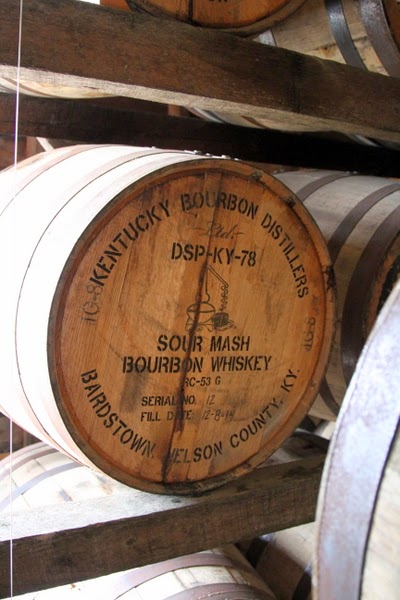
Willett’s rickhouses have barrels with a variety of logos depending on the DBA that the company was using at the time the spirit was casked.  Some barrels are identified as Willett but others were labeled as Kentucky Bourbon Distillers.  Until somewhat recently, spirits marketed by Willett were made by other distilleries.  Now the family owned distillery makes all of their spirits at the Bardstown distillery.
After leaving the rickhouses, we returned to the visitor center for a sampling of Willett’s products.  The first thing we tried was Johnny Drum Bourbon.  This is a great value bourbon selling at retail for less than $15 for a 750 ml bottle.  However, the bourbon is quite good although a little too high in rye for our tastes. It would be an excellent mixer where the rye would come through the tastes of the mixers well.  We also tasted the Noah’s Mill and Rowen’s Creek Bourbons, both of which were very good.  Willett’s signature product, the Willett Pot Still Reserve was excellent in our opinion.  This is a wheated bourbon and lacked the peppery taste of high rye mashbills.  Like other Willett products, the Pot Still Reserve is attractively priced and is a good value.  Willett also makes a few rye whiskeys that are each well reviewed.
The drive to Maker’s Mark Distillery in Loretto, Kentucky was only about a 20 minute drive from Willett.  We took advantage of the drive to eat our sub sandwiches that we purchased that morning.  When we arrived at the distillery we were shocked to learn that the parking lot was filled.  Tour groups of 25-30 people were leaving the visitor center every 15 minutes.  We learned that the wait for a tour was over an hour so we decided to not tour on this trip.  I suppose the recent increase in the popularity of bourbon, the holiday weekend and the beautiful weather all combined for bringing large crowds to the large distillery.
We had toured Marker’s Mark several time in the past so we didn’t feel that we would miss anything by not taking the tour this time.  We enjoy Maker’s Mark since, as a wheated whiskey, it has a sweet flavor with no burn.  Maker’s Mark also mixes as well as it goes as a sipping whiskey.  They also make a double aged product, Maker’s Mark 46 that, after aging several years in a new white oak barrel, is recasked in a French oak barrel where it goes through a second again.  We actually prefer the regular Maker’s Mark but both are quality bourbons.  Emily and I are both registered as Maker’s Mark Ambassadors.  As such, we receive cards, offers and gifts from the distillery several times a year.  In addition, our names have been placed on a barrel of aging Maker’s Mark.  We can monitor our barrel’s aging process with our ambassador log in and will be invited to the distillery to participate in opening our barrel and will be able to purchase bottles for bourbon from our barrel.
Upon leaving Maker’s Mark, we took the short drive to Lebanon, Kentucky.  We drove along a beautiful small stream that flowed down riffles over limestone shelves.  When we arrived at Limestone Branch Distillery, we were met by owner and distiller, Steve Beam. 
Steve comes from a long line of bourbon royalty on both sides of his family.  His mother was a Dant, descended from J. W. Dant who settled in Kentucky’s Cumberland Gap area in the 1830s making whiskey in a log still with a copper pipe.  The Dant Distillery made a number of whiskey brands including J. W. Dant and Yellowstone.  The Dant Distillery even produced and sold whiskey during prohibition for “medicinal purposes” only.  Steve’s bourbon ancestry on his father’s side goes back to Jacob Boehm, great grandfather of Jim Beam.  Jacob started distilling operations in Kentucky in 1795 after immigrating from Germany.  In that time, members of the Beam family have been represented in nearly every Kentucky distillery.
Steve could not have given us a warmer reception.  He greeted us as if we were family and made us feel welcome at Limestone Branch.  Steve took us through his small but efficient operations where he produces excellent moonshine whiskey.  Steve’s basic recipe, T. J. Pottinger Sugar Shine is a 100 proof spirit that is made from 50% corn and 50% sugar to yield a moonshine that is 50% alcohol.  Unlike some distillers, Steve doesn’t cook the corn mash, telling us that the sugar contributes to all of the alcohol production in his moonshine and that the corn only provides flavor and complexity.  He showed us the mash fermenting in the oak barrels in his distillery some of which had a portion of blue corn in the mash to explore other possibilities for the spirits.
Steve showed us his stills including the copper pot still where he makes the basic moonshine recipes that have been passed down for generations of moonshiners in Kentucky and the surrounding states.  He also showed us the still where Tim Smith makes his Climax Moonshine.  Steve has mentored Tim in his conversion from an illegal moonshiner to a legal distiller of corn whiskey.  Tim and Steve were featured in several episodes of the Discovery Channel television show, Moonshiners.  Steve took great pains to help Tim negotiate the complex laws, regulations and procedures surrounding liquor production.  Tim named his moonshine for his home community of Climax, Virginia.
After a demonstration of the stills, Steve showed us how he blends fruits into the moonshine for his strawberry, cherry and blackberry moonshine.  He also ages some of the moonshine in used bourbon barrels to give the moonshine a hint of bourbon flavor and color.  We were anxious to go to the tasting room where Steve treated us to a sample of the T. J. Pottinger Sugar Shine.  Like other moonshine we sampled on the trip, we expected it to be harsh and rough.  My previous experience with drinking moonshine could be likened to swallowing a porcupine.  However, the T. J. Pottinger’s Sugar Shine was easy to drink and had a pleasing corn taste.  The shine tingled the tongue and warmed all the way down.  We liked the apple pie and blackberry flavors but were intrigued with the Moon Pie Moonshines.  We were skeptical of a moonshine flavored like Moon Pie, especially since chocolate, vanilla and banana options were available.  Steve uses natural flavors like cacao and Madagascar Vanilla to give the moonshine a great Moon Pie taste.  We were convinced that Moon Pie Moonshine was a hit.
We went to the gift shop and purchased a bottle of T. J. Pottinger’s Sugar Shine and a Mason jar of Chocolate Moon Pie Moonshine.  Steve signed both of our purchases for us as we chatted.  It was obvious that Steve Beam’s connection to the bourbon industry is not just from his family heritage in Kentucky bourbon.  He obviously has a love of what he does and a desire to produce the highest quality product he can make.  Being a craft distiller, he is very connected to his customer base and knows the importance of putting the hard work into his spirits.  As we were leaving, Steve wished us well and gave us directions to Independent Stave Company nearby.
As we walked from the parking lot of Independent Stave Company, we saw a sign that the factory was closed this afternoon for the Easter weekend.  However, we were still able to take a tour of the plant.  In fact, the tour of the factory was probably better with production stopped since we were better able to see the machinery used to produce the barrels that store bourbon and many other products.  We were prohibited from taking photos or videos in the factory since the company didn’t want overseas manufacturers to obtain information on the mechanisms to produce water tight oak barrels.
Most barrels made by Independent Stave Company are the typical 53 gallon white oak barrels that are used by the bourbon distillers in the area.  ISC barrels from their Lebanon, Kentucky or Lebanon, Missouri factories are used by nearly every US bourbon and whiskey maker.  One notable exception are the Brown-Forman companies (Jack Daniels, Canadian Club, Woodford Reserve) who use barrels from the Brown-Forman cooperage.  Bourbon isn’t the only thing stored in ISC barrels.  Used bourbon barrels often go to Scotland for aging Scotch or to Tennessee for whiskey.  Used bourbon barrels are even used on Avery Island, Louisiana to age Tabasco Sauce.
Independent Stave Company receives white oak logs which are quarter sawn and cut to length for barrel staves.  The rough staves are placed to the radius of the barrel and tapered to the correct profile.  The staves are arranged in temporary hoops by expert coopers who then send the barrels to a steaming area for about 40 minutes to soften the staves in preparation for bending.  After coming out of the steam chamber, powerful hydraulics are used to pull the staves together tightly.  The temporary hoops are replaced by six steel hoops that will hold the staves tightly.  Rivets connect the hoops at the stave where the bung will be located. 
The barrel heads are assembled from white oak planks and held only by the friction of tongue and groove joints.  No glues or adhesives are used in making a barrel.  The heads are cut to the circular shape to fit in the barrel to make a watertight seal.
Once assembled, the barrels are passed through a natural gas flame to char the inside of the barrels.  Each bourbon manufacturer has unique specifications for their barrels but most want a number 3 or number 4 char which are the deepest burn levels available in the barrels.  The barrel heads are charred with a wood fire fueled by scraps of wood from other processes at the factory.
A bung is drilled into the barrels so product can be added then the barrels are pressure tested to assure that there are no leaks and that the casks are watertight.  Since bourbon is taxed when it enters the barrel, distillers want to make certain that the precious spirits do not leak from the barrel.
Perhaps the most impressive thing about the production at Independent Stave Company is the full utilization of everything that enters the factory.  Waste bark from the logs and sawdust from cutting and shaping goes to make hardwood mulch that is sold by the factory.  Scraps of wood fuels the charring of the barrel heads.  Excess wood scrap is given to employees for kindling in their wood stoves at home.  End users of the barrels often return damaging or leaking barrels to ISC for repair.
We had an excellent visit to Independent Stave Company and will plan to come by again when we are in the area to see the plant in operation.
We headed to Danville, Kentucky to tour Wilderness Trace Distillery there.  Danville is another interesting little Kentucky town, in some part because of Centre College.  As a small liberal arts college, Centre College has an excellent academic and service reputation.  The presence of the college in the town gives it a literate and youthful feel.  Like Bardstown, Danville has any small shops and eateries in the historic old buildings for students and the community to enjoy.
We were met at Wilderness Trace Distillery by master distiller, Shane Baker who gave us a tour of the facility.  The parent company is a biotech company that has been a producer of industrial ethanol as well as Neutral Grain Spirits for other distilleries.  In addition, they produce, store and archive yeast strains for many distilleries.  Wilderness Trace has been making their own brands only a short time. 
Shane showed us the fermentation areas and the production stills.  Unlike many distillers who use natural gas flame or steam to power their stills, the stills at Wilderness Trace are powered by hot water.  Shane says that this gives a more controlled heat that produces a more consistent spirit.  Since the company’s roots are in biotechnology, the atmosphere at Wilderness Trace seemed to have a more scientific feel than the production at other craft distilleries.
After touring the facilities, Shane took us to the tasting room where we sampled their Blue Heron Vodka.  They make the vodka from locally grown wheat and distil the spirits to 190 proof before diluting down to 80 proof.  Unlike other rums which are made from fermented cane sugar, Wilderness Trace Harvest Rum is made by fermenting molasses made in Winchester, Kentucky from locally grown sorghum.  Following distillation, the rum is briefly aged in used bourbon barrels for color and flavor.  Wilderness Trace has started making their Settler’s Select Bourbon by the sweet mash process.  Most bourbon is made with the sour mash process in which a small quantity of mash from a nearly mature mash is added to a newly started mash.  This “set back” gives a sour flavor to the mash and creates an environment that is favorable to certain fermenting microbes.  No set back is added to the mash for Settler’s Select Bourbon making the mash less sour and a higher pH that permits different fermentation microbes.
Although it will be some time before Settler’s Select Bourbon will be available, Shane promised to reserve a bottle from one of the first barrels for us.  It will be interesting to compare the sweet mash bourbon to the traditional sour mash bourbons.
We had originally planned to spend Friday night in Danville then to go to Wild Turkey and Four Roses on Saturday.  Since it was only 3 pm, we considered our options.  We kept thinking about how crowded Maker’s Mark was at 11 am and how the pretty the holiday weekend was.  We figured that the two large distilleries we had planned to visit would be very crowded on Saturday.  The decision to come back home on Friday night was an easy one.  We thought we would visit Barrel House Distillery in Lexington then meet up with Emily and Ian for dinner before coming home.
We made the mistake of attempting to come into Lexington on Nicholasville Road.  What a nightmare.  Traffic on Nicholasville Road at rush hour is crazy.  It took us forever to get from Nicholasville to Barrel House Distillery.  We were certain that we would not make it by the 5 pm closing time at the distillery but we eventually pulled into the parking lot at 4:50 pm.
Barrel House Distillery is located just off Old Frankfort Pike near the McConnell Springs Historic Site.  Although the front door was closed, we were beckoned inside by operations manager, Noah Brown.  Noah was manipulating the temperature of the copper pot still as he monitored the alcohol level of the spirits coming out of the condenser.  As he worked the still, he told us about Barrel House’s spirits and plans for the distillery’s future.  As with other startup distillers, unaged spirits are being produced and sold while the aged products are being stored.  
Noah looked like a moonshiner of generations ago as he turned the gas flame up and down under the still and took a tiny sip of the moonshine as the still operated.  Once the still was running to his satisfaction, Noah took us into the visitor center for a sample of their products.  Oak Rum is aged in used bourbon barrels to impart a woody flavor and an amber color to the rum.  The Pure Blue Vodka is a nice sweet clear vodka made from Kentucky corn and water.  Barrel House’s Devil John Moonshine is named for one of the owner’s relatives who was a Civil War veteran and moonshiner.  The bourbon being made by Barrel House is aging and isn’t yet ready to be bottled and sold.
The vodka and rum were very nice and had a pleasant flavor.  Neither of us cared much for the Devil John Moonshine.  It was very reminiscent of moonshine whiskey made in the hills and hollows of Appalachia generations ago.  It was a little rough for our tastes.  Mary purchased a jar of cherries preserved in Devil John Moonshine to put in Emily’s Easter basket.
We got back on New Circle Road after leaving Barrel House and drove to Harrodsburg Road where we went to the Liquor Barn.  We bought a bottle of Buffalo Trace Bourbon Cream for Gran and some Johnny Drum for one of Mary’s work friends.
As we were leaving the parking lot of Liquor Barn, Emily called to tell us that Butt Rubb’In Barbecue was closed.  We really like the brisket there and hope that they are closed for the weekend and that they will be back open again soon.  Since traffic was bad and Emily & Ian were already out, they suggested German food at Marikka’s Restaurant across Southland Drive from Butt Rubb’In.  We started with appetizers of Kartoffelpuffer which are excellent potato pancakes.  Mary and Ian had large servings of goulash.  Emily had Rahmschnitzel which is a breaded veal cutlet covered in a creamy sauce and served with fried potatoes and green beans.  I had Jaegerschnitzel which is a pork cutlet with mushrooms served with red kraut.  Everyone enjoyed the meal.
We enjoyed seeing Ian & Emily for the meal and look forward to them coming home for Easter in a couple of days.  We left Lexington at 7 pm and arrived back at home by 9:30.  We were both tired and turned in to rest.  Today, like the other days of the trip, was beautiful, sunny and warm.  We were very fortunate to have had such great spring weather for our trip.
Although we were unable to visit all of the distilleries on the Kentucky Bourbon Trail and the Craft Spirits Trail, we were able to stop by most of them.  We will plan another trip to the area soon to visit the ones we were unable to visit this week.

View Larger Map